
Friction is often seen as a force that resists motion, something to be minimized in machines or avoided when trying to slide heavy objects. But without friction, everyday life as we know it would be impossible. From walking to driving, writing to gripping tools—friction plays a critical role in enabling these actions. Far from being just an obstacle, friction is a foundational force that makes controlled movement, stability, and interaction possible. Understanding why friction is needed reveals its indispensable value across countless aspects of daily life and engineering.
The Role of Friction in Everyday Motion
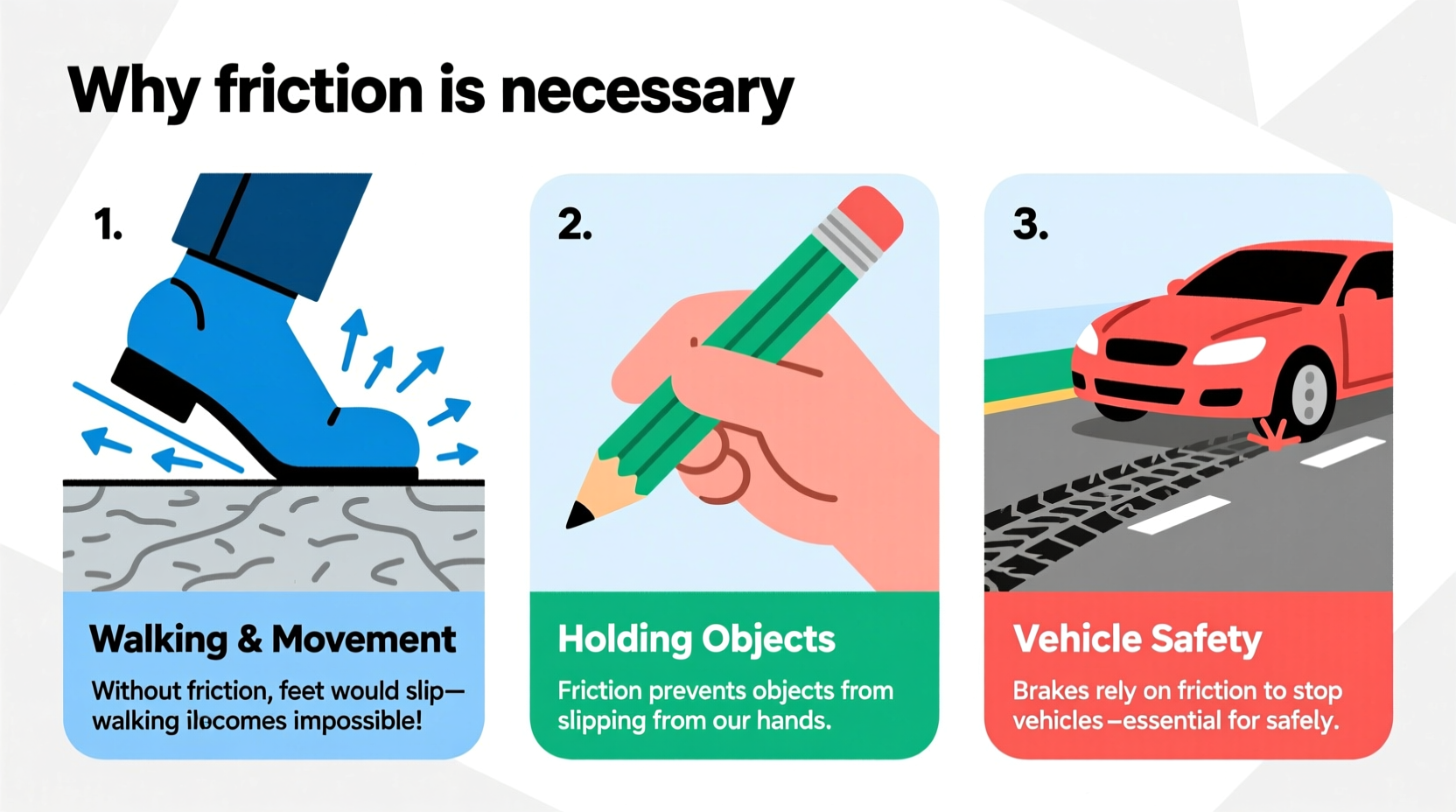
At its core, friction is the resistance that occurs when two surfaces move—or attempt to move—against each other. This force arises due to microscopic irregularities on surfaces that interlock, creating resistance. While excessive friction can cause wear and energy loss, a certain level is essential for control and functionality.
Consider walking: when your foot pushes backward against the ground, friction provides the forward reaction force that propels you. Without sufficient friction—such as on icy or wet surfaces—your foot slips because there's not enough grip to generate forward motion. This demonstrates that friction isn't just a passive byproduct; it's actively involved in generating movement.
Reason 1: Friction Enables Locomotion and Control
One of the most fundamental reasons friction is needed is that it allows for locomotion. Whether it’s human movement, vehicles on roads, or robotic systems navigating terrain, friction between contact surfaces is what makes directional control possible.
In automobiles, tires rely on friction with the road surface to accelerate, turn, and brake. The tread pattern on tires is specifically designed to maximize this friction, especially in wet conditions. Anti-lock braking systems (ABS) are engineered to maintain optimal friction during emergency stops, preventing wheel lockup and skidding.
Similarly, athletes depend on high-friction footwear. A soccer player needs cleats to dig into grass, a basketball player requires rubber-soled shoes for quick cuts on hardwood, and rock climbers use specialized shoes with sticky rubber to grip tiny ledges. In each case, friction translates muscular effort into effective motion.
“Without friction, even the strongest engine or most powerful muscles would result in futile spinning or slipping.” — Dr. Alan Reeves, Mechanical Engineer
Reason 2: Friction Provides Safety and Stability
Safety in both natural and built environments depends heavily on friction. It prevents uncontrolled sliding, falling, and mechanical failure. Imagine stairs without non-slip treads, ladders without rubberized feet, or kitchen floors polished to a mirror-like shine—each scenario increases the risk of accidents due to insufficient friction.
In industrial settings, proper flooring materials are selected based on required friction coefficients. For example, factory walkways often use anti-slip coatings, and handrails are textured to ensure a secure grip. Even simple acts like holding a pen or carrying a glass of water rely on the friction between skin and object to prevent drops.
In construction, friction between structural components can prevent collapse under dynamic loads. Bolted joints, for instance, stay tight because friction between the clamped surfaces resists shear forces. Engineers calculate minimum friction values to ensure connections remain stable over time.
Real-World Example: The Dangers of Low Friction
A mini case study from winter driving illustrates this well. In regions with frequent snowfall, municipalities apply salt or sand to roads. Salt lowers the freezing point of water, melting ice, while sand increases surface roughness and thus friction. A 2022 report from the Minnesota Department of Transportation showed a 37% reduction in traffic accidents after preemptive sanding of bridges—a known blackspot for icing. This practical intervention underscores how intentionally increasing friction saves lives.
Reason 3: Friction Powers Mechanical Systems
Beyond movement and safety, friction is essential in the operation of mechanical devices. Many machines rely on friction to transmit power, regulate speed, or hold parts in place.
Belts and pulleys, commonly used in engines and conveyor systems, function through friction between the belt and the pulley surface. If this friction is too low, the belt slips, reducing efficiency or causing system failure. Similarly, clutches in vehicles use friction plates to engage and disengage the engine from the transmission, allowing smooth gear changes.
Braking systems are perhaps the most critical application of friction in mechanics. When you press the brake pedal, hydraulic pressure forces brake pads against rotating discs. The resulting friction converts kinetic energy into heat, slowing the vehicle. High-performance brakes use materials like ceramic composites to maintain consistent friction under extreme temperatures.
| Mechanical System | Role of Friction | Consequence of Insufficient Friction |
|---|---|---|
| Car Tires | Provides grip for acceleration, steering, braking | Skidding, loss of control |
| Walking Shoes | Prevents slipping on floors and slopes | Falls, injuries |
| Brake Pads | Slows down moving parts via resistance | Increased stopping distance, failure |
| Belt-Driven Motors | Transfers rotational power | Slippage, reduced output |
Common Misconceptions About Friction
Many people assume friction is always undesirable—an energy-wasting force that should be eliminated. While it's true that excess friction causes inefficiency and heat buildup (requiring lubrication in engines), eliminating it entirely would be catastrophic.
Another misconception is that smoother surfaces always perform better. In reality, overly smooth surfaces often reduce friction to unsafe levels. For example, polished marble floors may look elegant but pose a slipping hazard when wet. The key is balance: optimizing friction for the specific task, not minimizing it universally.
Actionable Checklist: Managing Friction Effectively
- ✅ Assess surfaces for adequate grip, especially in high-traffic or wet areas
- ✅ Use appropriate footwear or tire treads for the environment (e.g., winter tires in snow)
- ✅ Maintain mechanical systems by checking belts, brakes, and lubrication levels regularly
- ✅ Apply anti-slip treatments where needed (stairs, ramps, bathtubs)
- ✅ Avoid over-polishing floors or using inappropriate cleaning agents that reduce surface friction
FAQ: Common Questions About Friction
Can friction exist without motion?
Yes. Static friction acts between stationary surfaces and must be overcome to initiate motion. For example, a heavy box on the floor doesn’t move until the pushing force exceeds static friction.
Is friction a fundamental force?
No. Friction is not one of the four fundamental forces (gravity, electromagnetism, strong, weak). Instead, it emerges from electromagnetic interactions between surface atoms at the microscopic level.
Why do some materials have higher friction than others?
Surface texture, material composition, and presence of contaminants (like oil or water) affect friction. Rubber on concrete has high friction due to deformation and adhesion, while ice on metal has very low friction due to a lubricating water layer.
Conclusion: Embracing Friction as a Vital Force
Friction is far more than a physical inconvenience—it is a silent enabler of modern life. From the first step you take in the morning to the precision braking of a high-speed train, friction ensures control, safety, and functionality. Recognizing its importance allows us to design safer environments, build more reliable machines, and make smarter choices in daily activities.
Instead of viewing friction solely as a force to reduce, consider how to manage it wisely—enhancing it where needed and minimizing it where it hinders performance. By understanding and respecting this essential interaction, we gain greater mastery over our physical world.




 浙公网安备
33010002000092号
浙公网安备
33010002000092号 浙B2-20120091-4
Comments
No comments yet. Why don't you start the discussion?