
Gold has held a unique place in human civilization for thousands of years. From ancient empires minting their first coins to modern central banks stockpiling bullion, gold’s value remains remarkably resilient. Unlike most commodities, its price doesn’t just fluctuate with supply and demand—it carries deep cultural, economic, and psychological weight. But what exactly makes gold so expensive? The answer lies in a combination of natural scarcity, historical trust, industrial utility, and its role as a financial safe haven.
The Scarcity Factor: Why Gold Can’t Be Mass-Produced
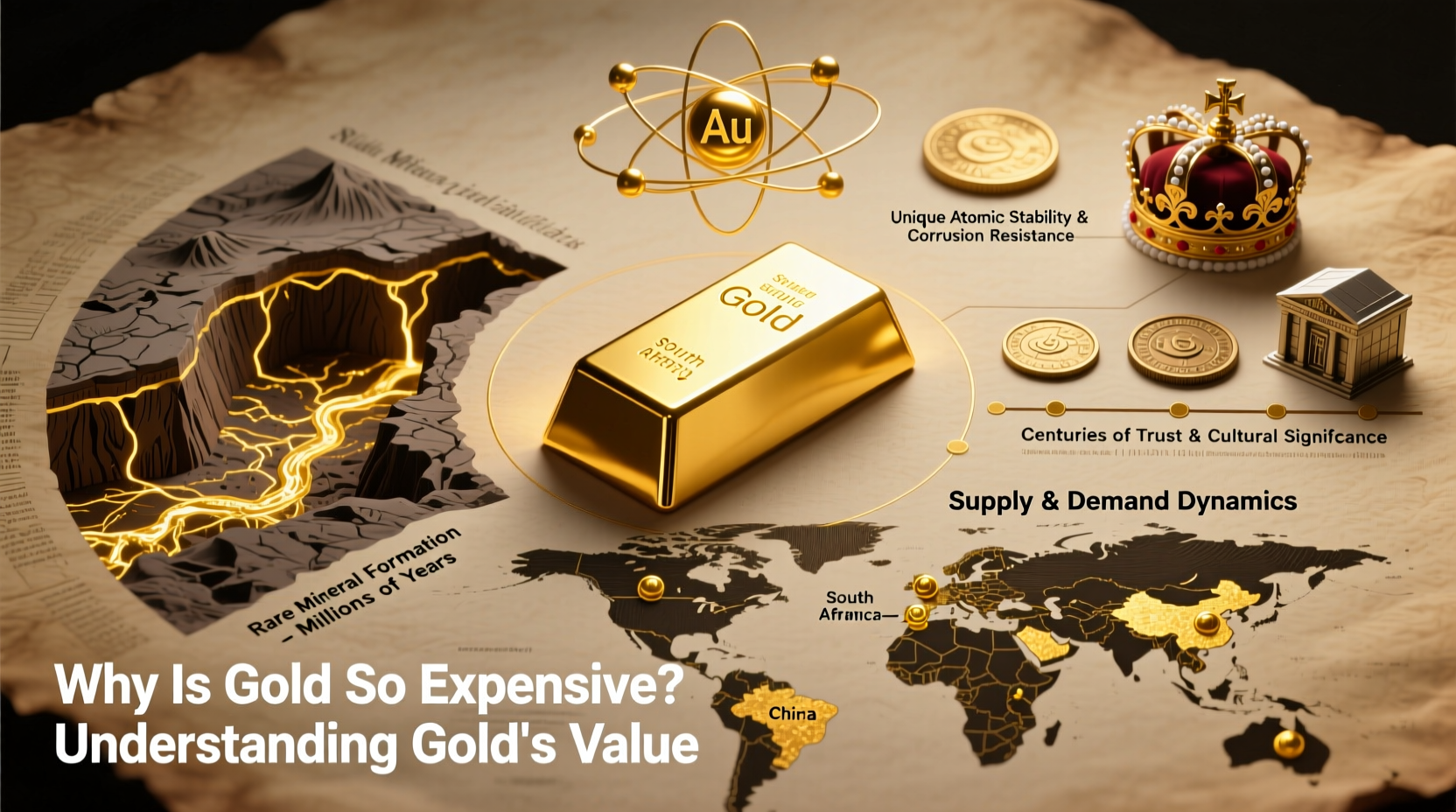
One of the most fundamental reasons gold commands such a high price is its inherent scarcity. While not the rarest metal on Earth, gold is difficult and costly to extract. All the gold ever mined would fit into a cube roughly 22 meters per side—smaller than a typical city block. This limited supply ensures that even with advanced mining technology, new gold enters the market slowly.
Gold is formed in supernova explosions and neutron star collisions, making it extraterrestrial in origin. It arrived on Earth through asteroid impacts billions of years ago. Today, miners must process tons of ore to extract just a few grams of gold. For example, an average open-pit mine processes about 30 tons of rock to produce one ounce (31.1 grams) of gold. This labor-intensive process significantly increases production costs, which are reflected in the final market price.
Historical Trust: A Currency That Never Fails
Unlike fiat currencies, which rely on government backing and public confidence, gold has maintained intrinsic value across civilizations. Ancient Egyptians used gold in burial rituals, the Roman Empire minted gold aureus coins, and during the Gold Standard era (1870s–1930s), paper money was directly convertible into gold.
This historical continuity gives gold unmatched credibility. Even after the collapse of the Bretton Woods system in 1971—when the U.S. dollar was decoupled from gold—central banks continued holding large reserves. As of 2023, the U.S. holds over 8,100 metric tons of gold, second only to Germany.
“Gold is the only asset that isn’t someone else’s liability.” — Ray Dalio, Founder of Bridgewater Associates
This quote captures gold’s essence: it doesn’t depend on interest payments, corporate earnings, or government promises. Its worth is self-evident across cultures and time periods.
Safe-Haven Demand During Economic Uncertainty
When stock markets crash, inflation spikes, or geopolitical tensions rise, investors flock to gold. It acts as a hedge against systemic risks because it tends to retain—or even increase—its purchasing power when other assets falter.
For example, during the 2008 financial crisis, gold prices rose by over 25% in a single year. Similarly, amid the pandemic-driven uncertainty of 2020, gold hit an all-time high above $2,000 per ounce. These patterns repeat because gold lacks counterparty risk; no institution needs to honor a promise for it to hold value.
Central banks also contribute to this dynamic. Countries like China, Russia, and India have been steadily increasing their gold reserves in recent years, reducing reliance on the U.S. dollar and diversifying national wealth.
Industrial and Technological Uses Beyond Jewelry
While jewelry accounts for about 50% of annual gold demand, the rest is split between investment (coins, bars, ETFs), central banks, and industrial applications. What many overlook is gold’s critical role in modern technology.
Gold is highly conductive, resistant to corrosion, and malleable enough to be drawn into wires thinner than a human hair. These properties make it indispensable in electronics, aerospace, and medical devices. It’s found in smartphones, satellites, pacemakers, and even NASA spacecraft.
| Industry | Use of Gold | Why Gold Is Preferred |
|---|---|---|
| Electronics | Contact points in circuits | Corrosion resistance ensures reliability |
| Aerospace | Thermal shielding coatings | Reflects infrared radiation efficiently |
| Medicine | Diagnostic tools and implants | Biocompatible and non-reactive |
Though industrial use accounts for only about 7–10% of total demand, it reinforces gold’s value proposition beyond mere ornamentation or speculation.
Supply Constraints and Environmental Costs
Mining new gold is becoming increasingly difficult. High-grade deposits are dwindling, forcing companies to dig deeper and operate in remote or ecologically sensitive areas. The environmental impact—including deforestation, mercury pollution, and water contamination—has led to stricter regulations, further raising operational costs.
In addition, artisanal and small-scale mining, which produces nearly 20% of global gold, often operates informally and faces challenges in sustainability and labor practices. Ethical sourcing initiatives like the Responsible Gold Mining Principles aim to address these issues, but compliance adds another layer of expense.
All these factors limit the rate at which new gold can enter the market, creating a structural imbalance where demand consistently outpaces sustainable supply growth.
Mini Case Study: The Rise of Digital Gold in India
In India, where gold is deeply embedded in culture and weddings, traditional ownership meant buying physical jewelry. However, premiums, making, and storage risks deterred younger investors. In response, platforms like MMTC-PAMP and digital gold apps emerged, allowing users to buy 24-karat gold in fractions via mobile wallets.
This shift reduced transaction friction and expanded access. Between 2020 and 2023, digital gold sales in India grew by over 300%. Investors could now treat gold as both a cultural asset and a liquid financial instrument. The premium over spot price dropped from 10–15% for jewelry to under 3% for digital purchases.
This case illustrates how innovation can enhance gold’s accessibility while preserving its value—proving that even an ancient asset can adapt to modern economies.
Expert Insight: Gold in a Diversified Portfolio
“A balanced portfolio should include 5–10% allocation to gold, especially during times of currency devaluation or rising inflation.” — Meir Statman, Behavioral Finance Professor, Santa Clara University
This recommendation reflects decades of research showing that gold reduces overall portfolio volatility. Because it often moves inversely to stocks and bonds, it provides balance during turbulent markets.
Checklist: How to Evaluate Gold as an Investment
- Assess your risk tolerance and investment horizon
- Determine whether you want physical gold or paper exposure (ETFs, futures)
- Research premiums, storage costs, and liquidity options
- Monitor macroeconomic indicators: inflation, interest rates, USD strength
- Consider tax implications based on your country’s regulations
- Diversify within gold holdings (e.g., mix of coins, bars, and ETFs)
Frequently Asked Questions
Why doesn't gold decay or lose value over time?
Gold is chemically inert and does not react easily with oxygen or moisture, meaning it doesn’t rust, tarnish, or corrode. This durability allows it to be stored indefinitely without degradation—unlike paper money or perishable goods.
Can governments ban gold ownership?
They have in the past. In 1933, President Franklin D. Roosevelt issued Executive Order 6102, requiring Americans to surrender gold coins and bullion. However, such measures are rare today. Most developed nations allow private ownership, though reporting requirements may apply for large transactions.
Is gold a good hedge against inflation?
Historically, yes. Over long periods, gold has preserved purchasing power when fiat currencies erode due to inflation. For example, from 1970 to 1980, U.S. inflation averaged 7.8% annually, while gold rose from $35 to $850 per ounce—a return that far outpaced consumer price increases.
Conclusion: Embracing Gold’s Timeless Value
Gold’s high price isn’t arbitrary—it’s the result of centuries of trust, physical scarcity, functional utility, and strategic demand. Whether worn as a ring, stored in a vault, or embedded in a smartphone, gold serves multiple roles simultaneously. It transcends fashion, geography, and political systems.
Understanding why gold is so expensive isn’t just about economics; it’s about recognizing a rare convergence of nature, history, and human behavior. As long as uncertainty exists in global markets and societies seek stable stores of value, gold will remain not just expensive—but essential.




 浙公网安备
33010002000092号
浙公网安备
33010002000092号 浙B2-20120091-4
Comments
No comments yet. Why don't you start the discussion?