
The human body is full of terms so familiar that their origins are rarely questioned. One such word is \"forehead\"—a feature central to facial expression, identity, and even health. But why do we call it a forehead? The answer lies in centuries of linguistic evolution, cultural shifts, and anatomical observation. This term, now taken for granted in modern English, carries within it layers of history stretching back to Old English and beyond.
Understanding the origin of \"forehead\" reveals more than just dictionary definitions—it uncovers how ancient speakers perceived the human form, how language adapts over time, and how seemingly simple words can reflect complex cognitive processes. By tracing its journey from early Germanic roots to contemporary usage, we gain insight into both language and human self-awareness.
Etymological Breakdown: Fore + Head
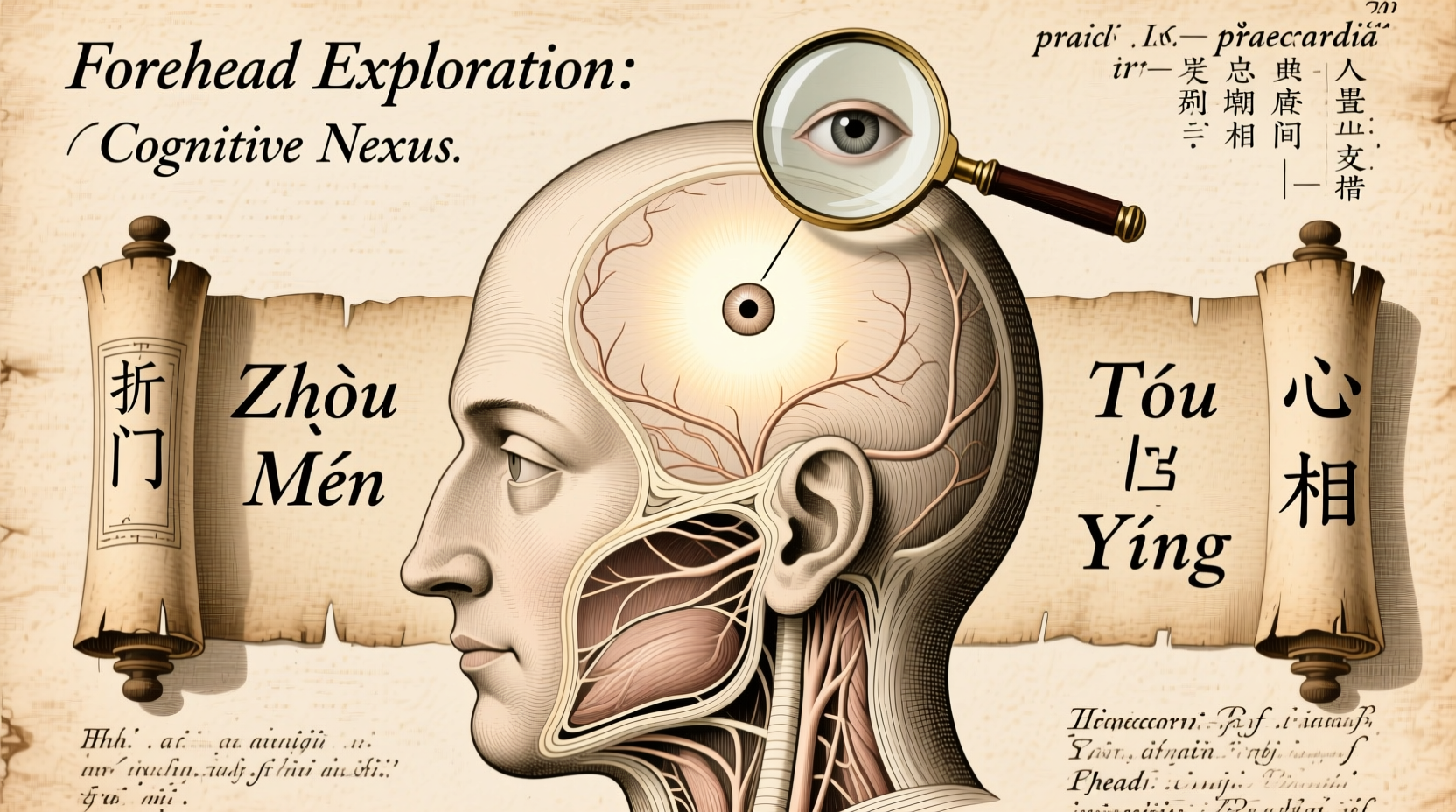
The word \"forehead\" is a compound noun formed from two elements: “fore” and “head.” At first glance, this seems straightforward—the forehead is literally the front part of the head. However, the development of this term was neither immediate nor uniform across languages.
In Old English, the word appeared as foranheáfod, which combines foran (meaning “before” or “in front”) and heáfod (meaning “head”). Over time, pronunciation and spelling shifted due to phonetic simplification and dialectal variation. By Middle English, forms like *forehedde* and *forhed* emerged, eventually settling into the standardized \"forehead\" by the 16th century.
Interestingly, earlier versions sometimes included an intrusive \"d\" sound between syllables—a phenomenon known as epenthesis—which helped ease articulation. This explains why the modern pronunciation includes a silent \"d\" at the end: not because it’s pronounced, but because it once played a role in spoken flow.
“Language doesn’t just describe reality—it shapes how we perceive anatomy through naming conventions.” — Dr. Lydia Chen, Historical Linguist, University of Edinburgh
Historical Evolution Across Germanic Languages
The concept of the forehead exists universally, but different cultures have named it in distinct ways. Comparing related Germanic languages highlights shared ancestry and subtle divergences:
| Language | Word for Forehead | Literal Meaning |
|---|---|---|
| Old English | foranheáfod | front-head |
| Old High German | virihuobit | before-head |
| Gothic | fairagibais | fore-part (of the head) |
| Dutch | voorhoofd | fore-head |
| German | Stirn | No direct compound; derived from Proto-Germanic *sturnaz |
While English and Dutch retained the compound structure, German took a different path with *Stirn*, likely rooted in a Proto-Indo-European base associated with rigidity or prominence—perhaps referencing the bony structure of the brow ridge. This contrast shows how even closely related languages evolve independently when describing the same physical feature.
Anatomical Naming Conventions in Pre-Modern Medicine
Before standardized anatomical terminology, body parts were often described functionally or metaphorically. In medieval medical texts, the forehead was sometimes referred to as the \"seat of thought\" or linked to humoral theory—the idea that bodily fluids governed temperament.
The forehead's association with intellect and emotion made it significant in physiognomy, the pseudoscientific practice of judging character based on facial features. A broad forehead was considered a sign of intelligence during the Renaissance, influencing portraiture and social perception. This cultural weight may have reinforced the need for a precise term like \"forehead,\" distinguishing it from other parts of the face or skull.
By the 17th century, anatomists began adopting Latin-based nomenclature. The forehead became known as *frons*—the root of modern terms like \"frontal bone\" and \"frontalis muscle.\" Though \"forehead\" remained in common speech, scientific discourse favored Latin precision, illustrating a split between vernacular and technical language.
Timeline of Key Developments in the Term’s Use
- c. 800–1100 AD: Old English foranheáfod used in manuscripts and religious texts.
- 1200–1500: Middle English variants (*forehed*, *forhed*) appear in medical and literary works.
- 1550s: Standardized spelling \"forehead\" emerges in printed English texts.
- 1680s: Anatomical Latin term *frons* becomes standard in European medical education.
- 1800s–Present: \"Forehead\" remains dominant in everyday language despite scientific preference for Latin derivatives.
Cultural and Symbolic Significance of the Forehead
Beyond linguistics, the forehead holds symbolic importance across civilizations. In Hindu tradition, married women apply a bindi or sindoor on the forehead, marking spiritual and marital status. In Islamic culture, prostration during prayer involves touching the forehead to the ground, symbolizing humility before God. Ancient Egyptians painted deities with serpentine markings on their foreheads—representing divine authority.
These practices underscore the forehead’s role not just as a physical feature, but as a site of identity, ritual, and meaning. Such cultural emphasis likely contributed to the durability and specificity of the term in language. Unlike less symbolically loaded body parts, the forehead warranted a dedicated, unambiguous name—one that could carry both literal and figurative weight.
Mini Case Study: Shakespeare’s Use of “Forehead”
In William Shakespeare’s plays, the forehead appears frequently—not merely as anatomy, but as a canvas for emotion and fate. In *Macbeth*, Lady Macbeth cries, “Out, damned spot! Out, I say!” while imagining blood on her hand, yet earlier she invokes spirits to “stop up th’ access and passage to remorse, / That no compunctious visitings of nature / Shake my fell purpose, nor keep peace between / The effect and it!” She then asks them to “make thick my blood, / Stop up the access here”—tapping her chest and possibly her forehead.
Shakespeare also uses metaphors like “wrinkled front” (referring to a furrowed forehead) to convey inner turmoil. His consistent use of \"forehead\" and its poetic equivalents demonstrates that by the late 16th century, the word was well-established, richly connotative, and deeply embedded in expressive language.
Common Misconceptions and Linguistic Myths
One widespread myth is that \"forehead\" originally meant “hairline” or “brow.” While related, these are distinct features. The confusion arises because older illustrations and textual descriptions sometimes conflated the upper face. Another misconception is that the silent \"d\" in \"forehead\" is a recent addition. In fact, it reflects historical pronunciation patterns where consonant clusters were eased through inserted sounds.
- The forehead does not include the eyebrows—they sit below the frontal bone.
- It is not synonymous with the temple or hairline, though adjacent.
- The term has never carried sexual or taboo connotations in English, unlike some body part names.
Checklist: Understanding the Word “Forehead” in Context
To fully grasp the term’s significance, consider the following:
- Trace its components: “fore” + “head” = front of the head.
- Recognize its Old English roots: foranheáfod.
- Understand the silent \"d\" as a remnant of phonetic evolution.
- Compare it with cognates in Dutch and German.
- Appreciate its symbolic roles in religion and art.
- Use it accurately in anatomical or descriptive writing.
Frequently Asked Questions
Why is the “d” in “forehead” silent?
The silent \"d\" results from historical sound changes. Originally, speakers inserted a \"d\" to separate the vowel sounds in \"fore-heafod,\" making it easier to pronounce. Over time, the final syllable weakened, leaving the \"d\" present in spelling but not in speech.
Is “forehead” used in scientific anatomy?
Rarely. Medical professionals typically use the Latin-derived term *frons* or refer to specific structures like the frontal bone or glabellar region. However, \"forehead\" remains acceptable in general clinical descriptions.
Do all languages have a single word for forehead?
Most do, but some Indigenous and non-Indo-European languages describe it periphrastically—using phrases like “top-front of head.” This suggests that while the concept is universal, lexicalization varies by linguistic complexity and cultural focus.
Conclusion: The Power of a Name
The word \"forehead\" may seem mundane, but its history is anything but. From its compound origins in Old English to its enduring presence in literature and ritual, this term encapsulates how language evolves alongside human understanding. It reflects our ancestors’ observational skills, their desire to categorize the body, and their ability to imbue physical features with deeper meaning.
Every time we speak of the forehead, we echo centuries of linguistic refinement and cultural resonance. Recognizing this depth enriches not only vocabulary but also appreciation for the invisible threads connecting us to past generations.




 浙公网安备
33010002000092号
浙公网安备
33010002000092号 浙B2-20120091-4
Comments
No comments yet. Why don't you start the discussion?