
The term “oblique kick” appears frequently in martial arts, dance, and even fitness circles—but what does it actually mean, and why is it called that? Unlike more straightforward techniques such as front kicks or roundhouse kicks, the oblique kick occupies a nuanced space in movement vocabulary. Its name hints at geometry, angle, and intention. To fully understand the oblique kick, we must explore its linguistic roots, historical usage, biomechanics, and practical applications across different disciplines.
The Meaning of \"Oblique\" in Movement
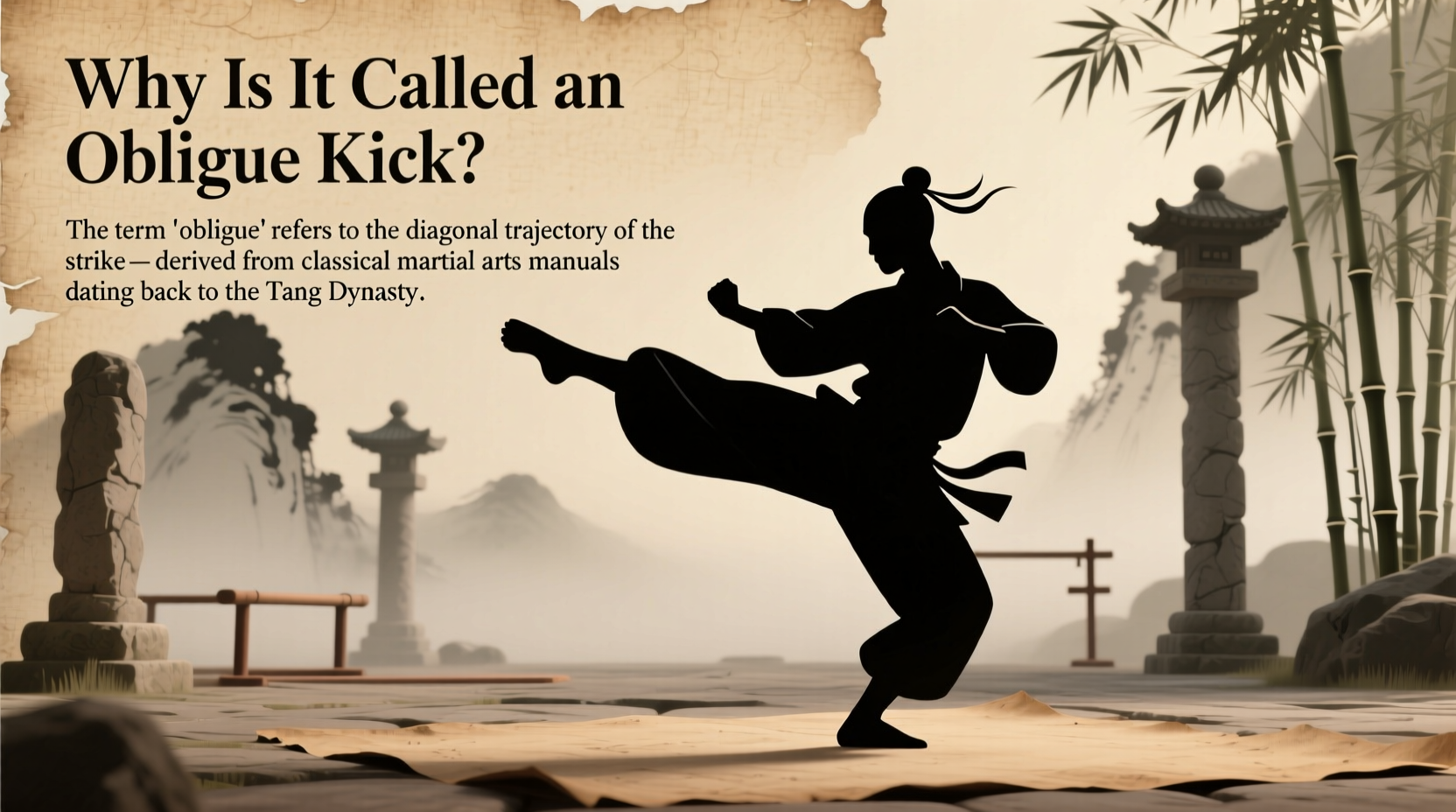
The word “oblique” originates from the Latin obliquus, meaning slanting, sidelong, or indirect. In geometry, an oblique angle is neither right nor straight—it cuts diagonally across a plane. When applied to physical movement, particularly kicking techniques, “oblique” describes a strike that travels along a diagonal trajectory rather than moving directly forward, backward, or laterally.
In combat sports and martial arts, this distinction is critical. An oblique kick isn’t merely a variation of a side kick or a hook kick; it represents a specific path of motion designed to exploit angles, evade defenses, and target vulnerable zones like the ribs, hips, or inner thighs. The name reflects precision—not just in execution, but in intent.
“Naming a technique ‘oblique’ tells you not only how it moves, but also how to think about it strategically.” — Master Renzo Vieira, Brazilian Jiu-Jitsu & Muay Thai Instructor
Historical Roots: From Fencing to Martial Arts
The concept of oblique movement predates modern martial arts by centuries. In Renaissance-era European fencing, fencers used oblique steps and thrusts to create advantageous angles while minimizing exposure. These principles influenced early 20th-century hybrid martial systems, where practitioners began applying geometric terminology to striking methods.
By the mid-1900s, as Eastern martial arts gained global popularity, instructors translating Japanese, Chinese, and Thai terms into English often borrowed Western academic language for clarity. Terms like “front,” “side,” and “roundhouse” were intuitive, but more complex motions required descriptive precision. Thus, “oblique kick” emerged as a way to label diagonal leg attacks that didn’t fit neatly into existing categories.
In disciplines like Savate (French kickboxing), the coup de pied de côté oblique—literally “diagonal side kick”—was formally codified in training manuals during the 1800s. This technique involved lifting the knee across the body before extending the foot in a sharp diagonal line toward the opponent’s flank. Its naming reflected both direction and tactical purpose.
Evolution Across Combat Systems
While the term may sound technical, the oblique kick exists in many forms worldwide:
- Savate: Uses precise, shoe-clad oblique kicks aimed at midsection targets.
- Krav Maga: Employs low, aggressive oblique strikes to the knees or groin under stress conditions.
- Muay Thai: Incorporates short, angled teeps (push kicks) that function similarly to oblique motions when targeting the hip or thigh.
- Capoeira: Features sweeping, deceptive kicks with curved trajectories that align with oblique mechanics.
Anatomy of the Oblique Kick: How It Works
Mechanically, the oblique kick distinguishes itself through three key elements:
- Chambered Entry: The knee lifts and crosses slightly over the midline of the body, creating torque.
- Diagonal Extension: The leg extends outward at a 30–60 degree angle relative to the torso, depending on range and target.
- Hip Engagement: Unlike linear kicks, the oblique relies heavily on rotational force generated from the hips and core.
This combination allows the kicker to maintain balance while generating power from an unexpected angle. Because the motion starts internally (knee crossing) and finishes externally (foot striking), it can bypass guards that are prepared for frontal assaults.
Common Targets and Tactical Advantages
The oblique kick excels in close-to-mid range engagements. Common applications include:
| Target Zone | Purpose | Best Used When... |
|---|---|---|
| Ribs (side) | Disrupt breathing, stagger opponent | Opponent leans forward or drops hands |
| Inner thigh | Weaken stance, impair mobility | Defender squares up predictably |
| Hip joint | Off-balance or set up takedowns | Closing distance for clinch entries |
| Groin (low oblique) | Stop advancing attacker | Under self-defense pressure |
Step-by-Step Guide: Executing a Basic Oblique Kick
Whether you’re training for sport or self-defense, mastering the oblique kick requires deliberate practice. Follow these steps to build correct muscle memory:
- Stance: Begin in a balanced fighting stance—feet shoulder-width apart, lead foot slightly forward, hands up.
- Chamber: Lift your rear knee, bringing it across your body toward the opposite shoulder. Keep the heel close to the buttock.
- Rotate Hips: Pivot on the ball of your supporting foot, turning your hips open to generate momentum.
- Extend: Snap the lower leg outward along a diagonal path, aiming just below the ribcage or at the inner thigh.
- Retract: Pull the leg back quickly along the same line, returning to stance with control.
- Breathe: Exhale sharply upon impact to maximize power and stability.
Practice slowly at first, using a mirror or coach feedback to ensure alignment. Speed and force should come only after form is consistent.
Real-World Application: A Case Study in Self-Defense
Consider a scenario where Alex, a 32-year-old office worker taking weekly Krav Maga classes, finds themselves cornered in a parking garage by an aggressive individual stepping forward rapidly. With limited space to flee, Alex uses a low oblique kick to the attacker’s lead inner thigh—disrupting their gait and creating just enough time to escape.
Later, Alex’s instructor emphasizes that the success wasn’t due to strength, but to angle and surprise. “You didn’t meet force head-on,” he explains. “You used an oblique motion to strike where they weren’t protecting. That’s smart defense.”
This illustrates the core value of the oblique kick: efficiency through geometry. It doesn’t require knockout power—just timing, accuracy, and understanding of human movement patterns.
Checklist: Mastering the Oblique Kick
- ✅ Practice hip rotation daily—even without kicking
- ✅ Use shadow drills to refine chamber and extension path
- ✅ Record yourself to check if the kick travels diagonally, not laterally
- ✅ Condition shins and feet gradually if making contact
- ✅ Pair with feints to increase effectiveness in sparring
- ✅ Train both sides equally to avoid imbalance
Frequently Asked Questions
Is an oblique kick the same as a side kick?
No. A traditional side kick travels perpendicular to the body, moving straight out from the hip. An oblique kick follows a diagonal line, combining elements of forward and lateral motion. It typically starts with a crossed knee chamber, which a standard side kick does not.
Can beginners learn the oblique kick safely?
Yes, provided they start with slow repetitions focusing on form. Due to its rotational nature, improper execution can strain the knee or lower back. Beginners should work under supervision and avoid full-power attempts until coordination improves.
Where did the term originate in martial arts?
The term likely entered martial arts lexicon through French and English technical manuals in the 19th and early 20th centuries. Savate was among the first systems to formalize it, though similar movements existed in Asian styles long before being labeled “oblique.”
Conclusion: More Than Just a Name
The oblique kick is more than a fancy term for a diagonal leg motion—it embodies a philosophy of intelligent aggression. By choosing angles over brute force, precision over panic, practitioners tap into centuries of combative wisdom. Understanding why it’s called an oblique kick deepens appreciation for the science behind martial movement. It reminds us that every technique carries history, logic, and purpose.




 浙公网安备
33010002000092号
浙公网安备
33010002000092号 浙B2-20120091-4
Comments
No comments yet. Why don't you start the discussion?