
The name “elephant toothpaste” evokes curiosity—images of towering puffs of foam and oversized animals brushing their teeth come to mind. But behind the whimsical name lies a fascinating chemical reaction that has captivated students, educators, and science enthusiasts for decades. This experiment, known for its dramatic foaming eruption, is more than just a visual spectacle. It’s a hands-on demonstration of catalysis, decomposition, and exothermic reactions. Understanding why it’s called elephant toothpaste—and how it originated—reveals both the playful side of science communication and the serious chemistry principles at work.
The Origin of the Name: Why \"Elephant Toothpaste\"?
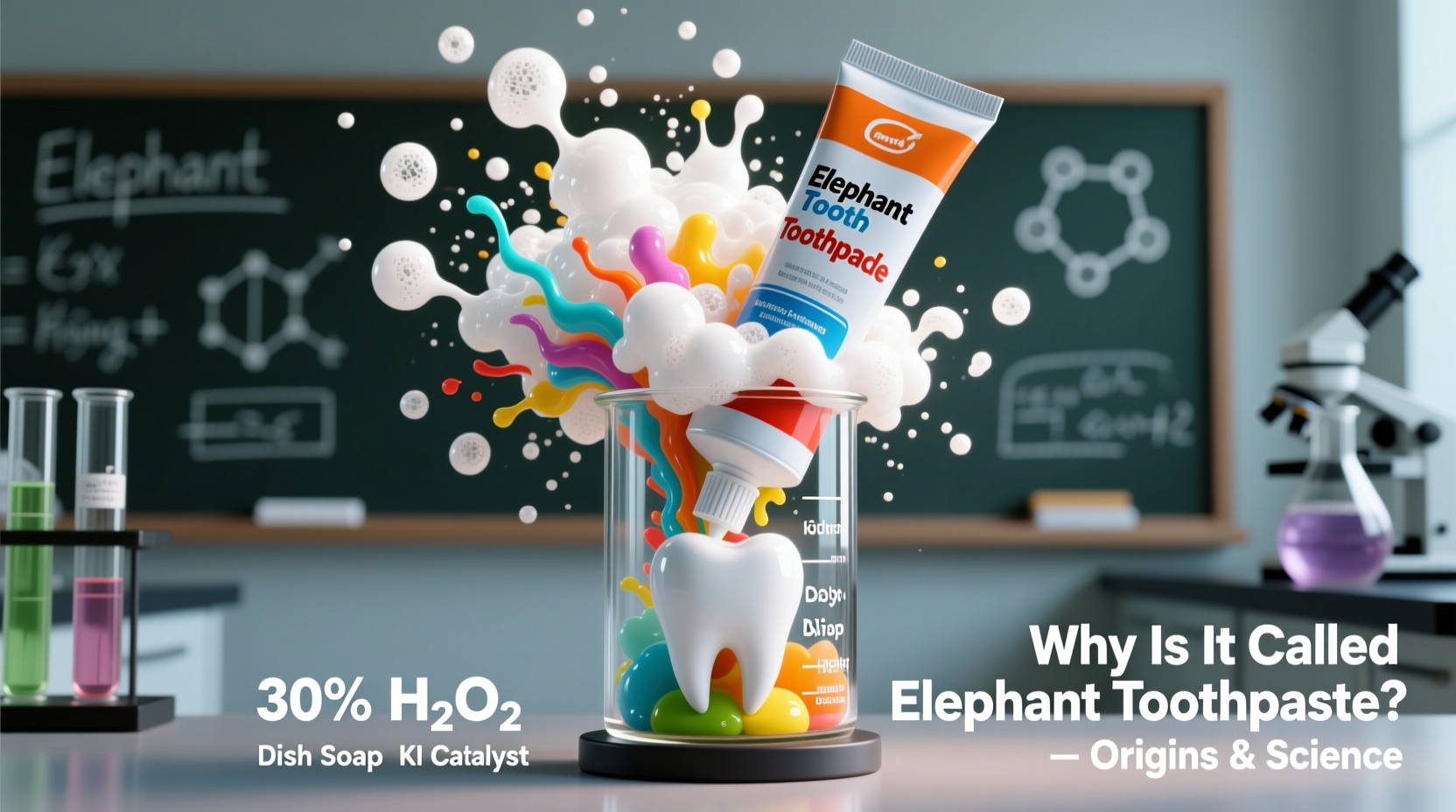
The term “elephant toothpaste” was coined not in a laboratory journal but in educational settings where teachers sought memorable names for engaging experiments. The name emerged from the visual resemblance of the rapid foam expansion to toothpaste being squeezed from a tube—except on an enormous scale, as if meant for an elephant. No actual elephants are involved, nor is any dental hygiene taking place. Instead, the name sticks because it’s imaginative, humorous, and instantly captures attention.
This naming strategy reflects a broader trend in science education: using relatable or absurd imagery to make complex concepts accessible. Just as “dihydrogen monoxide” sounds dangerous but is simply water, “elephant toothpaste” disguises a serious chemical process under a layer of fun. The name lowers intimidation barriers, encouraging students to ask questions and explore further.
The Science Behind the Foam
At its core, elephant toothpaste is a rapid decomposition of hydrogen peroxide (H₂O₂) into water (H₂O) and oxygen gas (O₂), accelerated by a catalyst. The basic reaction is:
2 H₂O₂ → 2 H₂O + O₂
In its pure form, hydrogen peroxide breaks down slowly. But when a catalyst like potassium iodide (KI) or yeast is introduced, the reaction speeds up dramatically. The released oxygen gas gets trapped in soap molecules added to the mixture, creating a dense foam that expands quickly out of its container.
The reaction is exothermic, meaning it releases heat. In high-concentration versions (using 30% hydrogen peroxide), the foam can feel warm to the touch, adding another sensory dimension to the demonstration. Food coloring is often added for visual effect, turning the foam into vibrant columns that enhance the theatrical impact.
Key Components and Their Roles
| Component | Role in Reaction | Common Form Used |
|---|---|---|
| Hydrogen Peroxide | Reactant that decomposes into water and oxygen | 6%–30% solution (household to lab-grade) |
| Potassium Iodide or Yeast | Catalyst that speeds up decomposition | Solid KI or hydrated active yeast |
| Liquid Dish Soap | Traps oxygen gas to form foam | Dawn, Joy, or similar detergents |
| Food Coloring | Visual enhancement | Water-soluble dyes |
| Warm Water | Activates yeast (if used) | ~40°C / 105°F |
Historical Development and Educational Use
While the exact origin of the first demonstration is unclear, the elephant toothpaste experiment gained popularity in the late 20th century as part of inquiry-based science curricula. It aligns with key learning objectives in middle and high school chemistry, including reaction rates, catalysts, and gas laws. Its low cost and high visual payoff made it a staple in classrooms and science fairs.
The modern version widely seen online—with towering foam plumes—was popularized by educators and science communicators such as Steve Spangler, who demonstrated a large-scale version on television in the early 2000s. His energetic presentation and emphasis on safe yet dramatic experiments helped cement the name and method in public consciousness.
“Engagement starts with wonder. Elephant toothpaste doesn’t just teach chemistry—it makes students believe in it.” — Dr. Rebecca Lang, Science Education Researcher, University of Colorado Boulder
Step-by-Step Guide to a Safe Demonstration
Performing the elephant toothpaste experiment safely requires attention to concentration levels and protective measures. Here’s a recommended procedure suitable for classroom or home use with adult supervision:
- Gather materials: 6% hydrogen peroxide, dry active yeast, warm water, dish soap, food coloring, plastic bottle, tray (to contain overflow), safety goggles, gloves.
- Set up containment: Place the bottle on a large tray or in a sink to catch foam.
- Mix activator: In a small cup, combine one tablespoon of warm water with one teaspoon of yeast. Stir gently and let sit for 1 minute.
- Prepare reactants: Pour 1/2 cup of 6% hydrogen peroxide into the bottle. Add 1–2 squirts of dish soap and 5–10 drops of food coloring. Swirl gently to mix.
- Initiate reaction: Quickly pour the yeast mixture into the bottle and step back.
- Observe: Watch as foam rapidly rises and exits the bottle due to oxygen production.
- Clean up: Dispose of foam in trash; rinse bottle and tray with water.
Safety Considerations and Common Misconceptions
A major misconception is that elephant toothpaste is harmless because it uses household ingredients. While the low-concentration version (3–6%) is relatively safe, higher concentrations (above 10%) can cause burns and require professional handling. Hydrogen peroxide at 30% is corrosive and must be diluted carefully with proper PPE.
- Always wear safety goggles and gloves.
- Use only food-grade yeast and standard dish soap.
- Never seal the bottle—pressure buildup can cause explosions.
- Keep away from eyes, skin, and ingestion.
- Do not attempt with children under 12 without direct adult supervision.
Do’s and Don’ts of Elephant Toothpaste
| Do | Don't |
|---|---|
| Use 3–6% hydrogen peroxide for beginners | Use >10% H₂O₂ without training |
| Perform on a contained surface | Conduct near open flames (oxygen supports combustion) |
| Explain the science afterward | Treat it as just a 'trick' |
| Involve students in setup (with guidance) | Leave chemicals unattended |
Real-World Application: A Classroom Case Study
In a seventh-grade science class in Portland, Oregon, teacher Maria Tran used the elephant toothpaste experiment to introduce her unit on chemical reactions. She began by showing a video of a massive foam explosion, then asked students to hypothesize what caused it. After discussing possible explanations, the class designed their own small-scale tests, varying soap amounts and catalyst types.
One group discovered that doubling the yeast increased foam volume by 30%, while another found that red food coloring produced denser foam than blue—likely due to differing dye viscosity. Though anecdotal, these observations led to deeper discussions about variables and experimental design. By the end of the week, test scores on reaction kinetics improved by an average of 22% compared to previous years.
“They weren’t just memorizing equations,” Tran noted. “They were seeing chemistry happen. That moment when the foam started rising—they leaned forward. That’s when learning clicks.”
Frequently Asked Questions
Can you make elephant toothpaste without hydrogen peroxide?
No—not in the traditional sense. The defining feature is the rapid release of oxygen from decomposed hydrogen peroxide. Substitutes like vinegar and baking soda produce carbon dioxide, but the reaction is slower and doesn’t create the same voluminous foam structure.
Is the foam safe to touch?
In low-concentration versions (3–6% H₂O₂), the foam is mostly water, soap, and oxygen, so brief contact is generally safe. However, washing hands afterward is recommended, especially if sensitive skin is involved. High-concentration versions should never be touched directly.
Why does yeast work as a catalyst?
Yeast contains the enzyme catalase, which naturally breaks down hydrogen peroxide as a byproduct of metabolism. When introduced to H₂O₂, catalase accelerates decomposition thousands of times faster than the uncatalyzed reaction—making it ideal for demonstrations.
Final Thoughts and Call to Action
The name “elephant toothpaste” may sound silly, but it opens the door to real scientific understanding. From its roots in classroom engagement to its role in illustrating fundamental chemistry principles, this experiment exemplifies how creativity enhances education. Whether you're a teacher looking to inspire students or a curious learner exploring reactions at home, the story behind elephant toothpaste proves that science doesn’t have to be严肃 to be serious.




 浙公网安备
33010002000092号
浙公网安备
33010002000092号 浙B2-20120091-4
Comments
No comments yet. Why don't you start the discussion?