
The Red Sea stretches between northeastern Africa and the Arabian Peninsula, a striking body of water known for its vibrant marine life and strategic importance in global trade. Yet one of its most enduring mysteries isn’t geological or ecological—it’s linguistic: Why is it called the \"Red Sea\"? The name evokes images of crimson waters, but the sea rarely appears red. Its origin spans ancient languages, cultural interpretations, natural phenomena, and even biblical lore. Unraveling the etymology and history behind this name reveals a fascinating intersection of geography, mythology, and human perception.
Ancient Linguistic Roots
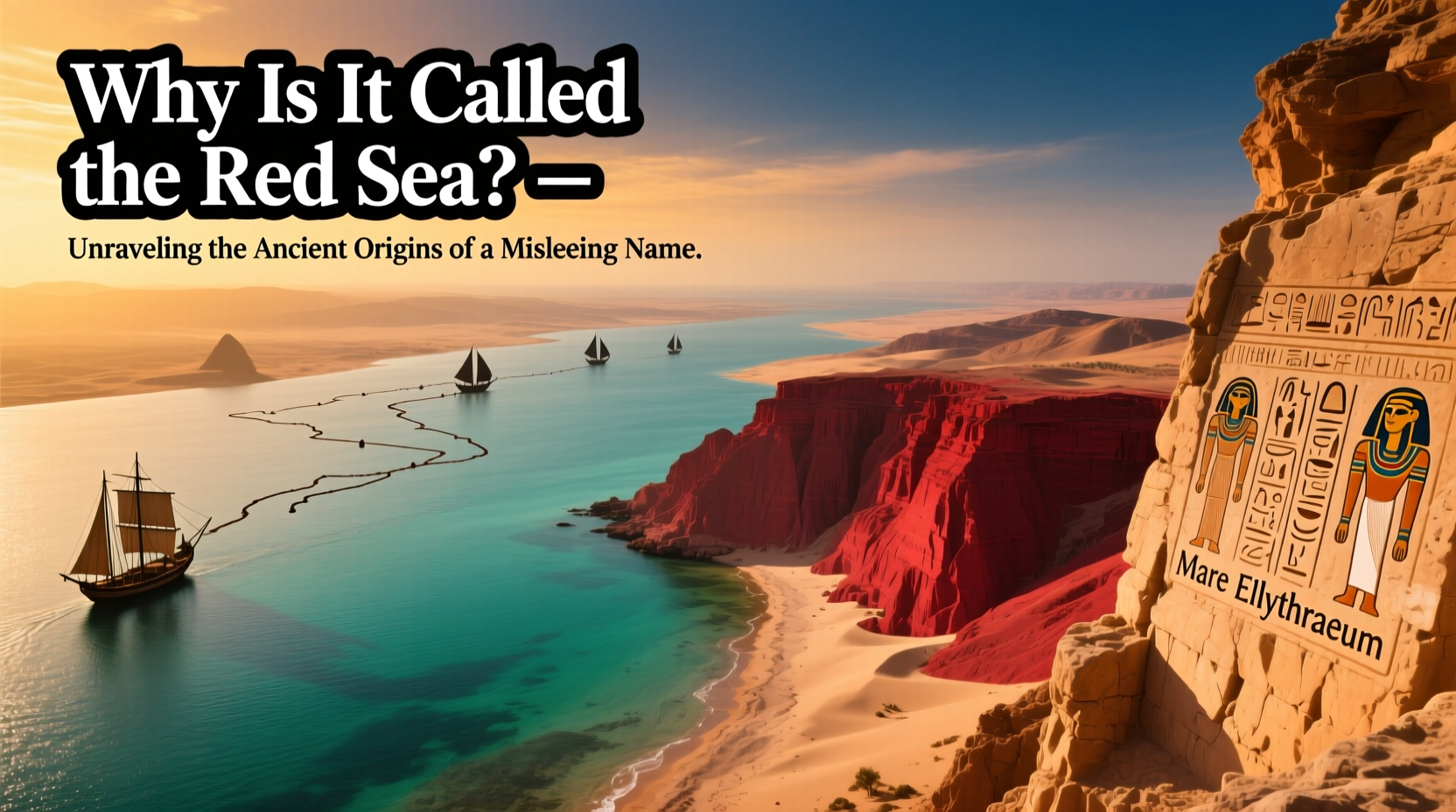
The term \"Red Sea\" traces back to ancient civilizations that lived along its shores or traded across it. The earliest known references appear in Egyptian, Akkadian, and Hebrew texts, where directional color systems played a significant role in naming geographical features.
In ancient Semitic languages, cardinal directions were often associated with colors. For example, some scholars suggest that “red” may have denoted the south, just as “black” referred to the north. Since the Red Sea lies south of the Levant and Mesopotamia, it may have been labeled based on direction rather than hue. This symbolic use of color was common in early cartography and cosmology.
The Hebrew Bible uses the term *Yam Suph* (ים סוף), often translated as “Sea of Reeds” or “Sea of Seaweed.” This phrase appears in the Exodus narrative, describing the body of water crossed by the Israelites. Over time, Greek translators of the Hebrew scriptures rendered *Yam Suph* as *Erythra Thalassa*, meaning “Red Sea”—a translation that likely influenced later European language versions.
“Color terms in antiquity weren’t always literal. ‘Red’ could symbolize direction, season, or divine association rather than actual pigment.” — Dr. Lena Mahmoud, Historian of Ancient Near Eastern Languages
The Greek and Roman Influence
The term *Erythra Thalassa* became standard in Hellenistic geography. Greek historian Herodotus referenced the Red Sea in the 5th century BCE, using the name consistently in his descriptions of trade routes and regional boundaries. Later, Roman geographers adopted the Latin equivalent, *Mare Rubrum*, further cementing the name in Western tradition.
Interestingly, the Greeks had no direct explanation for the \"red\" designation. Some speculated it was due to seasonal algae blooms, while others believed it contrasted with other seas named for colors—such as the Black Sea (*Pontos Melas*) to the north. This color-based naming convention suggests an early attempt at systematic geographical classification.
Trade also played a role. The Red Sea connected Egypt to the Indian Ocean, serving as a vital route for spices, incense, and precious stones from southern Arabia and East Africa. Merchants and sailors may have used the name colloquially, reinforcing its usage across cultures.
Natural Explanations: Is the Water Actually Red?
One of the most persistent theories is that the sea occasionally appears red due to natural causes. Two primary explanations stand out:
- Algal Blooms: Certain species of phytoplankton, particularly *Trichodesmium erythraeum*, can bloom in warm, nutrient-rich waters. When these microorganisms die, they release pigments that turn the water a reddish-brown hue. These events are rare but dramatic, potentially giving rise to the name.
- Surrounding Geology: The desert landscapes flanking the Red Sea—especially in Sudan and Eritrea—are rich in red-hued minerals and sands. At sunrise or sunset, the reflection of these terrains onto the water’s surface can create an illusion of redness.
Cultural and Religious Interpretations
Beyond linguistics and nature, myth and religion have shaped the name’s legacy. In Islamic tradition, the Red Sea is linked to the story of Prophet Musa (Moses) parting the waters—an event known as the crossing of the *Bahr al-Qulzum*. While Arabic typically calls it *Al-Bahr al-Ahmar* (“the Red Sea”), some classical commentators speculated that “red” referred to the destruction of Pharaoh’s army, symbolizing blood or divine judgment.
In Ethiopian Coptic texts, the sea was sometimes described as “red” in reference to the direction of the rising sun—another example of symbolic rather than literal coloring. These layered interpretations show how names evolve not just from sight, but from meaning.
Timeline of Naming Across Civilizations
- c. 1500 BCE: Egyptians refer to the Gulf of Suez region in relation to expeditions to Punt, possibly using directional color codes.
- 8th–6th century BCE: Hebrew texts use *Yam Suph*, later mistranslated or reinterpreted as “Red Sea” in Greek versions.
- 5th century BCE: Herodotus documents *Erythra Thalassa* in his Histories.
- 1st century CE: Roman maps label the area *Mare Rubrum*.
- 7th century CE onward: Arabic adopts *Al-Bahr al-Ahmar*, maintaining the Greco-Roman name.
- 15th century CE: European explorers and cartographers popularize “Red Sea” in English and other vernaculars.
Modern Scientific Perspective
Today, oceanographers confirm that while the Red Sea doesn’t appear red under normal conditions, the phenomenon of *Trichodesmium* blooms does occur—particularly in the northern reaches near Egypt and Saudi Arabia. These cyanobacteria thrive in high-salinity, warm environments, which the Red Sea provides due to limited freshwater inflow and intense evaporation.
Moreover, satellite imagery has captured large-scale discoloration events, validating ancient accounts. Though infrequent, these occurrences support the theory that early observers named the sea after rare but memorable visual anomalies.
| Theory | Evidence | Plausibility |
|---|---|---|
| Directional Color Symbolism | Semitic directional systems; Black Sea = north | High – widely accepted by linguists |
| Algal Blooms | Documented *Trichodesmium* blooms turning water red | Medium – episodic, not permanent |
| Desert Reflections | Red sands reflecting at dawn/dusk | Low – transient visual effect |
| Religious Symbolism | Biblical and Quranic narratives of deliverance | Symbolic, not etymological |
| Mistranslation of *Yam Suph* | Hebrew for “sea of reeds” vs. Greek “red sea” | High – key moment in naming history |
Mini Case Study: The Dahlak Archipelago Observation
In 2018, marine researchers monitoring coral health near the Dahlak Archipelago in Eritrea observed an unusual shift in water color. Over several days, the surface turned a distinct coppery-red. Water samples confirmed a *Trichodesmium erythraeum* bloom. Local fishermen reported similar events occurring roughly once every decade, often preceding changes in fish migration patterns.
This case illustrates how periodic natural events could have left a lasting impression on ancient mariners. A single vivid occurrence might have been enough to inspire a permanent name, especially in oral traditions where dramatic visuals were emphasized.
Frequently Asked Questions
Is the Red Sea actually red?
No, not under normal conditions. It typically appears deep blue or turquoise. However, rare algal blooms can temporarily turn patches of the water reddish-brown.
Could “Red Sea” be a mistranslation?
Yes, many scholars believe so. The Hebrew *Yam Suph* likely meant “Sea of Reeds,” referring to marshy areas. When translated into Greek as *Erythra Thalassa* (“Red Sea”), the meaning shifted—possibly due to confusion or symbolic interpretation.
Are there other “colored” seas?
Yes. The Black Sea may get its name from dark depths or northern storms. The White Sea in Russia is ice-covered much of the year. The Yellow Sea in Asia is named for silt deposits. Color-based naming is more common than it appears.
Actionable Checklist: Exploring Historical Place Names
- Research original language terms (e.g., *Yam Suph*, *Al-Bahr al-Ahmar*)
- Consider symbolic or directional meanings of colors in ancient cultures
- Investigate natural phenomena that could influence appearance
- Trace translation shifts across major historical texts
- Consult archaeological and oceanographic records for environmental context
Conclusion: More Than Just a Name
The name “Red Sea” is not a simple descriptor but a convergence of language, environment, and human storytelling. Whether born from a mistranslation, a fleeting natural spectacle, or an ancient symbolic system, it reflects how people interpret the world through available frameworks. Understanding its origins deepens our appreciation not only of geography but of the ways culture shapes perception.




 浙公网安备
33010002000092号
浙公网安备
33010002000092号 浙B2-20120091-4
Comments
No comments yet. Why don't you start the discussion?