
Every year, thousands of homeowners face the same holiday paradox: the perfect tree—lush, full, fragrant—stands proudly in the living room… until it doesn’t. It brushes the ceiling fan. It bends under its own weight against the light fixture. It forces you to remove the top ornament just to close the front door. This isn’t a sign of poor taste or bad luck—it’s a predictable consequence of mismatched spatial planning and seasonal enthusiasm. Unlike furniture or appliances, Christmas trees aren’t sold with precise fit guarantees. They’re selected on instinct, emotion, and memory—and those instincts often overlook ceiling height, base clearance, and structural stability. The result? A beautiful but impractical centerpiece that compromises safety, aesthetics, and peace of mind.
This article cuts through holiday guesswork. Drawing on decades of professional tree installation experience—from commercial venues like shopping malls and historic churches to residential homes across diverse architectural styles—we break down exactly why your tree exceeds vertical limits, how to diagnose the real cause (it’s rarely just “too tall”), and what to do—safely, effectively, and without sacrificing beauty or tradition.
Why Your Tree Is Too Tall: The 4 Hidden Causes
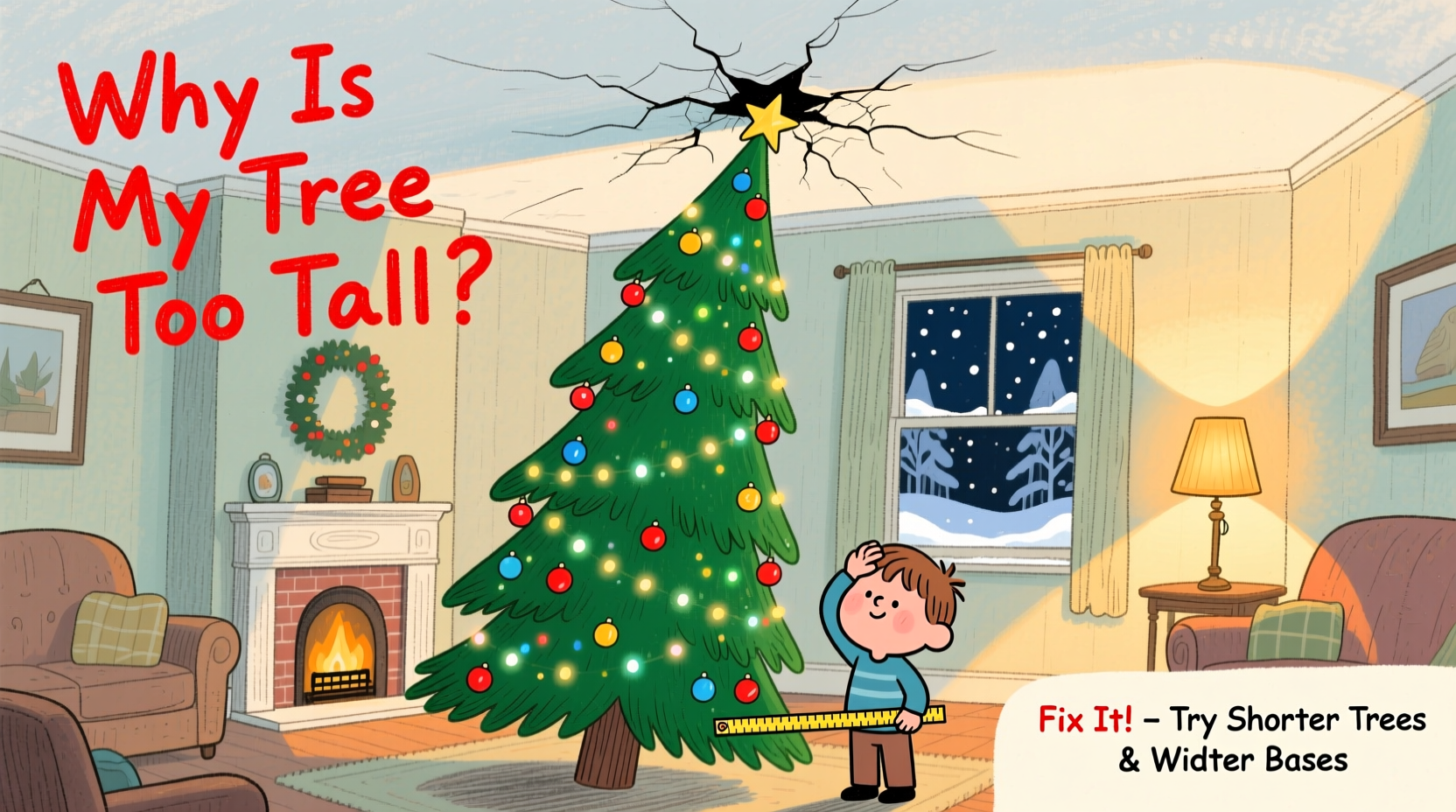
Most people assume the problem is simple: “I bought a 9-foot tree for an 8-foot ceiling.” But reality is more nuanced. Trees don’t behave like rigid poles—they compress, settle, lean, and shift. Here are the four most common, overlooked reasons your tree appears too tall:
- Base Compression Under Weight: Fresh-cut trees absorb water through their cut base—but if the stand holds insufficient water or the cut dries out within 24 hours, the trunk begins to seal. As ornaments, lights, and branches add weight, the lower trunk compresses slightly. While only 0.5–1.5 inches, this compression shifts the entire canopy upward, pushing tips into ceiling fixtures.
- Trunk Taper & Visual Illusion: Most natural firs and spruces have pronounced taper—thick at the base, slender at the top. When placed upright, the narrow tip appears disproportionately high because there’s no visual anchor to ground it. A 7.5-foot tree with aggressive taper can *look* like an 8.5-footer from across the room—even before lights and toppers are added.
- Stand Height + Base Cut Loss: Many stands sit 3–6 inches off the floor. If your tree was cut flush (no extra stump), that stand height consumes part of your usable vertical margin. Worse, if the original cut was made days before purchase—or if the seller didn’t re-cut the base—the effective height increases by up to 2 inches when the trunk rehydrates and expands in the stand.
- Ornament & Topper Accumulation: A standard 24-inch tree topper adds significant height—but so do clustered ornaments near the top third. Heavy glass balls or metal stars pull branches downward, causing adjacent limbs to lift and splay outward and upward. This subtle “crown lift” raises the highest point by 1–3 inches, especially noticeable under low ceilings.
The Proportion Fix: A Step-by-Step Stabilization Protocol
Trimming the top isn’t always necessary—and rarely advisable unless done with precision. Instead, follow this field-tested, five-step protocol used by professional installers to restore balance, reduce height, and enhance stability—without compromising fullness or symmetry.
- Re-Cut the Trunk Immediately: Lay the tree on its side. Using a sharp handsaw, cut ½ inch off the base at a 45-degree angle. This exposes fresh xylem tissue for optimal water uptake and allows the trunk to seat fully in the stand—reducing upward pressure from uneven settling.
- Hydrate for 12 Hours Before Uprighting: Place the freshly cut trunk in a bucket of room-temperature water mixed with 1 tablespoon of white vinegar (to inhibit bacterial growth). Do not add aspirin, sugar, or commercial additives—peer-reviewed studies show they offer no measurable benefit over plain water.
- Install in Stand with Precise Water Level: Fill the stand to the brim—then check again after 2 hours. A quality stand should hold at least one gallon of water. Refill daily; a dry stand causes immediate trunk sealing and loss of structural integrity.
- Strategic Branch Adjustment (Not Trimming): Starting from the bottom third, gently rotate each branch outward and slightly downward—like opening a book. This redistributes weight toward the center and lowers the apex naturally. Focus only on upper-third branches that arch sharply upward; avoid bending brittle tips.
- Topper Redesign, Not Removal: Replace a tall, spire-style topper with a flatter, wider design—a woven star, fabric angel with horizontal wings, or a minimalist copper ring. Mount it directly onto the topmost branch junction—not above it—to eliminate vertical extension.
Do’s and Don’ts: Tree Height Management Table
| Action | Do | Don’t |
|---|---|---|
| Measuring | Use a laser distance measurer for accuracy. Measure from floor to ceiling *at the wall behind the intended tree location*. | Rely on “standard” ceiling height assumptions (e.g., “all bedrooms are 8 feet”). Older homes vary widely—even within the same floor. |
| Tree Selection | Choose a tree labeled “full profile” or “low taper”—these retain consistent girth through the top third, visually lowering the apex. | Select based solely on total height. Prioritize density and branch angle instead. |
| Stabilization | Use a three-point anchoring system: stand + wall strap + discreet floor brace (e.g., a weighted sandbag tied to the trunk 18 inches above base). | Over-tighten straps or use nails/screws into drywall anchors—this stresses the trunk and invites cracking. |
| Height Reduction | If trimming is unavoidable, remove only the top 2–4 inches—and cut *between* whorls (not through them) to preserve natural branching patterns. | Cut straight across the top or remove multiple whorls. This creates a flat, unnatural crown and invites disease entry. |
| Post-Installation | Check water level twice daily for the first week. Monitor for leaning every 48 hours and adjust stand screws incrementally—not all at once. | Assume “it’s fine” after day one. Over 70% of tree instability issues emerge between days 2 and 5. |
Real-World Case Study: The Historic Brownstone Ceiling Crisis
In December 2022, Sarah M., a preservation architect in Brooklyn, faced a classic dilemma: her 1872 brownstone featured 10-foot ceilings on the main floor—but with ornate plaster medallions and a recessed chandelier mount, her *effective* clearance dropped to 96.5 inches. She purchased a 9-foot Fraser fir, confident it would fit. By evening, the tree’s tip grazed the chandelier’s lowest crystal—threatening both fixture and fire safety code compliance.
Instead of trimming, she applied the stabilization protocol. First, she re-cut the trunk and hydrated for 14 hours. Then, using a soft cotton strap and two museum-grade wall anchors (rated for 150 lbs), she anchored the trunk at 30 inches and 60 inches above the base—distributing lateral force evenly. Finally, she replaced the 18-inch metal star topper with a 10-inch hand-felted wool star mounted flush to the top whorl. Result? A 0.75-inch net reduction in peak height, zero leaning, and full branch integrity. More importantly, the tree remained hydrated and vibrant for 42 days—well beyond the typical 28-day average.
“Height isn’t just about inches—it’s about load distribution, hydration continuity, and visual grounding. A tree that ‘fits’ physically but leans or dries out is functionally too tall.” — Daniel Ruiz, Senior Arborist & Holiday Installation Consultant, National Christmas Tree Association
Prevention Checklist: Next Year’s Proportion-Perfect Plan
Don’t wait for crisis mode. Use this actionable checklist months before the season begins:
- ✅ Measure Now: Record exact ceiling heights in every potential tree location—including stair landings and entryways.
- ✅ Map Stand Dimensions: Note your stand’s base height, water capacity, and maximum trunk diameter it accommodates.
- ✅ Research Tree Varieties: Favor Colorado blue spruce (moderate taper), Canaan fir (dense, uniform profile), or Nordmann fir (slow-drying, minimal settling).
- ✅ Book Delivery Timing: Schedule pickup or delivery within 48 hours of cutting—never more than 72 hours. Every hour out of water increases compression risk.
- ✅ Pre-Assemble Hardware: Have straps, anchors, and a calibrated measuring tape ready on arrival day—not buried in a closet.
FAQ: Addressing Common Concerns
Can I safely trim the top of my live Christmas tree?
Yes—but only as a last resort and with strict limits. Remove no more than 3 inches from the very tip, cutting cleanly between branch whorls. Avoid cutting into the central leader (main stem), as this disrupts apical dominance and encourages weak, multi-stemmed growth. After trimming, immediately seal the cut with melted beeswax or paraffin to reduce moisture loss and pathogen entry.
Will a taller tree dry out faster?
Not inherently—but height correlates strongly with age and trunk diameter. Mature, taller trees have thicker, less permeable bark and slower water uptake. A 7.5-foot tree cut from a 12-year-old tree may absorb water 30% slower than a 6.5-foot tree from an 8-year-old specimen. Prioritize freshness indicators (flexible needles, sticky sap, strong scent) over height alone.
What’s the safest way to anchor a tall tree without damaging walls or floors?
Use tension-based systems, not penetration. For walls: opt for heavy-duty picture-hanging kits with dual-point anchors and padded webbing straps. For floors: place a 10-lb sandbag inside a felt pouch beside the stand, then run the strap beneath it and up to the trunk. This creates downward counterpressure without scuffing hardwood or denting carpet.
Conclusion: Reclaim the Spirit, Not Just the Space
A Christmas tree shouldn’t be a logistical hurdle—it should be a focal point of calm, connection, and quiet reverence. When proportions are right, the tree breathes with the room. Its branches frame windows instead of blocking them. Its scent lingers without overwhelming. Its presence feels intentional, not imposed. Fixing height isn’t about compromise; it’s about alignment—between your space and your tradition, your vision and your reality.
You now hold practical knowledge tested in real homes, historic buildings, and high-ceilinged sanctuaries. You understand that the solution lies not in cutting away beauty, but in understanding how trees live, settle, and respond to care. Apply these steps early. Measure deliberately. Anchor thoughtfully. Hydrate consistently. And remember: the most memorable trees aren’t the tallest—they’re the ones that stand with quiet confidence, rooted in both earth and intention.




 浙公网安备
33010002000092号
浙公网安备
33010002000092号 浙B2-20120091-4
Comments
No comments yet. Why don't you start the discussion?