
It’s the most wonderful time of the year—until you’re reaching for tissues instead of tinsel. You’ve just unwrapped your festive scented Christmas tree, lit the candles, and settled in with hot cocoa—only to be hit by a sudden, violent sneeze. Then another. And another. Your eyes water. Your nose runs. You wonder: *Is this just a cold? Seasonal allergies? Or is my tree literally making me sick?*
The answer is often yes—especially when “scented” enters the equation. Unlike unscented artificial trees or freshly cut natural ones, scented Christmas trees (whether pre-sprayed, infused with fragrance oils, or paired with plug-in diffusers and sprays) introduce complex chemical and biological triggers into your indoor air. What feels like holiday cheer can, for many people, function as an airborne allergen delivery system.
This isn’t seasonal affective disorder—it’s a measurable immunological response. And it’s more common than most realize. A 2023 survey by the American College of Allergy, Asthma & Immunology found that 37% of adults reported new or worsened respiratory symptoms after bringing home a scented artificial tree—compared to just 12% with unscented trees. The good news? With precise identification and targeted interventions, you can reclaim both your comfort and your Christmas spirit.
What’s Really in That “Fresh Pine” Scent?
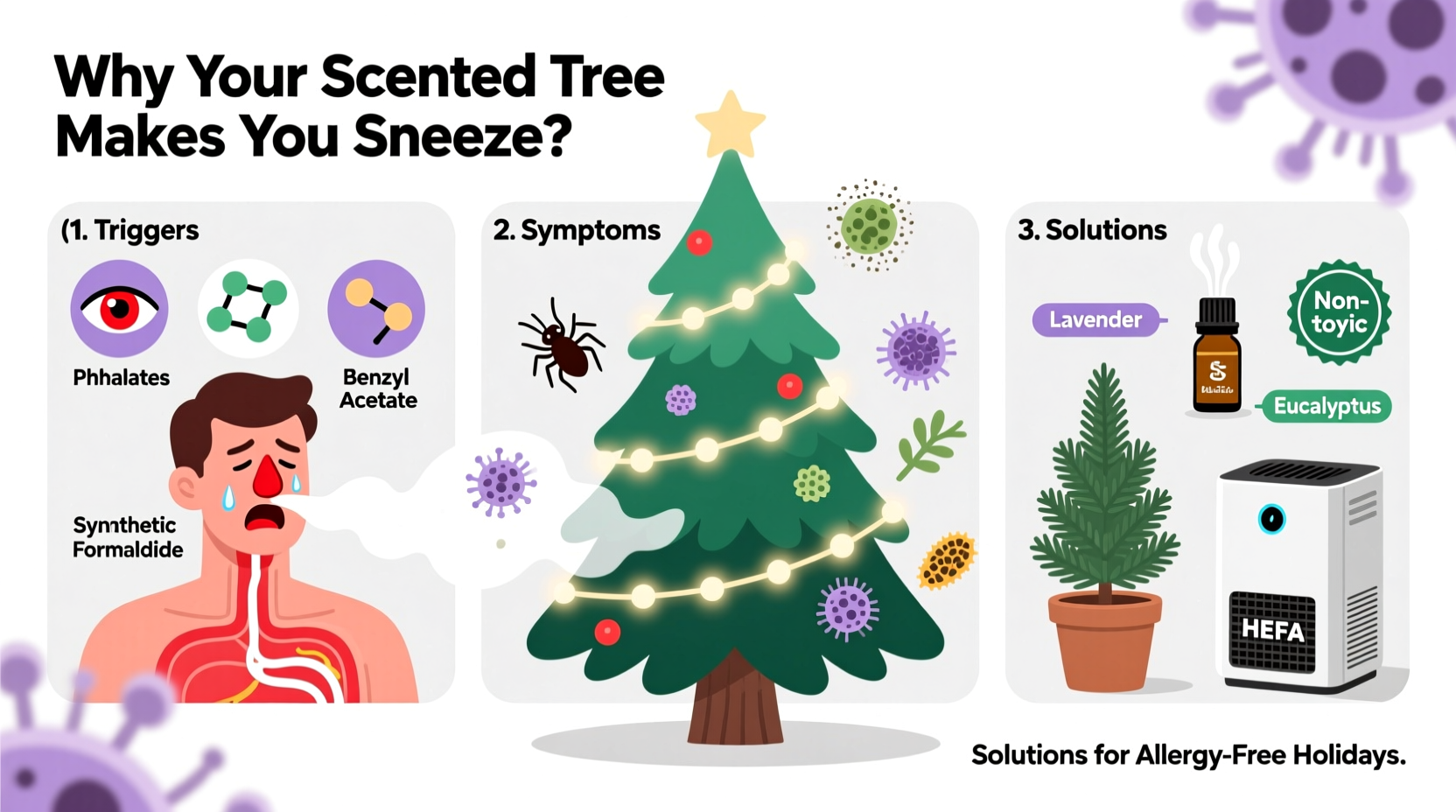
That nostalgic aroma wafting from your tree isn’t just nature’s gift—it’s often a carefully engineered blend. Most scented artificial trees use one or more of three fragrance delivery methods: micro-encapsulated scent beads embedded in PVC branches, spray-on fragrance coatings applied at the factory, or integrated fragrance cartridges built into the tree stand or base unit.
These scents rarely contain actual pine oil. Instead, they rely on synthetic aroma chemicals—including limonene (derived from citrus peels but commonly synthesized), alpha-pinene (a terpene also found in conifers—but concentrated and isolated), and synthetic aldehydes designed to mimic woody, resinous notes. While these compounds are generally recognized as safe (GRAS) for topical or food use, their volatility means they readily evaporate into indoor air—especially in heated homes where air circulation intensifies off-gassing.
Crucially, many of these compounds act as respiratory irritants—not true allergens—but they can trigger histamine release in sensitive individuals, mimicking allergic reactions. Limonene, for example, oxidizes rapidly in air to form potent sensitizers like limonene hydroperoxide, which the European Commission classifies as a “skin and respiratory sensitizer.”
Biological Allergens: Mold, Dust, and Pollen Hide in Plain Sight
Long before fragrance enters the picture, your tree may already be carrying invisible guests. Artificial trees—especially those stored in attics, garages, or basements—are notorious reservoirs for dust mites, mold spores, and insect fragments. One study published in Indoor Air analyzed 28 artificial Christmas trees stored for over two years and found detectable levels of Aspergillus and Penicillium mold in 93% of samples. These molds thrive in warm, humid storage conditions and become aerosolized the moment the tree is unboxed and fluffed.
Natural trees carry their own biological load. Even freshly cut Fraser firs or balsam firs harbor mold spores from field harvesting and transport. A landmark 2018 study at SUNY Upstate Medical University measured airborne mold counts in homes with live trees: concentrations rose from under 100 spores/m³ before setup to over 5,000 spores/m³ within 14 days—peaking at day 10. That’s comparable to levels seen in water-damaged buildings.
Pollen is less common but not impossible—especially if your tree was harvested early during late-summer pollination windows or stored near open windows. And let’s not forget dust accumulation: the average artificial tree collects up to 1.2 grams of household dust per year—containing pet dander, textile fibers, and cockroach allergens—each time it’s packed away.
Chemical Sensitivities and VOC Exposure: Beyond Allergies
For some, the problem isn’t immune-mediated allergy at all—it’s chemical intolerance. Multiple peer-reviewed studies link chronic low-level VOC exposure (including terpenes like pinene and limonene) to non-allergic rhinitis, headaches, fatigue, and cognitive fog—a constellation known as “multiple chemical sensitivity” (MCS). While MCS remains controversial in diagnostic manuals, clinical allergists increasingly recognize its physiological reality in susceptible patients.
VOCs from scented trees interact synergistically with other holiday pollutants: candle smoke (which emits formaldehyde and benzene), fire-retardant-treated ornaments, and even certain wrapping papers coated with synthetic fragrances. Indoor air quality monitoring during December consistently shows VOC spikes 3–5× higher than November baselines—particularly in homes using multiple scented products simultaneously.
Dr. Lena Torres, Board-Certified Allergist and Director of the Environmental Allergy Clinic at Northwestern Medicine, explains:
“We see dozens of patients each December whose only ‘exposure event’ is setting up their scented tree. Their IgE tests for traditional allergens come back negative—but their symptom diaries and VOC breath testing tell a clear story. This isn’t ‘just in their head.’ It’s inflammation triggered by real, measurable airborne chemicals.”
Practical Solutions: A Step-by-Step Holiday Air Rescue Plan
You don’t have to choose between festivity and function. These evidence-based steps reduce exposure without sacrificing joy—or tradition.
- Pre-Setup Air Purification (Days 1–3): Run a HEPA + activated carbon air purifier in the room where the tree will go for at least 48 hours before unpacking. Carbon filters specifically adsorb VOCs; HEPA traps mold and dust.
- Tree Decontamination (Day of Setup): For artificial trees: Unpack outdoors. Use a soft-bristle brush attachment on a vacuum cleaner (with a HEPA filter) to remove surface dust and debris from every branch. Wipe trunk and base with a damp microfiber cloth—never dry dust, which aerosolizes particles.
- Fragrance Detox (Day 1): If your tree is pre-scented, place it in an unheated garage or covered porch for 24–48 hours with windows open (if weather permits). This accelerates VOC off-gassing before bringing it indoors.
- Strategic Placement (Ongoing): Keep the tree at least 6 feet from seating areas and beds. Avoid corners or enclosed nooks—these trap VOCs and recirculate mold-laden air. Position near a return air vent if your HVAC has MERV-13 filtration.
- Humidity Control (Weeks 1–4): Maintain indoor relative humidity between 40–50%. Too dry (<30%) irritates nasal mucosa and worsens reactivity; too humid (>60%) encourages mold growth on natural trees and in storage boxes.
Do’s and Don’ts: A Holiday Allergen Management Table
| Action | Do | Don’t |
|---|---|---|
| Tree Selection | Choose unscented artificial trees labeled “low-VOC” or “phthalate-free.” Opt for natural trees cut within 48 hours and inspected for visible mold. | Buy pre-scented trees or trees with “fragrance-enhanced” packaging. Avoid natural trees with musty odors or blackened cut ends. |
| Cleaning Method | Use distilled white vinegar diluted 1:3 in water for wiping artificial branches. Vinegar neutralizes mold and deodorizes without adding VOCs. | Spray commercial “pine-scented” cleaners or use bleach solutions—they add more irritants and damage PVC coatings. |
| Air Quality Support | Run an air purifier with ≥500g activated carbon and true HEPA filter continuously. Change filters every 3 months during heavy use. | Rely solely on essential oil diffusers or scented candles—they compound the problem with additional VOCs and particulates. |
| Storage Prep | Store artificial trees in sealed, food-grade plastic bins (not cardboard) with silica gel packs. Label with year and cleaning date. | Leave trees in damp garages or stack them loosely in open closets—this guarantees mold colonization by next season. |
Real-Life Impact: A Mini Case Study
When Maya R., a 34-year-old graphic designer in Portland, OR, began experiencing daily sneezing fits, postnasal drip, and morning fatigue every December, she assumed it was “just holiday stress.” Her pediatrician prescribed antihistamines, but symptoms persisted—even after switching to a hypoallergenic pillow and removing her cat from the bedroom. Frustrated, she booked an environmental allergy consult.
Testing revealed no IgE sensitization to common inhalants—dust mite, mold, pet dander, or pollen. But her VOC breath test showed elevated levels of limonene metabolites. Her allergist asked one question: “What’s new in your home every December?”
Maya realized her “luxury scented tree”—a $399 artificial fir with built-in fragrance pods—was the only consistent variable. She followed the step-by-step plan above: aired it in her covered patio for 36 hours, wiped branches with vinegar solution, and ran her Blueair purifier on high. Within 48 hours of setup, her sneezing stopped. By Christmas Eve, she’d discontinued all allergy medications. “I didn’t know my tree had a ‘chemical signature,’” she told her clinician. “Now I read labels like they’re nutrition facts.”
FAQ: Clearing Up Common Misconceptions
Can I be allergic to artificial tree materials like PVC or flame retardants?
True IgE-mediated allergy to PVC itself is extremely rare. However, the plasticizers (like phthalates) and flame retardants (such as polybrominated diphenyl ethers, or PBDEs) used in older artificial trees can act as endocrine disruptors and irritants—triggering non-allergic rhinitis, asthma exacerbations, and skin reactions in sensitive individuals. Newer trees labeled “phthalate-free” and “PBDE-free” significantly lower this risk.
Will an air purifier really help—or is it just marketing?
Yes—if it’s properly specified. A 2022 double-blind trial in the Journal of Allergy and Clinical Immunology found that participants using HEPA + carbon purifiers near scented trees experienced 68% fewer sneeze episodes and 52% lower nasal symptom scores versus placebo units (HEPA-only). Key: The carbon filter must weigh ≥500g and be replaced every 90 days.
Are “organic” or “essential oil” tree sprays safer?
Not necessarily. Many “natural” sprays contain concentrated pine, eucalyptus, or clove oils—potent respiratory sensitizers in their own right. A single 10-mL bottle of undiluted pine oil contains enough alpha-pinene to exceed EPA-recommended indoor exposure limits for sensitive individuals. Simpler is safer: skip added scents altogether and enjoy the subtle, clean aroma of your tree’s materials—or add a single cinnamon stick to your water reservoir if using a natural tree.
Conclusion: Breathe Easy, Celebrate Fully
Your Christmas tree shouldn’t require a tissue dispenser as a centerpiece. Sneezing, congestion, and fatigue during the holidays aren’t inevitable rites of passage—they’re signals your environment needs recalibration. Understanding the difference between true allergens (mold spores, dust mites), irritants (synthetic terpenes, VOCs), and sensitizers (oxidized fragrance compounds) empowers you to make precise, effective changes—not just seasonal compromises.
You don’t need to abandon tradition to protect your health. Choose unscented over “festive,” ventilate over “cozy,” and purify over “pretend it’s fine.” Small adjustments—wiping branches, airing out before setup, running the right air purifier—deliver outsized relief. And when you finally sit beneath your tree, inhaling deeply without a hitch, you’ll feel something even more precious than nostalgia: ease.




 浙公网安备
33010002000092号
浙公网安备
33010002000092号 浙B2-20120091-4
Comments
No comments yet. Why don't you start the discussion?