
Shadows are typically seen as dark silhouettes—absences of light where an object blocks a source. But what happens when your shadow isn’t black or gray, but distinctly purple? It’s not a trick of the mind, nor a sign of something supernatural. Instead, it’s a fascinating interplay of physics, human vision, and environmental lighting. Understanding why shadows can appear purple reveals deeper insights into how we perceive color, how light behaves, and how our surroundings subtly influence what we see.
This phenomenon may seem rare, but once you know what to look for, you’ll notice it more often—especially during sunrise, sunset, or under artificial lighting. The answer lies not just in the object casting the shadow, but in the quality of light around it, the colors reflected from nearby surfaces, and the way your eyes process contrast.
The Science of Shadow Color
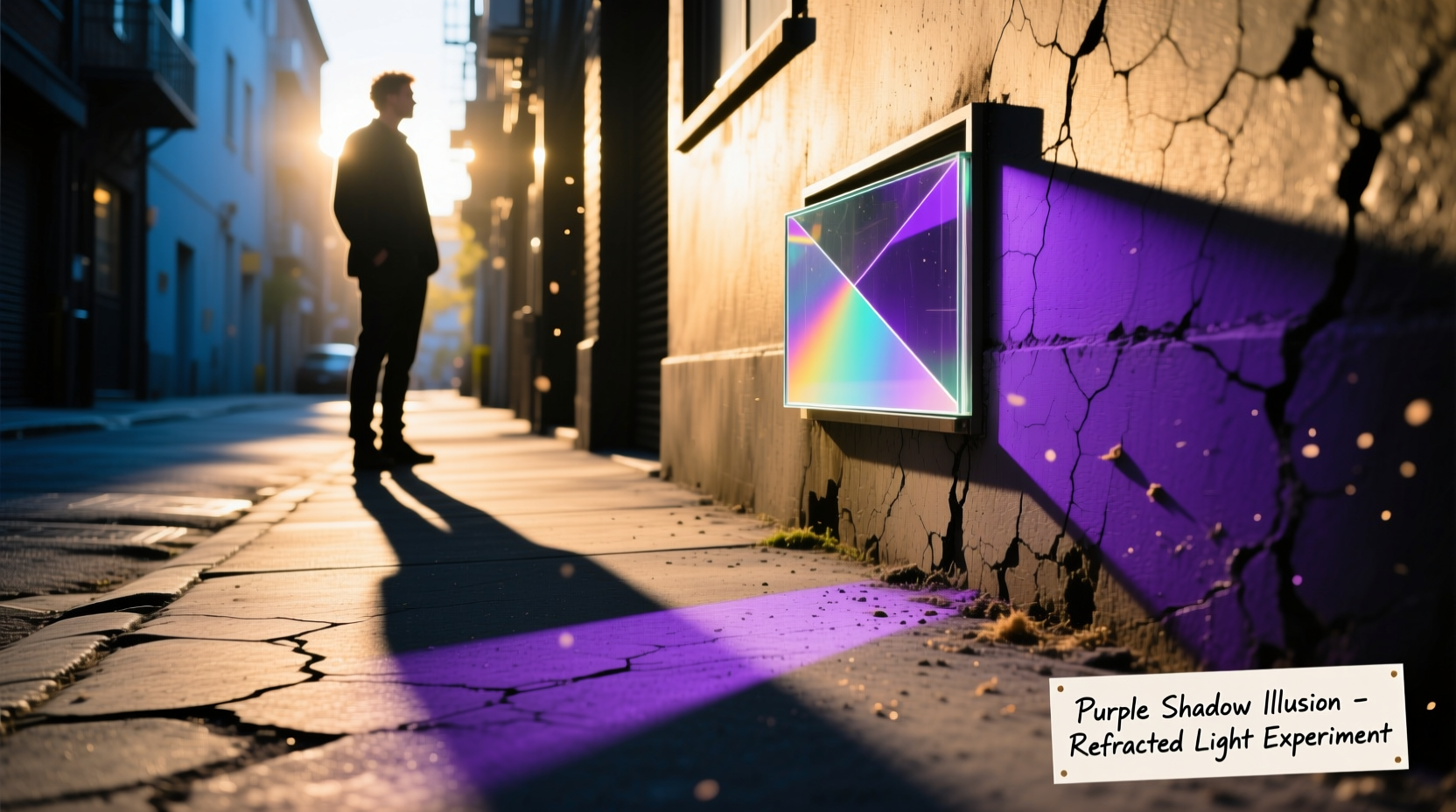
At first glance, a shadow appears dark because it receives less direct illumination than the surrounding area. However, shadows are rarely completely devoid of light. Ambient or indirect light—reflected from walls, the sky, or other objects—often fills in the shadowed region. This scattered light carries color information, which can dramatically alter the perceived hue of a shadow.
In natural daylight, shadows often appear bluish. This is due to Rayleigh scattering, the same phenomenon that makes the sky blue. When sunlight travels through the atmosphere, shorter (blue) wavelengths scatter more than longer (red) ones. While direct sunlight reaches the ground as white or slightly yellow light, the diffuse skylight that fills in shadows is rich in blue tones. Hence, outdoor shadows in open areas tend to have a cool, bluish cast.
But when a shadow appears purple, something more complex is at play. Purple is not a spectral color like blue or red—it’s a perceptual mix of red and blue light interpreted by the brain. A purple shadow usually means two light sources of contrasting hues are interacting: one warm (yellowish or reddish), and one cool (bluish). Your shadow, blocked from the dominant warm source, becomes illuminated primarily by the cooler, ambient light—and if there's residual red reflection nearby, your visual system blends them into purple.
Common Scenarios That Create Purple Shadows
Purple shadows don’t require special equipment or rare conditions. They occur naturally in everyday settings where multiple light sources with different color temperatures coexist. Here are some typical situations:
- Sunset or twilight outdoors: As the sun dips below the horizon, its light turns golden or orange. Meanwhile, the upper sky retains a deep blue hue. Objects block the warm direct light, leaving their shadows lit by the cool skylight. If the ground or nearby surfaces reflect warm tones (like from city lights or illuminated buildings), the contrast enhances the purple appearance.
- Indoor lighting with mixed sources: A room lit by incandescent bulbs (warm, ~2700K) next to a large window (cool daylight, ~6500K) creates ideal conditions. A person standing between the two will cast a shadow receiving mostly blue-dominant light, while the illuminated areas are warm. The brain perceives this contrast as purple.
- Colored walls or floors: If a surface reflects red or pink light (such as from a painted wall or a rug), and the primary light source is cool white, shadows may pick up both blue and red reflections, combining into a purplish tone.
- LED lighting environments: Modern LEDs vary widely in color temperature. Some emit a slightly magenta or violet spike in their spectrum. In poorly balanced setups, this can cause subtle purple tints in shadows, especially on neutral surfaces.
Real Example: The Artist’s Studio Observation
A portrait painter in Portland reported noticing purple shadows beneath her models during late afternoon sessions. She used north-facing windows for consistent daylight and supplemented with warm studio lamps as light faded. Initially, she assumed her canvas was distorting colors. After testing with grayscale cards, she confirmed the shadows themselves carried a measurable lavender tone. By adjusting her lighting setup—adding diffusers and balancing color temperatures—she reduced the effect. Her experience illustrates how even trained observers can be surprised by the subtlety of chromatic shadows.
“Color is not inherent in objects or light alone—it emerges from the relationship between illumination, surface, and perception.” — Dr. Lena Torres, Vision Scientist, MIT Department of Brain and Cognitive Sciences
How Human Vision Contributes to Purple Shadows
Your eyes and brain do not record color like a camera sensor. Instead, they constantly adjust to context, enhancing contrasts and filling in expectations. This is known as color constancy. For example, a white sheet of paper looks white whether viewed under sunlight, fluorescent light, or candlelight—even though the actual wavelengths hitting your retina differ drastically.
When a shadow forms under warm light, your visual system expects it to be cooler. The absence of red/yellow wavelengths makes the remaining blue light appear more intense. But if there’s any residual red reflection nearby—say, from a brick wall or a red shirt—the shadow edge may blend both signals. Since purple sits between red and blue in perceptual space, your brain interprets this mixture as purple, even if no actual purple light is present.
This effect is amplified by simultaneous contrast: a color appears differently depending on its surroundings. A gray shadow next to a bright yellow surface will look bluish or even purplish because your eye compensates for the dominant warm tone. This is why artists use complementary color schemes—placing orange next to blue intensifies both.
Do’s and Don’ts of Observing Chromatic Shadows
| Action | Do | Don't |
|---|---|---|
| Lighting Setup | Mix warm and cool light sources intentionally to observe color shifts. | Rely solely on single-source lighting if studying shadow color. |
| Surface Choice | Use neutral, matte surfaces (white paper, concrete) to avoid misleading reflections. | Observe shadows on glossy or colored surfaces without accounting for reflectance. |
| Time of Day | Test during dawn or dusk when color temperature gradients are strongest. | Expect strong effects under uniform midday sun. |
| Visual Tools | Use a grayscale card to isolate true shadow color. | Trust uncalibrated phone cameras, which auto-correct white balance. |
Step-by-Step Guide: Recreating and Analyzing Purple Shadows
You can experiment with this phenomenon at home using simple materials. Follow this timeline to observe and understand purple shadows:
- Choose your environment (5 minutes): Find a room with both natural light (a window) and a warm artificial light source (like a table lamp with an incandescent or warm LED bulb).
- Prepare a neutral surface (3 minutes): Place a large sheet of white paper or cardboard on the floor or wall where shadows will fall.
- Position the light sources (5 minutes): Angle the lamp so its warm light overlaps with daylight. Ensure both illuminate the same area but come from slightly different directions.
- Capture the shadow (2 minutes): Stand between the lights and the surface, casting a clear shadow. Move slightly to find where the shadow is filled with ambient light rather than total darkness.
- Observe and compare (5 minutes): Look closely at the shadow. Compare it to a piece of gray paper placed nearby. Does it appear bluish, gray, or purplish? Note how the color changes when you block one light source at a time.
- Modify variables (optional, 10+ minutes): Try changing the surface color, adding a colored filter over one light, or using only one light source to see how the shadow reverts to neutral.
This exercise demonstrates how easily our perception can be influenced by environmental factors. It also underscores that “color” is not an absolute property but a dynamic interaction.
Tips for Photographers and Designers
For creatives working with light and color, recognizing the potential for purple shadows is essential for accurate representation.
- Photographers: Be aware that automatic white balance settings often eliminate subtle chromatic shadows by forcing neutrality. Switch to custom Kelvin settings to retain the natural color dynamics.
- Interior designers: Consider how furniture shadows may interact with wall and floor colors. A warm-toned sofa against a blue wall could cast faintly purple shadows in low light, affecting the room’s perceived harmony.
- Digital artists: When rendering realistic scenes, include slightly colored shadows instead of flat black or gray. This adds depth and authenticity to lighting models.
Frequently Asked Questions
Can shadows really be purple, or is it just an illusion?
It’s both physical and perceptual. The light in the shadowed area can contain a mix of blue and red wavelengths, especially in mixed lighting. Your eyes then interpret this combination as purple. So while no single \"purple light\" is shining, the resulting perception is real and measurable in terms of human vision.
Why don’t all shadows show color?
Colorful shadows are most visible when there are multiple light sources of differing color temperatures and when ambient light is strong enough to illuminate the shadow. Under a single, dominant light source—like a bright overhead LED—shadows receive little fill light and appear neutral or simply darker versions of the surroundings.
Are purple shadows more common at certain times of day?
Yes. During sunrise and sunset, the contrast between warm direct sunlight and cool skylight is most pronounced. Urban environments with artificial lighting also increase the likelihood due to the mix of yellow streetlights and blue night skies.
Conclusion: Embracing the Complexity of Light
The appearance of a purple shadow is a quiet reminder that reality is more nuanced than it first appears. What we perceive as simple darkness is often a complex blend of scattered light, surface reflection, and neural interpretation. Far from being an error or anomaly, a purple shadow is a testament to the richness of visual experience.
Understanding this phenomenon empowers you to see the world more clearly—not just literally, but conceptually. Whether you're an artist refining your technique, a photographer capturing mood, or simply someone curious about everyday mysteries, paying attention to shadow color opens a new dimension of observation.




 浙公网安备
33010002000092号
浙公网安备
33010002000092号 浙B2-20120091-4
Comments
No comments yet. Why don't you start the discussion?