
You look up, and there it is—the big, beautiful blue sky stretching as far as you can see. But have you ever stopped and asked, “Why is it blue?” It’s not a silly question. In fact, it’s one of the most common and smartest questions kids ask about the world. The answer isn’t magic or paint—it’s science! And the best part? You don’t need a lab coat or a telescope to understand it. Let’s explore how sunlight, tiny air particles, and a little trick of light combine to make our sky look like a giant blue painting.
How Sunlight Makes Colors Appear
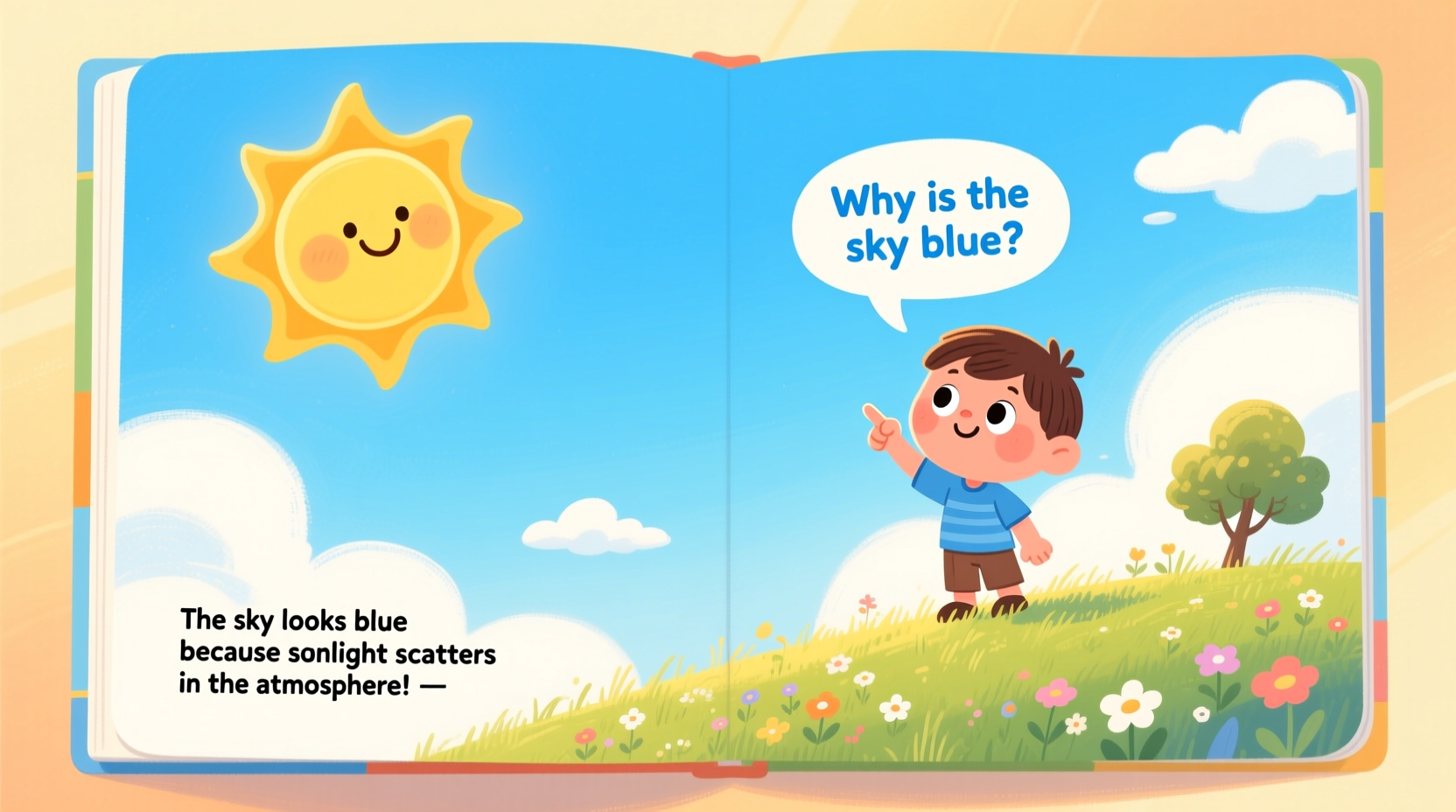
Sunlight might look white when it shines down on us, but it’s actually made up of many different colors. Think of it like a rainbow packed into one bright beam. If you’ve ever seen a rainbow after a storm, you’ve seen those colors separated: red, orange, yellow, green, blue, indigo, and violet. Scientists call this group of colors the \"visible spectrum.\"
When sunlight travels from the Sun to Earth, it moves in waves. Each color has its own kind of wave—some are long and lazy (like red), while others are short and quick (like blue and violet). These differences matter more than you might think, especially when light meets something in its path—like the air around us.
What Happens When Sunlight Hits the Air?
Earth is wrapped in a thick blanket called the atmosphere. It’s made of invisible gases like nitrogen and oxygen, plus tiny floating particles like dust and water droplets. Even though we can’t see them, these bits are everywhere—and they play a big role in coloring the sky.
When sunlight enters the atmosphere, it bumps into these tiny particles. Most colors pass through without much trouble, but blue light? It’s special. Because blue light waves are shorter and more energetic, they bounce off the air molecules much more than other colors. This bouncing is called scattering.
Imagine you’re tossing a handful of small rubber balls (blue light) and big foam balls (red light) at a wall full of tennis rackets (air molecules). The little rubber balls will bounce around wildly in all directions, while the big foam ones just roll straight through. That’s exactly what happens with blue light in the sky—it scatters in every direction, filling the whole sky with blue.
“Sunlight contains all colors, but our atmosphere acts like a filter that scatters blue light the most.” — Dr. Nina Patel, Atmospheric Scientist
Why Not Violet? It’s an Even Shorter Wave!
This is a brilliant question—and one that even scientists love. Violet light actually scatters *more* than blue because its waves are even shorter. So why don’t we see a violet sky?
There are two main reasons. First, the Sun sends out less violet light compared to blue. Second, our eyes aren’t very good at seeing violet. Human eyes have special cells called cones that detect color, and they’re much more sensitive to blue than to violet. So even though some violet light is scattered, our brains mostly register the blue.
Think of it like listening to music with your eyes closed. If someone plays a soft flute note (violet) and a loud guitar chord (blue) at the same time, you’ll notice the guitar more—even if the flute is technically louder in pitch.
How the Sky Changes Color Throughout the Day
If the sky is blue during the day, why does it turn orange or pink at sunrise and sunset? The answer lies in how far sunlight has to travel through the atmosphere.
During midday, sunlight comes straight down through a thinner part of the atmosphere. Blue light gets scattered easily, so we see blue above us. But at sunrise or sunset, the Sun is near the horizon. That means sunlight has to pass through a much thicker layer of air to reach your eyes.
As it travels that longer path, most of the blue light gets scattered *away* before it reaches you. What’s left? The longer waves—reds, oranges, and pinks. That’s why sunsets glow like fire and sunrises look like cotton candy.
| Time of Day | Path of Sunlight | Colors We See | Why? |
|---|---|---|---|
| Noon | Short, direct path | Blue | Blue light scatters widely in all directions |
| Sunrise/Sunset | Long, slanted path | Red, Orange, Pink | Blue is scattered away; longer waves dominate |
| Twilight | Sun below horizon | Purple, Deep Blue | Residual blue scattering at high altitudes |
Real Example: Emma’s Sunset Journal
Emma, a 9-year-old from Oregon, started drawing the sky every evening for a school project. At first, she only saw “orange” during sunset. But after a few days, she noticed changes—sometimes it was pink, sometimes gold, sometimes streaked with purple. Her teacher explained how the air, dust, and even pollution could change the colors. Emma began writing notes: “July 12: super red—maybe because of distant wildfires?” She wasn’t just drawing anymore—she was doing real science. By understanding why the sky changes, she turned curiosity into discovery.
Step-by-Step: Watch the Sky Like a Scientist
You don’t need a lab to explore the sky. Just your eyes and a little patience. Follow these steps to see how light and air work together every day:
- Step 1 – Look Up at Noon: On a clear day, find a safe outdoor spot and look straight up. What color is the sky? Is it the same everywhere?
- Step 2 – Observe at Sunrise or Sunset: Return early in the morning or late in the afternoon. Compare the colors near the horizon to those overhead.
- Step 3 – Note the Weather: Does the sky look different on hazy, cloudy, or windy days? Dust and moisture scatter light too.
- Step 4 – Draw or Describe: Keep a simple journal. Write down or sketch what you see. Over time, you’ll notice patterns.
- Step 5 – Ask “Why?”: Every time you see a change, wonder why it happened. That’s how great scientists begin.
Common Myths About the Sky’s Color
Even grown-ups sometimes get this wrong. Here are a few myths kids (and adults!) often hear:
- Myth: The sky is blue because it reflects the ocean.
Truth: No! The sky would still be blue even if there were no oceans. Deserts and mountains also have blue skies. - Myth: The atmosphere is naturally blue.
Truth: Air is actually invisible. The blue comes from how light interacts with it, not the air’s color. - Myth: Clouds are white because they block the blue.
Truth: Clouds scatter *all* colors equally, which makes them appear white. Thick storm clouds look gray because they block light.
Frequently Asked Questions
Why is the sky sometimes gray or white?
On cloudy days, the sky looks gray or white because clouds are made of bigger water droplets. These droplets scatter all colors of light equally, mixing them into white or dull gray. Thick clouds block sunlight, making the sky seem darker.
Why do astronauts see a black sky in space?
In space, there’s no air—no atmosphere to scatter sunlight. Without anything to bounce the light around, the sky stays black, even when the Sun is shining. That’s why photos from the Moon show a dark sky with bright stars and a glowing Sun.
Can the sky ever be other colors?
Yes! During dust storms, volcanic eruptions, or wildfires, the sky can turn yellow, orange, or even green. Pollution and smoke add larger particles that scatter light differently. Rarely, strong weather systems can create greenish skies before tornadoes—though that’s due to sunlight passing through storm clouds, not the air itself.
Fun Checklist: Become a Sky Detective
Grab a notebook and check off each task as you go. The more you observe, the more you’ll understand!
- ✅ Watch the sky at noon and write down its color
- ✅ Observe a sunrise or sunset and draw what you see
- ✅ Compare the sky on a clear day vs. a cloudy day
- ✅ Explain to a friend or family member why the sky is blue
- ✅ Spot different cloud types and guess what they mean for the weather
- ✅ Notice if the sky changes after rain or wind
The Bigger Picture: Curiosity Leads to Discovery
Asking “Why is the sky blue?” might seem small, but it’s actually a giant leap in thinking. Some of the greatest discoveries in science started with simple questions. Isaac Newton wondered why apples fall. Marie Curie asked what made certain rocks glow. And you? You’re asking how sunlight paints the sky.
Every time you look up and wonder, you’re doing what scientists do every day. You’re observing, questioning, and testing ideas. And the best part? There’s no right or wrong way to be curious. Whether you grow up to study weather, build rockets, or become an artist inspired by sunsets—this moment of wonder matters.
“The most beautiful experience we can have is the mysterious. It is the fundamental emotion that stands at the cradle of true art and true science.” — Albert Einstein
Conclusion: Keep Looking Up
The sky is blue because sunlight dances with the air, and blue light wins the game of hide-and-seek. It bounces around our atmosphere, filling the world above with a calming, endless blue. But that’s not the end of the story—it’s just the beginning. Tomorrow, the sky might be streaked with sunset gold or dotted with fluffy white clouds. Each day brings a new chance to watch, wonder, and learn.
So next time someone asks why the sky is blue, you’ll know the answer. And better yet, you can share it in a way that makes science feel fun, friendly, and full of surprises. The sky isn’t just above us—it’s a daily invitation to be curious.




 浙公网安备
33010002000092号
浙公网安备
33010002000092号 浙B2-20120091-4
Comments
No comments yet. Why don't you start the discussion?