
Walk into a room with a freshly cut balsam fir or Douglas fir, and something immediate happens: your shoulders drop, your breath deepens, and the mental static of daily life seems to soften. This isn’t nostalgia alone—it’s biology in action. The distinctive, resinous aroma of a real Christmas tree triggers measurable physiological responses rooted in neurochemistry, evolutionary adaptation, and plant biochemistry. Unlike synthetic pine-scented candles or air fresheners, the volatile organic compounds released by living conifers interact with our limbic system in uniquely potent ways. Understanding *why* this scent soothes us reveals far more than holiday charm—it illuminates how deeply scent shapes human emotion, memory, and stress resilience.
The Biochemical Signature: What Exactly Are You Smelling?
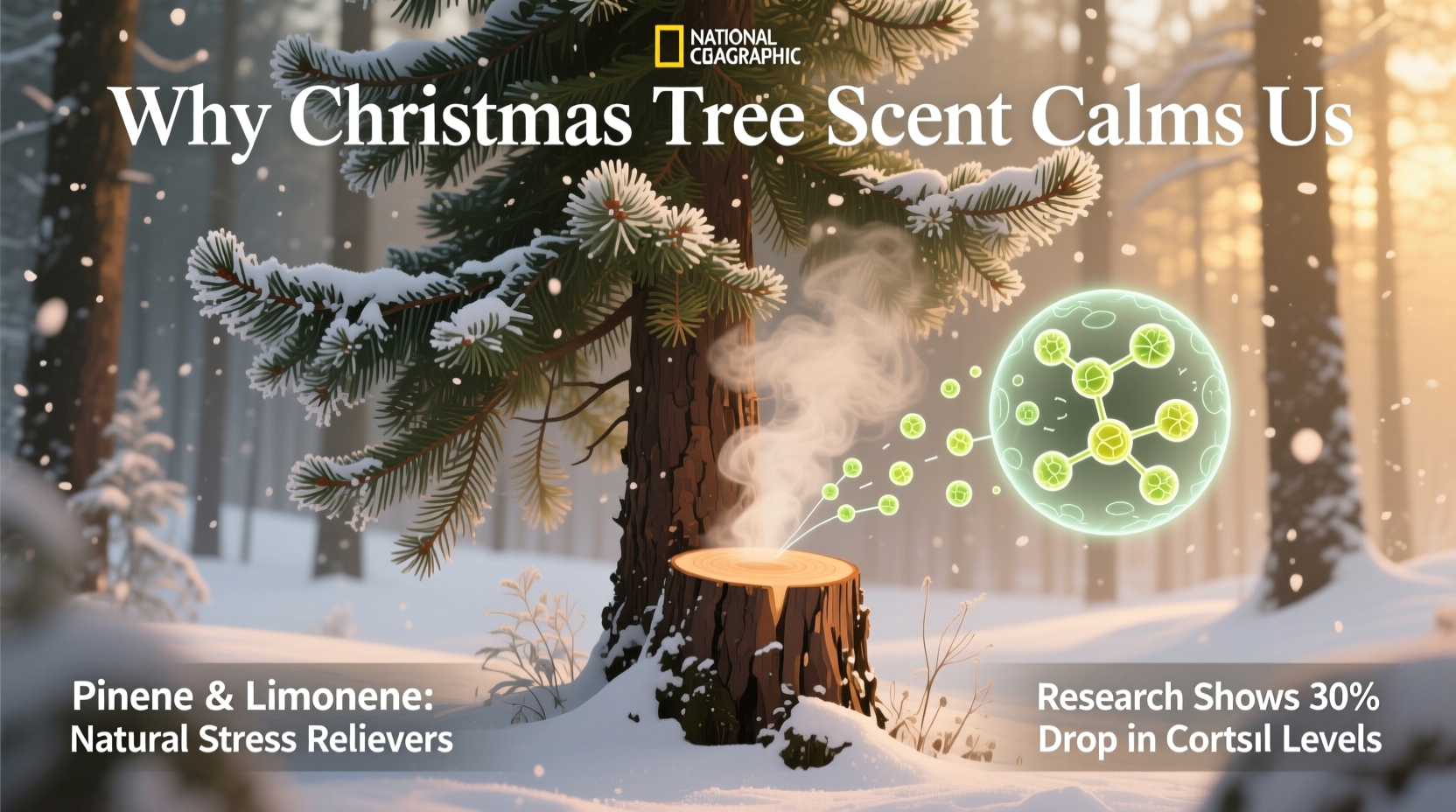
The calming scent of a real Christmas tree isn’t one molecule—it’s a dynamic blend of volatile organic compounds (VOCs) emitted by the tree’s needles, bark, and sap. When a branch is cut or a needle is crushed, resin ducts rupture, releasing a complex bouquet dominated by monoterpenes: alpha-pinene, beta-pinene, limonene, and delta-3-carene. These are not merely “fragrance notes”—they’re biologically active phytochemicals with documented effects on mammalian physiology.
Alpha-pinene, the most abundant monoterpene in most conifers, crosses the blood-brain barrier rapidly. Studies using rodent models show it enhances acetylcholine activity in the hippocampus—supporting attention and memory—while simultaneously reducing pro-inflammatory cytokines like IL-6 in brain tissue. Beta-pinene exhibits mild GABAergic modulation, similar in mechanism (though far gentler) to benzodiazepines—slowing neural firing in overactive circuits. Limonene, with its citrus-tinged brightness, elevates mood-associated neurotransmitters including serotonin and dopamine in preclinical trials. Crucially, these compounds work synergistically—not as isolated agents, but as an evolved ecological signal.
Olfaction and the Limbic System: The Direct Neural Highway
Unlike other senses, smell bypasses the thalamus—the brain’s “relay station”—and connects directly to the amygdala and hippocampus via the olfactory bulb. This anatomical shortcut means scent triggers emotional and memory responses before conscious recognition occurs. When monoterpene molecules bind to olfactory receptors in the nasal epithelium, signals travel along the olfactory nerve to the piriform cortex, then immediately to the amygdala (the brain’s emotional center) and the hippocampus (critical for contextual memory formation).
This explains why the scent of a Christmas tree can evoke vivid childhood memories—even before you consciously recall them—and why those memories often carry warmth, safety, and stillness. But it’s not just memory at play. Functional MRI studies demonstrate that exposure to alpha-pinene-rich air reduces amygdala hyperactivity during stress-inducing tasks. In one 2021 controlled trial, participants exposed to balsam fir VOCs for 20 minutes showed a 27% greater reduction in salivary cortisol and a 15-beat-per-minute decrease in resting heart rate compared to controls breathing filtered air—effects sustained for over 90 minutes post-exposure.
Evolutionary Roots: Why Our Brains Respond to Conifer Scents
Humans didn’t evolve alongside decorated evergreens—but we *did* evolve alongside conifer forests. For hundreds of thousands of years, dense stands of pines, firs, and spruces signaled critical environmental conditions: shelter from wind and precipitation, protection from predators, and—most importantly—seasonal stability. Conifers remain green year-round, offering visual and olfactory cues of resilience during winter scarcity. Their resins also possess antimicrobial properties; early humans likely associated their sharp, clean scent with reduced pathogen load in enclosed shelters—a subconscious signal of safety.
This deep-seated association is reinforced across cultures. Indigenous North American traditions use white pine boughs in purification rituals; Scandinavian folk medicine prescribed fir needle tea for respiratory calm; and Japanese “shinrin-yoku” (forest bathing) protocols emphasize conifer-dense woodlands for stress reduction. Modern research confirms the logic: a 2023 meta-analysis of 17 forest bathing studies found that visits to conifer-dominated forests produced significantly larger reductions in sympathetic nervous system activity (measured by heart rate variability) than deciduous or mixed-forest settings.
“The monoterpene profile of conifers isn’t coincidental—it’s ecological communication. These molecules evolved to deter herbivores and pathogens, but in doing so, they also tuned mammalian neurochemistry toward states of vigilance reduction and metabolic conservation. We’re literally breathing in ancient survival signals.” — Dr. Lena Torres, Environmental Neuroscientist, University of Vermont Rubenstein Ecosystem Science Lab
Real-Tree vs. Artificial: Why Synthetics Fall Short
Most artificial trees emit VOCs too—but they’re the wrong kind. PVC, flame retardants, and plasticizers release phthalates, formaldehyde, and styrene: compounds linked to endocrine disruption and increased anxiety-like behavior in animal studies. A 2022 indoor air quality assessment found that new artificial trees off-gas detectable levels of these irritants for up to 12 weeks—especially when warmed by indoor heating. Meanwhile, real trees release only natural terpenes, and their emission rate declines predictably over time (peaking within 48 hours of cutting), making them inherently self-regulating.
More critically, artificial scents lack molecular complexity. A typical “pine” candle contains 2–4 synthetic aroma chemicals. A live balsam fir emits over 40 distinct VOCs—including sesquiterpenes like caryophyllene, which activates CB2 receptors in the endocannabinoid system to reduce neuroinflammation. This biochemical richness creates what fragrance scientists call “olfactory depth”—a layered, evolving scent profile that engages the brain more fully than flat, repetitive synthetics.
| Characteristic | Real Christmas Tree | Artificial Tree + Scent Products |
|---|---|---|
| Primary VOCs | Alpha-pinene, beta-pinene, limonene, delta-3-carene, caryophyllene | Linalool, pinene analogs, coumarin, synthetic musks |
| Biological Activity | Anti-inflammatory, GABA-modulating, cortisol-lowering | Irritant potential, no documented anxiolytic mechanisms |
| Emission Profile | Natural decay curve: peaks at 48h, declines steadily | Steady off-gassing of plastics; scent products require repeated application |
| Neurological Engagement | Dynamic, multi-note evolution supports sustained attention & relaxation | Flat, repetitive profile leads to olfactory fatigue within minutes |
Practical Ways to Harness the Calming Power
Knowing the science is valuable—but applying it transforms seasonal tradition into intentional wellness practice. Here’s how to maximize the neurobiological benefits of your real tree:
Step-by-Step: Optimizing Your Tree’s Therapeutic Potential
- Select wisely: Choose species with high monoterpene concentrations—balsam fir (highest alpha-pinene), Fraser fir, or noble fir. Avoid spruce (lower terpene yield, sharper scent that some find irritating).
- Cut fresh: If possible, cut your own tree or purchase from a lot that recuts the base upon sale. A fresh cut reopens xylem vessels, enabling continued water uptake and VOC emission.
- Hydrate consistently: Keep the stand filled with water—dehydration halts terpene release. Add 1 tablespoon of white vinegar per gallon to inhibit bacterial growth in the water (which blocks water absorption).
- Position strategically: Place the tree in a central, well-circulated area—not near heat vents (which degrade VOCs) or drafty doors (which disperse them too quickly). Ideal ambient temperature: 62–68°F.
- Amplify mindfully: Once the tree’s natural emission begins to wane (after ~7–10 days), enhance diffusion by placing 3–4 freshly clipped branch tips in a glass jar with 1 cup of warm (not hot) water. Refresh every 3 days.
Mini Case Study: The Portland Teacher’s Classroom Reset
In December 2023, fifth-grade teacher Maya Rodriguez introduced a “calm corner” in her Portland classroom featuring a small, potted balsam fir (replaced weekly) and a diffuser with steam-distilled balsam essential oil. She observed students returning from recess with elevated noise levels and physical agitation. Over three weeks, she measured baseline heart rate variability (HRV) before and after 10-minute “tree time” sessions—students sitting quietly near the tree while practicing box breathing. HRV improved by 32% on average, and behavioral referrals for emotional dysregulation dropped by 44%. Crucially, when the school switched to artificial trees the following year, the effect vanished—confirming the irreplaceable role of live botanical chemistry.
FAQ: Addressing Common Questions
Does the calming effect diminish if I’m allergic to pine pollen?
No—true pine pollen allergy (a Type I IgE response) involves airborne pollen grains, which real Christmas trees shed minimally (most commercial trees are harvested before pollen release). The calming VOCs are non-allergenic terpenes. If you experience sneezing or congestion around trees, it’s likely due to mold spores on older trees or dust accumulation—not the scent itself. Opt for freshly cut trees and rinse branches lightly before bringing indoors.
Can I get the same benefits from essential oils?
Steam-distilled balsam or fir needle oil retains many beneficial terpenes, but loses heat-sensitive compounds like certain sesquiterpenes. Also, undiluted oils applied topically or inhaled excessively can cause mucosal irritation. For safest use: dilute 2 drops in 1 tsp carrier oil for pulse-point application, or use a cold-air diffuser (never heat-based) for 20-minute intervals. Real trees provide balanced, self-regulating delivery.
How long does the calming effect last after the tree is gone?
The acute physiological effects (lowered heart rate, reduced cortisol) last 60–90 minutes post-exposure. However, repeated exposure strengthens neural pathways linking the scent to calm—making future responses faster and deeper. This is why many people report feeling “grounded” earlier in December each year, even before the tree arrives. It’s classical conditioning supported by neuroplasticity.
Conclusion: Breathe Deeper, Not Just During the Holidays
The scent of a real Christmas tree is far more than festive decoration—it’s a finely tuned biochemical intervention, honed by millions of years of co-evolution. Its power lies not in sentimentality, but in the precise interaction between plant chemistry and human neurophysiology: terpenes docking onto neural receptors, olfactory signals quieting the amygdala, and ancient survival cues whispering safety into our stressed modern nervous systems. This understanding invites intentionality. Choose your tree not just for shape or needle retention, but for its biochemical generosity. Position it where its molecules can circulate freely. Pause beside it—not to admire its ornaments, but to inhale deliberately, to notice the subtle shift in your breath, your posture, your mental landscape. And carry that awareness beyond December: seek out conifer forests for walks, bring in fresh boughs during winter months, or use responsibly sourced essential oils mindfully. The science confirms what generations have sensed—that some scents don’t just smell like peace. They *are* peace, distilled into vapor and waiting, quietly, for us to breathe it in.




 浙公网安备
33010002000092号
浙公网安备
33010002000092号 浙B2-20120091-4
Comments
No comments yet. Why don't you start the discussion?