
Fog is a familiar sight in many parts of the world—rolling across highways, blanketing valleys, or clinging to coastal shores. While often picturesque, fog can also disrupt travel, reduce visibility, and influence local weather patterns. But what exactly causes fog? At its core, fog is simply a cloud that touches the ground, formed when air near the surface cools enough for water vapor to condense into tiny droplets. Understanding how and why this happens requires examining temperature, humidity, wind, and geography. This article breaks down the science of fog formation, explores its major types, and explains the conditions under which each occurs.
The Science Behind Fog Formation
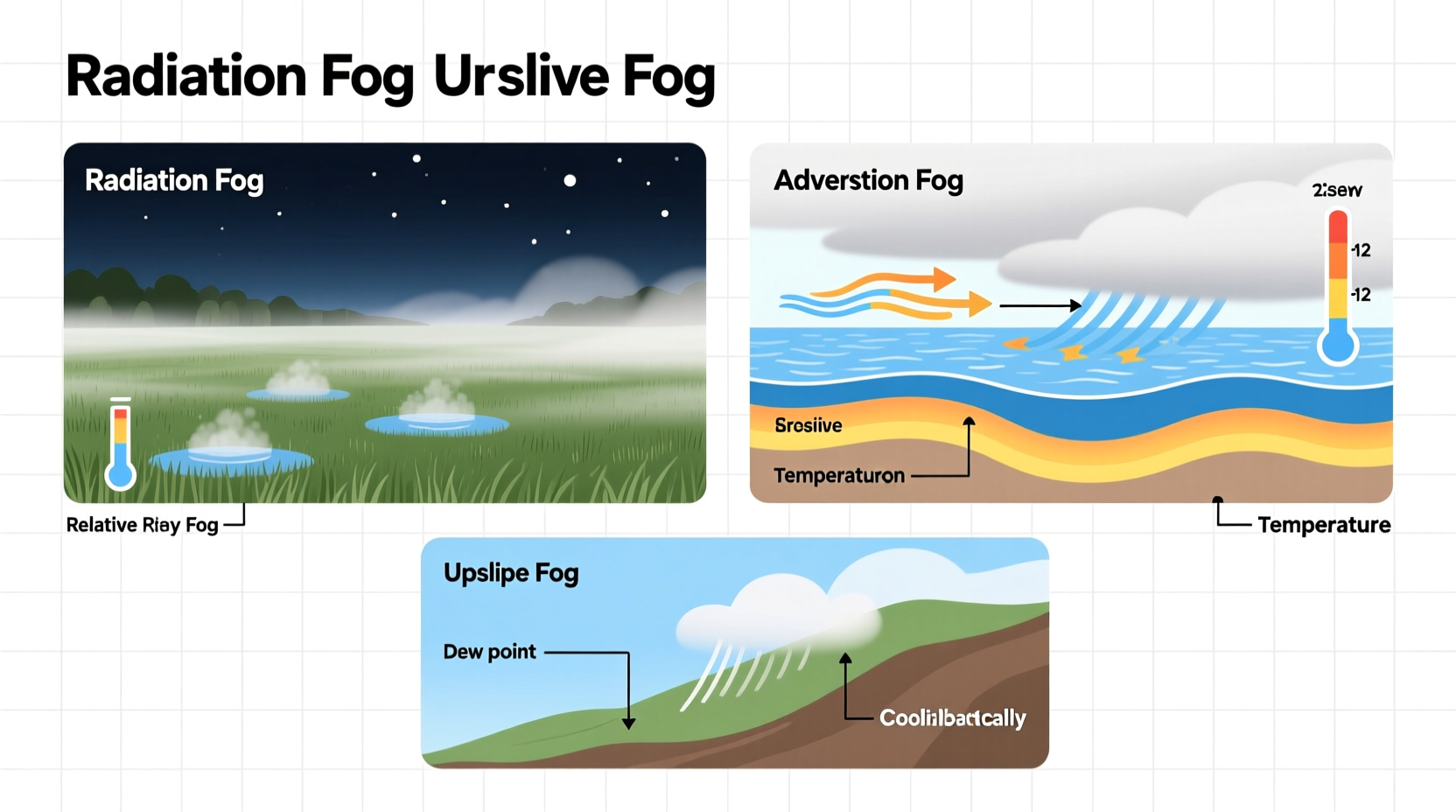
Fog forms when the air becomes saturated with moisture—meaning it reaches 100% relative humidity—and the excess water vapor condenses into liquid droplets. This process hinges on two key factors: cooling of the air and the presence of condensation nuclei (tiny particles like dust or salt that allow water vapor to cling and form droplets).
Cooling is the most common trigger. When air temperature drops to the dew point—the temperature at which air can no longer hold all its moisture—it begins to condense. Unlike rain, which involves falling droplets, fog consists of suspended droplets that remain aloft close to the ground. The thickness and duration of fog depend on how much moisture is present, how stable the atmosphere is, and whether wind or sunlight disrupts the layer.
It’s important to note that fog isn’t caused by “wet” air alone. Even dry regions can experience fog if the right combination of cooling and minimal moisture aligns. For example, radiation fog commonly forms on clear, calm nights in arid areas where rapid surface cooling occurs.
Main Types of Fog and How They Form
Not all fog is the same. Different atmospheric and geographic conditions give rise to distinct types of fog, each with unique characteristics and formation processes. The four primary types are radiation fog, advection fog, valley fog, and sea fog (a subtype of advection fog). Recognizing these types helps explain why fog appears in certain places and times.
Radiation Fog
This is the most common type of fog and typically forms on clear, calm nights. As the ground loses heat through longwave radiation, the air just above it cools rapidly. If the temperature drops to the dew point, fog develops. Radiation fog usually begins in low-lying areas like valleys and fields and dissipates after sunrise as the sun warms the surface.
It’s often referred to as \"ground fog\" when it's shallow, or \"tule fog\" in regions like California’s Central Valley, where it can be dense and persistent during winter months.
Advection Fog
Advection fog occurs when warm, moist air moves horizontally (advects) over a cooler surface—such as cold ocean currents or snow-covered ground. As the air mass cools from below, it reaches saturation and forms fog. This type is common along coastlines, particularly where warm tropical air meets cold upwelling waters.
A classic example is San Francisco’s famous summer fog, which rolls in from the Pacific Ocean as warm inland air pulls marine layer over the cool coastal shelf.
Valley Fog
This is essentially a prolonged form of radiation fog that gets trapped in mountain valleys. Cold, dense air sinks into low elevations, where it pools and remains stagnant, especially under high-pressure systems with little wind. Moisture accumulates overnight, and without solar heating or airflow to disperse it, the fog can linger for days during winter.
Regions like the Appalachian Mountains or the Swiss Alps frequently experience valley fog during colder months, sometimes reducing visibility to near zero.
Sea Fog (Marine Layer Fog)
A subset of advection fog, sea fog forms when warm, humid air moves over colder seawater. It’s prevalent in coastal zones and can extend several miles inland, especially when guided by onshore winds. Unlike radiation fog, sea fog can occur at any time of day and may persist even under partly cloudy skies.
In places like Nova Scotia or the Grand Banks off Newfoundland, sea fog is so frequent that it plays a role in local climate and maritime navigation hazards.
“Fog is not just an inconvenience—it’s a visible sign of delicate energy exchanges between the surface and the atmosphere.” — Dr. Lena Torres, Atmospheric Scientist, NOAA
Comparing Fog Types: When and Where They Occur
| Type | Formation Trigger | Common Locations | Typical Time of Day/Year |
|---|---|---|---|
| Radiation Fog | Ground cooling on clear, calm nights | Inland valleys, plains, agricultural areas | Night to early morning; autumn and winter |
| Advection Fog | Warm moist air moving over cold surface | Coastal regions, near cold ocean currents | Any time; common in spring and summer |
| Valley Fog | Cold air drainage and pooling in valleys | Mountainous terrain, enclosed basins | Persists for days; frequent in winter |
| Sea Fog | Marine air over cold ocean water | Coastal zones, offshore banks | Year-round, peaks in warmer months |
Real-World Example: The Tule Fog of California’s Central Valley
One of the most dangerous and persistent forms of radiation fog is tule fog, named after the tule grass wetlands of California. Each winter, after heavy rains and clear skies, this dense fog blankets the Central Valley, often reducing visibility to less than 100 feet. It forms when moist soil evaporates into the air, and nighttime radiative cooling brings temperatures down sharply.
In December 2021, a chain-reaction crash involving over 100 vehicles occurred on I-5 near Fresno due to sudden fog development. This tragic event highlighted how quickly radiation fog can form and how critical real-time weather monitoring is in such regions.
Meteorologists now use satellite data and surface observations to issue dense fog advisories, helping drivers and transportation agencies prepare. Local news stations broadcast fog forecasts daily during peak season, emphasizing slow driving and the use of low-beam headlights.
How to Predict and Respond to Fog
Understanding fog types allows individuals and professionals—from pilots to farmers—to anticipate its arrival. Here’s a practical checklist for recognizing and preparing for fog events:
- Monitor dew point spread: A small difference between air temperature and dew point (within 2–3°F) signals high humidity and potential fog.
- Check wind conditions: Light winds (1–5 mph) favor fog formation; strong winds mix air and prevent saturation.
- Observe sky conditions: Clear skies enhance radiative cooling, increasing chances of radiation fog.
- Watch coastal reports: Sudden drops in sea surface temperature can trigger advection fog within hours.
- Use reliable forecasts: Look for terms like “marine layer,” “fog bank,” or “low stratus” in weather bulletins.
FAQ: Common Questions About Fog
Can fog form in hot weather?
Yes. While fog is associated with cool conditions, it can form in warm climates when specific conditions align—such as warm, moist air moving over cold ocean currents (advection fog). Coastal Southern California often experiences summer fog despite high ambient temperatures.
Is fog dangerous?
Fog itself isn’t harmful, but it significantly reduces visibility, increasing risks for drivers, pilots, and mariners. Dense fog has been linked to multi-vehicle accidents and flight delays. In extreme cases, prolonged exposure to fog in polluted areas can concentrate airborne particles, affecting respiratory health.
Why does fog sometimes smell earthy?
The scent often noticed in fog, especially in rural or forested areas, comes from geosmin—a compound released by soil-dwelling bacteria. When fog settles, it enhances the perception of these natural odors, creating a damp, fresh aroma.
Conclusion: Seeing Clearly Through the Haze
Fog is far more than just misty air—it’s a dynamic meteorological phenomenon shaped by temperature, moisture, and terrain. Whether it’s the silent creep of radiation fog across a field or the rolling advance of sea fog along a coastline, each type tells a story of atmospheric balance. By understanding how and why fog forms, we gain better insight into local weather patterns and improve safety in transportation and outdoor activities.
Next time you encounter fog, observe its behavior. Is it lifting with the morning sun? Is it moving sideways with the breeze? These clues reveal the type of fog and the invisible forces at work. Stay informed, stay cautious, and appreciate the quiet beauty of this grounded cloud.




 浙公网安备
33010002000092号
浙公网安备
33010002000092号 浙B2-20120091-4
Comments
No comments yet. Why don't you start the discussion?