
Yawning is one of the most universal yet mysterious behaviors shared across species. Nearly everyone experiences it, and almost anyone can recall a moment when seeing someone yawn triggered an irresistible urge to do the same. This phenomenon—contagious yawning—is not just anecdotal; it’s been observed in humans, chimpanzees, dogs, and even birds. But why does it happen? Scientists have spent decades investigating the mechanisms behind this peculiar social reflex. While no single theory explains everything, multiple lines of research point to complex interactions between our brains, emotions, and evolutionary history.
The Neuroscience of Yawning: Mirror Neurons and Brain Activation
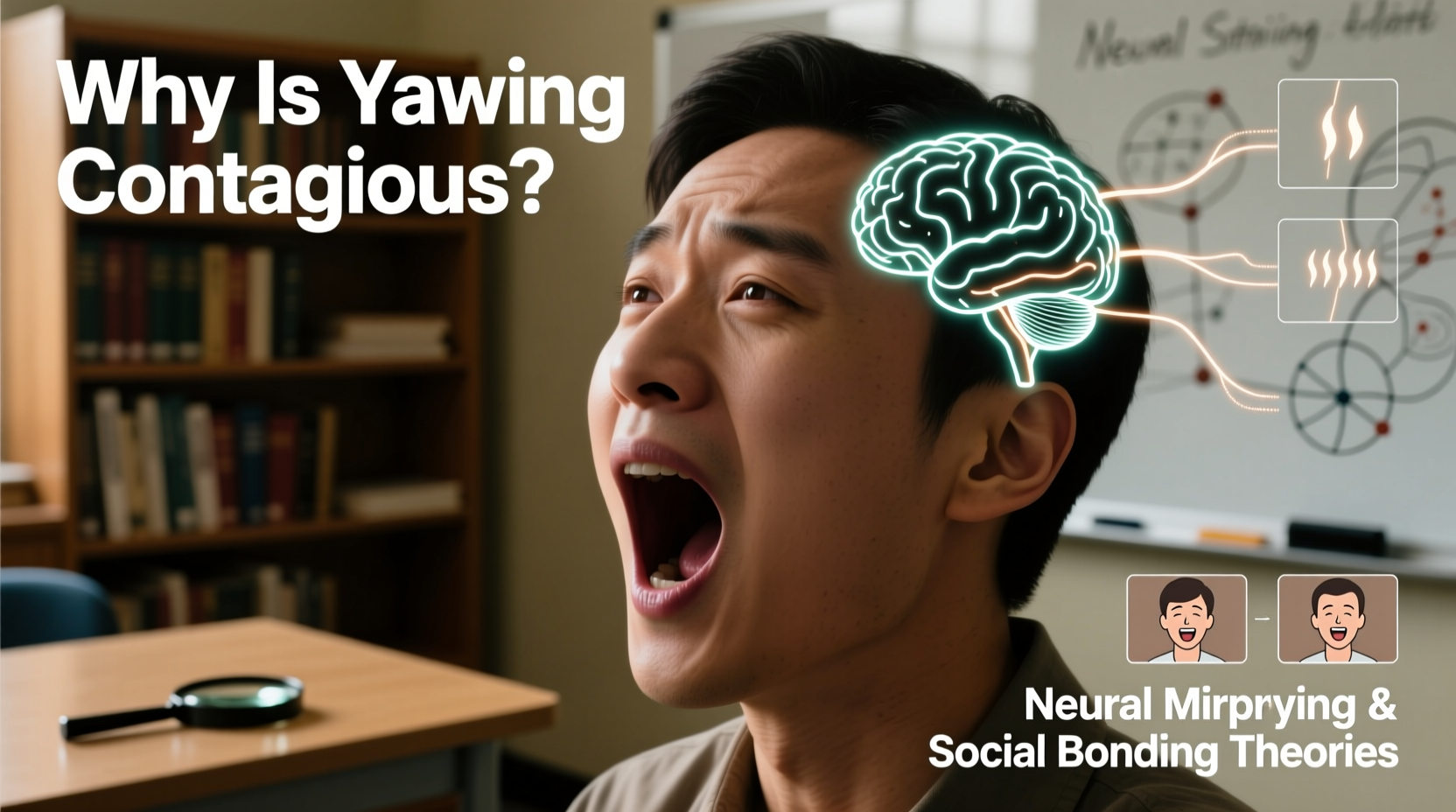
One of the most compelling explanations for contagious yawning lies in the brain's mirror neuron system. These specialized neurons fire both when we perform an action and when we observe someone else doing it. They are believed to play a crucial role in learning, imitation, and empathy.
When you see someone yawn, your mirror neurons may activate as if you were yawning yourself. Functional MRI studies have shown increased activity in brain regions associated with motor imitation—the premotor cortex and inferior frontal gyrus—during exposure to yawning stimuli. This neural mirroring appears to prime the body to replicate the observed behavior.
Interestingly, people with conditions that affect mirror neuron function, such as autism spectrum disorder (ASD), often show reduced susceptibility to contagious yawning. A 2017 study published in Personality and Individual Differences found that neurotypical individuals were significantly more likely to \"catch\" a yawn than those on the autism spectrum, supporting the idea that social cognition plays a key role.
“Contagious yawning may be a window into the social brain. It reflects our capacity to connect with others at a neurological level.” — Dr. Steven Platek, Cognitive Neuroscientist, University of Liverpool
Empathy and Social Bonding: The Emotional Connection
Beyond neural circuitry, another major theory links contagious yawning to empathy—the ability to understand and share the feelings of others. Research suggests that people who score higher on empathy scales are more likely to experience contagious yawning.
A landmark 2011 study conducted at the University of Pisa demonstrated that participants were more likely to yawn after watching videos of close friends or family members yawn compared to strangers. This “kinship effect” implies that emotional closeness enhances the contagion effect, reinforcing social bonds within groups.
This empathetic response may have evolved as a way to synchronize group behavior. In early human societies, aligning alertness levels—such as transitioning together from wakefulness to rest—could improve survival by ensuring coordinated vigilance against predators.
Further evidence comes from developmental psychology. Children typically don’t begin exhibiting contagious yawning until around age four or five, coinciding with the development of theory of mind—the understanding that others have thoughts and feelings different from their own. This delayed onset supports the idea that cognitive and emotional maturity are prerequisites for the phenomenon.
Do’s and Don’ts of Responding to Contagious Yawning
| Do’s | Don’ts |
|---|---|
| Recognize it as a natural, involuntary response | Feel embarrassed or apologize excessively |
| Use it as a cue to assess your energy levels | Suppress it forcefully, which may increase tension |
| Take a deep breath or stretch to counter drowsiness | Assume it always means you’re tired (it might be social) |
| Be mindful in high-focus environments like meetings | Blame others for \"making\" you yawn—it’s subconscious |
Evolutionary Perspectives: Survival and Synchronization
From an evolutionary standpoint, contagious yawning may have served practical functions long before modern social settings. One hypothesis posits that yawning helped regulate brain temperature. Studies using thermal imaging have shown that yawning increases blood flow to the skull and promotes cooling through jaw stretching and deep inhalation.
If yawning helps cool the brain, then its contagious nature could promote group-wide thermoregulation. For example, in hot climates or during periods of heightened mental exertion, synchronized yawning might help entire social units maintain optimal cognitive performance.
Another evolutionary model suggests that contagious yawning acted as a nonverbal signal of fatigue, prompting group coordination in sleep-wake cycles. Early humans living in tight-knit communities would benefit from aligning rest patterns to maximize safety and efficiency. A visible sign like yawning—especially when mirrored—could subtly communicate shifts in alertness without vocalizing and attracting predators.
This theory is supported by observations in animals. Chimpanzees yawn more frequently in response to familiar group members than outsiders. Similarly, domesticated dogs exhibit contagious yawning primarily in response to their owners, not strangers, indicating a bond-based mechanism rather than a general reflex.
Physiological Triggers vs. Social Cues
It’s important to distinguish between spontaneous yawning and contagious yawning. Spontaneous yawning occurs due to physiological needs—such as fatigue, boredom, or low oxygen levels—and serves internal regulatory functions. Contagious yawning, however, is triggered purely by external sensory input, usually visual or auditory.
Experiments show that even hearing a yawn—without seeing it—can induce yawning in about 50% of people. Reading about yawning or thinking about it can also trigger the response, suggesting a strong cognitive component.
Despite common belief, there’s little evidence linking contagious yawning directly to tiredness. In controlled studies, participants yawn just as often during the day as at night when exposed to yawning stimuli. This disconnect reinforces the idea that social and psychological factors outweigh physical ones in triggering the contagious effect.
Mini Case Study: The Office Meeting Effect
Sarah, a project manager at a tech startup, noticed a recurring pattern during afternoon team meetings. As soon as one person yawned—often while reviewing dense financial reports—within minutes, three or four others would follow suit. Initially concerned about morale, she began tracking occurrences over two weeks.
She realized the yawning rarely happened at the start of meetings but emerged midway, usually after someone stretched or rubbed their eyes. Curious, she introduced a five-minute movement break halfway through each session. The result? A 70% reduction in collective yawning episodes.
While not eliminating all contagious yawns, the intervention disrupted the visual feedback loop by reducing fatigue-related cues. More importantly, it highlighted how small environmental changes can influence unconscious group behaviors rooted in empathy and mimicry.
Alternative Theories and Ongoing Debates
While empathy and mirror neurons dominate current discourse, other theories persist:
- Stress Response Theory: Some researchers propose that yawning regulates arousal levels during transitions between states of alertness and calm. In this view, contagious yawning spreads a mild stress-reduction signal across a group.
- Pavlovian Conditioning: A minority argue that repeated association between yawning and sleepiness creates a learned response, making certain cues automatically trigger the behavior.
- Attentional Capture Model: This newer theory suggests that yawning captures attention due to its distinct motor pattern, increasing awareness of bodily states and inadvertently triggering similar responses.
No single explanation fully accounts for all aspects of the phenomenon. However, the convergence of neurological, emotional, and evolutionary data strongly favors a multi-factorial model where social connection plays a central role.
Expert Insight on Empathy and Imitation
“We’ve found that the strength of contagious yawning correlates with how closely people feel connected to the person they’re observing. It’s not just about seeing a yawn—it’s about feeling linked to another mind.” — Dr. Elisabetta Palagi, Behavioral Biologist, University of Pisa
Frequently Asked Questions
Is everyone susceptible to contagious yawning?
No. Approximately 40–60% of adults experience contagious yawning. Susceptibility varies based on empathy levels, age, and neurological factors. Children under four and individuals with autism spectrum disorder are less likely to \"catch\" yawns.
Can animals catch yawns from humans?
Yes. Dogs, chimpanzees, bonobos, and some bird species like budgerigars exhibit contagious yawning, especially in response to familiar humans or group members. This cross-species transmission underscores the deep evolutionary roots of the behavior.
Does covering your mouth stop others from catching your yawn?
Possibly. Since visual cues are the primary trigger, obscuring the full facial expression—particularly mouth opening and eye constriction—can reduce the likelihood of transmission. However, even partial glimpses or sounds may still activate mirror neurons.
Step-by-Step Guide to Managing Contagious Yawning in Professional Settings
While you can’t eliminate the instinct, you can minimize disruptions in formal environments:
- Stay Hydrated and Alert: Dehydration and mental fatigue increase baseline yawning. Drink water and take short breaks to stay sharp.
- Control Visual Exposure: If someone nearby yawns, gently shift your focus to notes, a screen, or your hands to avoid reinforcing the stimulus.
- Breathe Deeply Instead: When you feel the urge, take several slow, deep breaths. This mimics the physiological effect of yawning without the visible cue.
- Stretch Subtly: Gently roll your shoulders or stretch your neck to release tension without drawing attention.
- Break the Chain: In group settings, avoid reacting immediately to a yawn. Delaying your response—even by seconds—can prevent a cascade effect.
Practical Tips for Understanding and Responding to Contagious Yawning
- Recognize that yawning is not inherently rude—it’s an automatic, biologically ingrained response.
- In leadership roles, avoid interpreting group yawning as disinterest; it may reflect synchronization rather than boredom.
- Encourage movement breaks in long sessions to reset alertness and reduce fatigue-related cues.
- Teach children about empathy by discussing how we naturally respond to others’ actions, using yawning as a relatable example.
Conclusion: Embracing the Science Behind a Simple Act
Contagious yawning is far more than a quirky habit—it’s a window into human connection, brain function, and evolutionary adaptation. Whether driven by mirror neurons, empathy, or ancient survival strategies, this unassuming behavior reveals the depth of our social wiring. Understanding the science behind it doesn’t diminish its mystery; it enriches our appreciation for the subtle ways we influence one another every day.




 浙公网安备
33010002000092号
浙公网安备
33010002000092号 浙B2-20120091-4
Comments
No comments yet. Why don't you start the discussion?