
Sounds surround us every day—footsteps on a wooden floor, music through headphones, or even the distant rumble of thunder. Yet few consider how sound moves through different materials. One of the most consistent principles in acoustics is that sound travels fastest through solids, slower through liquids, and slowest through gases. This phenomenon isn't random; it's rooted deeply in the physical properties of matter. Understanding why sound moves more quickly in solids reveals fundamental truths about atomic interactions, energy transfer, and the nature of waves.
The Nature of Sound as a Mechanical Wave
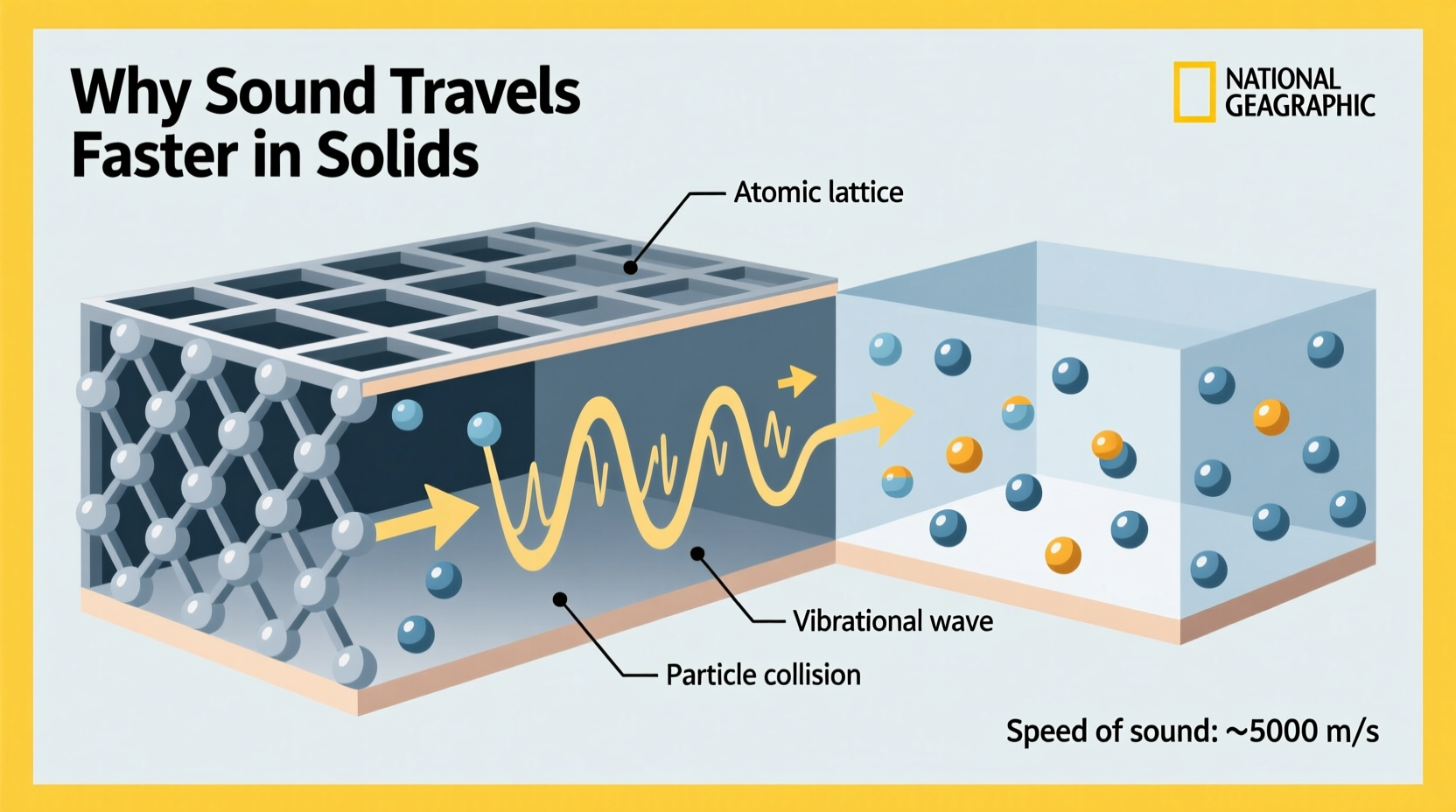
Sound is not an electromagnetic wave like light—it’s a mechanical wave that requires a medium to travel. It propagates by transferring energy from one particle to the next through vibrations. When a sound source vibrates—like a guitar string—it pushes nearby particles, which then collide with their neighbors, passing along the disturbance in a chain reaction. The speed at which this wave moves depends on how tightly packed the particles are and how strongly they interact.
In gases like air, molecules are far apart and interact weakly, so collisions take longer and energy transfer is inefficient. In liquids, molecules are closer, allowing faster transmission. But in solids, atoms or molecules are locked in a rigid structure, bonded tightly together. These strong intermolecular forces allow vibrations to be transmitted almost instantaneously from one particle to the next.
Molecular Structure and Elasticity: The Key Factors
The speed of sound in any material is determined by two primary physical properties: elasticity (or stiffness) and density. The relationship is captured in the formula:
v = √(K/ρ)
Where:
v = speed of sound,
K = elastic modulus (a measure of stiffness),
ρ (rho) = density of the material.
This equation shows that stiffer materials allow faster sound propagation, while higher density tends to slow it down. However, in solids, the increase in stiffness usually outweighs the effect of increased density. For example, steel is much denser than air, but its rigidity is so high that sound travels over 15 times faster in steel than in air.
Elasticity refers to a material’s ability to return to its original shape after being deformed. Solids, especially crystalline ones like metals or diamond, have highly ordered atomic lattices that efficiently transmit vibrational energy. When one atom vibrates, it pulls or pushes adjacent atoms due to strong covalent or metallic bonds, creating a rapid ripple effect.
“Solids act like networks of springs and masses—the tighter the springs (bonds), the faster the vibrations travel.” — Dr. Alan Reyes, Acoustics Researcher, MIT
Comparative Speeds Across States of Matter
To appreciate the difference, consider how fast sound travels in various media:
| Material | State | Speed of Sound (m/s) |
|---|---|---|
| Air (20°C) | Gas | 343 |
| Water (20°C) | Liquid | 1,482 |
| Granite | Solid | 5,950 |
| Steel | Solid | 5,960 |
| Diamond | Solid | 12,000 |
The data clearly shows that solids support significantly faster sound transmission. Diamond, one of the stiffest natural materials, allows sound to move at nearly 12 kilometers per second—over 35 times faster than in air. Even dense but less rigid materials like rubber transmit sound faster than air, though slower than metals due to lower elasticity.
Real-World Applications of Fast Sound Transmission in Solids
The principle that sound moves faster in solids isn’t just theoretical—it has practical implications across engineering, geology, and medicine.
In seismology, scientists analyze seismic waves generated by earthquakes. These waves travel through Earth’s layers, and their speed changes depending on whether they pass through solid rock or molten magma. By measuring arrival times at different locations, researchers can map the planet’s internal structure, including the solid inner core and liquid outer core.
Similarly, in non-destructive testing (NDT), engineers use ultrasonic waves to inspect metal welds, pipelines, or aircraft components. Because sound travels predictably through solids, anomalies like cracks or voids reflect or delay the waves, revealing flaws without damaging the material.
Medical ultrasound also benefits from this principle. While soft tissues behave somewhat like liquids, bones are solid and reflect sound waves strongly. This contrast allows imaging systems to distinguish between tissue types and create detailed internal images.
Mini Case Study: Detecting Pipeline Cracks Using Ultrasonic Testing
A natural gas company suspected structural weakness in an underground steel pipeline. Instead of excavation, technicians used ultrasonic sensors to send high-frequency sound pulses through the pipe wall. In healthy sections, the sound returned within expected timeframes. But in one segment, echoes arrived earlier than predicted, indicating a partial crack that altered wave reflection. The flaw was repaired before failure occurred, preventing environmental damage and saving millions. This success relied entirely on the predictable, high-speed transmission of sound through solid metal.
Common Misconceptions About Sound in Solids
One common misunderstanding is that sound travels faster in solids simply because particles are “closer together.” While proximity helps, it’s not the full story. If density were the only factor, lead—a very dense solid—would transmit sound faster than aluminum. But aluminum (speed: ~5,000 m/s) outperforms lead (~1,200 m/s) because it’s stiffer relative to its density.
Another myth is that loudness affects speed. In reality, amplitude (volume) doesn’t change how fast sound moves through a given medium under normal conditions. Whether a whisper or a shout, sound travels at the same speed in the same material at the same temperature and pressure.
Step-by-Step: How Sound Propagates Through a Solid
- Initiation: A disturbance (e.g., hammer strike) applies force to the surface of a solid.
- Vibration Transfer: Surface atoms vibrate and push against neighboring atoms via chemical bonds.
- Wave Formation: The disturbance creates a longitudinal wave (compression and rarefaction) moving through the lattice.
- Energy Conduction: Each atom oscillates slightly around its equilibrium point, transferring kinetic energy forward.
- Detection: The wave reaches a receiver (ear, sensor), where it’s interpreted as sound or data.
This entire process occurs in milliseconds, especially in stiff materials. The efficiency stems from minimal energy loss and direct coupling between atoms.
FAQ
Why doesn’t higher density in solids always mean faster sound?
While density plays a role, stiffness (elastic modulus) has a greater influence. A dense but soft material like rubber slows sound down because its weak internal bonds resist rapid vibration transfer.
Can sound travel in a vacuum?
No. Sound requires a medium with particles to transmit vibrations. In a vacuum, there are no molecules to carry the wave, so sound cannot propagate.
Do temperature changes affect sound speed in solids?
Yes, but less dramatically than in gases. In solids, higher temperatures can slightly reduce stiffness and increase atomic spacing, marginally decreasing sound speed. However, the effect is small compared to gases, where speed increases significantly with heat.
Checklist: Understanding Sound Speed in Materials
- Recognize that sound is a mechanical wave requiring a medium.
- Compare elasticity and density when evaluating transmission speed.
- Remember that bond strength in solids enables rapid energy transfer.
- Use the formula v = √(K/ρ) to estimate relative speeds.
- Apply knowledge to real fields like construction, medicine, or geophysics.
Conclusion
The reason sound travels faster in solids lies in the intimate, rigid connections between atoms. These tight bonds create an efficient network for transmitting vibrations—far more effective than the loose, sporadic collisions possible in gases. From diagnosing medical conditions to monitoring Earth’s core, this principle powers technologies that shape modern life. The next time you tap a table and hear the knock instantly, remember: you’re witnessing the power of structured matter at work.




 浙公网安备
33010002000092号
浙公网安备
33010002000092号 浙B2-20120091-4
Comments
No comments yet. Why don't you start the discussion?