
The founding of America is often romanticized as a bold experiment in liberty and self-governance. Yet beneath the familiar narratives of revolution and independence lies a complex web of motivations—economic, religious, political, and social—that drove European settlers across the Atlantic and eventually inspired thirteen colonies to break from Britain. Understanding why America was founded requires more than memorizing dates or battles; it demands an exploration of human ambition, oppression, and the pursuit of a new kind of society.
Religious Freedom: A Driving Force for Early Colonists
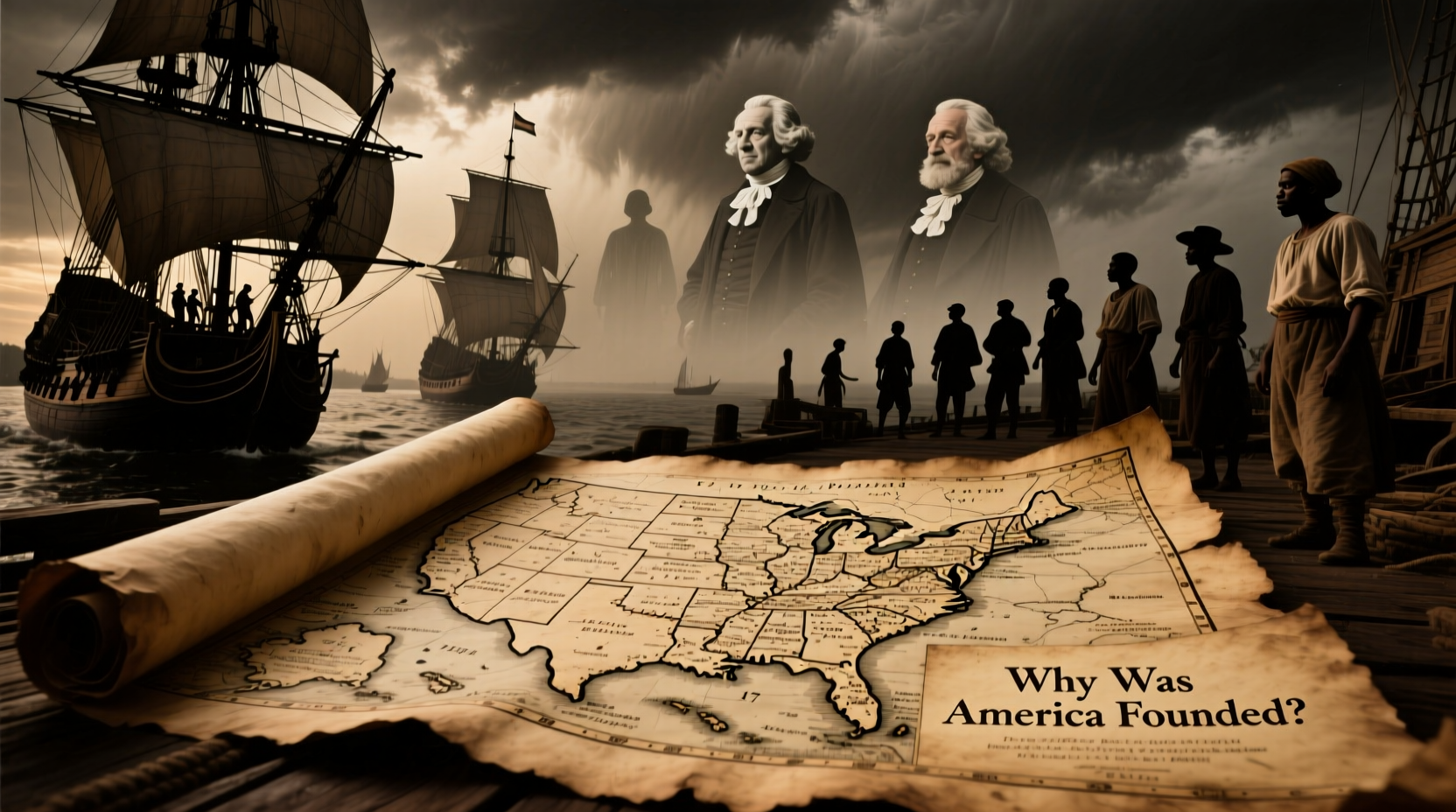
One of the earliest and most powerful motivations for settling in North America was the search for religious freedom. In 17th-century Europe, state-sponsored churches dominated public life, and dissenters faced persecution, imprisonment, or even execution. Groups like the Puritans and Pilgrims sought to practice their faith without interference, leading them to risk the perilous journey across the Atlantic.
The establishment of colonies such as Plymouth (1620) and Massachusetts Bay (1630) was rooted in this desire for spiritual autonomy. While these communities were not always tolerant of other beliefs—Puritan Massachusetts famously executed Quakers and banished dissenters like Roger Williams—their foundational principle was escape from religious tyranny.
“Men are not persecuted for being heretics, but for disturbing the peace by their opinions.” — John Winthrop, Governor of Massachusetts Bay Colony
Over time, other religious groups followed: Quakers founded Pennsylvania under William Penn’s vision of peaceful coexistence; Catholics established Maryland as a refuge; and waves of German Pietists, Huguenots, and Moravians created enclaves where faith could flourish away from European orthodoxy.
Economic Opportunity and Land Ownership
Beyond religion, economic incentives played a central role in colonization. England, though growing in power, faced overcrowding, limited social mobility, and widespread poverty. The promise of land—something unattainable for most commoners in Europe—attracted farmers, artisans, and laborers seeking upward mobility.
The Virginia Company’s founding of Jamestown in 1607 was explicitly profit-driven. Investors hoped to find gold or establish profitable trade routes. Though initial years brought famine and failure, the introduction of tobacco cultivation transformed the colony into an economic engine. This shift laid the foundation for plantation economies across the South, reliant on indentured servants and, increasingly, enslaved Africans.
In contrast, New England’s economy centered on fishing, shipbuilding, and small-scale farming. Here, family-owned plots allowed for greater independence, reinforcing values of self-reliance and civic participation.
| Region | Primary Economic Drivers | Social Structure |
|---|---|---|
| New England | Fishing, trade, crafts, subsistence farming | Small towns, literate populace, town meetings |
| Middle Colonies | Grain, livestock, diverse trade | Mixed population, moderate inequality |
| Southern Colonies | Tobacco, rice, indigo plantations | Elite planters, large enslaved populations |
Political Ideals and Enlightenment Influence
By the mid-18th century, colonial grievances against British rule began to crystallize around principles of governance. Though initially loyal subjects of the Crown, colonists grew frustrated with taxation without representation, arbitrary laws, and restrictions on westward expansion.
The Enlightenment profoundly shaped revolutionary thinking. Philosophers like John Locke argued that governments derive legitimacy from the consent of the governed and exist to protect natural rights—life, liberty, and property. These ideas resonated deeply among educated colonists, including Thomas Jefferson, James Madison, and Benjamin Franklin.
When Parliament imposed the Stamp Act (1765), Townshend Acts (1767), and Coercive Acts (1774), colonists responded not just with protests, but with reasoned arguments grounded in constitutional rights and legal precedent. Pamphlets like Thomas Paine’s *Common Sense* (1776) galvanized public opinion by framing independence as both a practical necessity and a moral imperative.
A Timeline of Key Political Developments Leading to Independence
- 1765: Stamp Act passed; first major tax on internal colonial transactions.
- 1770: Boston Massacre intensifies anti-British sentiment.
- 1773: Boston Tea Party protests tea tax; Britain responds with punitive measures.
- 1774: First Continental Congress convenes to coordinate resistance.
- 1775: Battles of Lexington and Concord mark the start of armed conflict.
- 1776: Declaration of Independence adopted on July 4.
The Role of Slavery and Contradictions in Founding Ideals
The founding of America cannot be fully understood without confronting its contradictions. While the Declaration of Independence proclaimed that “all men are created equal,” nearly one-fifth of the population was enslaved. Many Founding Fathers—including George Washington, Thomas Jefferson, and James Madison—owned slaves despite espousing liberty.
Slavery was economically entrenched, especially in the South, and its protection was written into the Constitution through clauses like the Three-Fifths Compromise and the Fugitive Slave Clause. Even Northern states that abolished slavery did so gradually, often over decades.
This paradox reveals a critical truth: America was founded not as a finished ideal, but as an aspirational project. The gap between rhetoric and reality would fuel future struggles—from abolitionism to civil rights movements—that redefined what America could become.
“I have sworn upon the altar of God eternal hostility against every form of tyranny over the mind of man.” — Thomas Jefferson
Mini Case Study: The Founding of Georgia
Established in 1732 under James Oglethorpe, Georgia stands out as a colony founded with explicit social reform goals. Unlike others driven primarily by profit or religion, Georgia was envisioned as a haven for Britain’s “worthy poor”—particularly debtors—and a buffer zone against Spanish Florida.
Oglethorpe banned slavery and large landholdings initially, hoping to create a society of small, independent farmers. However, economic pressures and settler demands led to the reversal of these policies by 1751. The case of Georgia illustrates how idealism often clashed with economic realities in colonial development.
FAQ
Was America founded solely for religious freedom?
No. While religious freedom motivated some early settlers—especially in New England and Pennsylvania—it was only one factor among many. Economic opportunity, land ownership, political autonomy, and imperial strategy were equally significant drivers across different regions and time periods.
Did all colonists support independence?
Far from it. Historians estimate that about one-third of colonists supported independence (Patriots), one-third remained loyal to Britain (Loyalists), and one-third were neutral or undecided. Civil tensions ran high, and families were often divided by allegiance.
What role did Native Americans play in the founding era?
Indigenous nations were active participants in colonial geopolitics, forming alliances with European powers and resisting encroachment. However, their sovereignty was largely ignored in the founding documents of the U.S. Westward expansion after independence led to displacement and conflict, undermining any notion of inclusive nation-building.
Actionable Checklist: Understanding the Motivations Behind America’s Founding
- ✅ Study the differences between regional colonial economies and how they shaped societal values.
- ✅ Read primary sources like the Declaration of Independence and *Common Sense* to identify key philosophical influences.
- ✅ Examine the role of Enlightenment thinkers in shaping revolutionary ideology.
- ✅ Acknowledge the contradiction between liberty rhetoric and the institution of slavery.
- ✅ Consider how local governance (e.g., town meetings, assemblies) fostered democratic habits before independence.
Conclusion
The founding of America was not the result of a single cause, but the convergence of multiple forces: the quest for religious expression, the lure of economic advancement, the evolution of political thought, and the realities of empire and exploitation. It was a moment shaped by both visionary ideals and deep human flaws.
To understand why America was founded is to recognize that nations are not born perfect, but through struggle, debate, and ongoing reinvention. The legacy of the founding continues to challenge each generation to narrow the gap between promise and practice.




 浙公网安备
33010002000092号
浙公网安备
33010002000092号 浙B2-20120091-4
Comments
No comments yet. Why don't you start the discussion?