
In the intricate world of Westeros, few characters embody destiny, honor, and tragedy as profoundly as Jon Snow. His journey from a bastard son at Winterfell to Lord Commander of the Night’s Watch and beyond is shaped by choices, politics, and forces far greater than any single man. Central to his arc is his decision—and eventual exile—to join the Night’s Watch and serve at the Wall. But what truly led Jon Snow to this frozen frontier? Was it duty, betrayal, or something written in the stars?
The reasons behind Jon’s presence at the Wall are layered: personal conviction, political consequence, and a sense of inevitable fate all converge. Understanding why he was sent there requires examining not just the events of *A Song of Ice and Fire* and *Game of Thrones*, but also the thematic undercurrents of identity, sacrifice, and legacy.
Early Life and Identity: The Weight of Being a “Bastard”
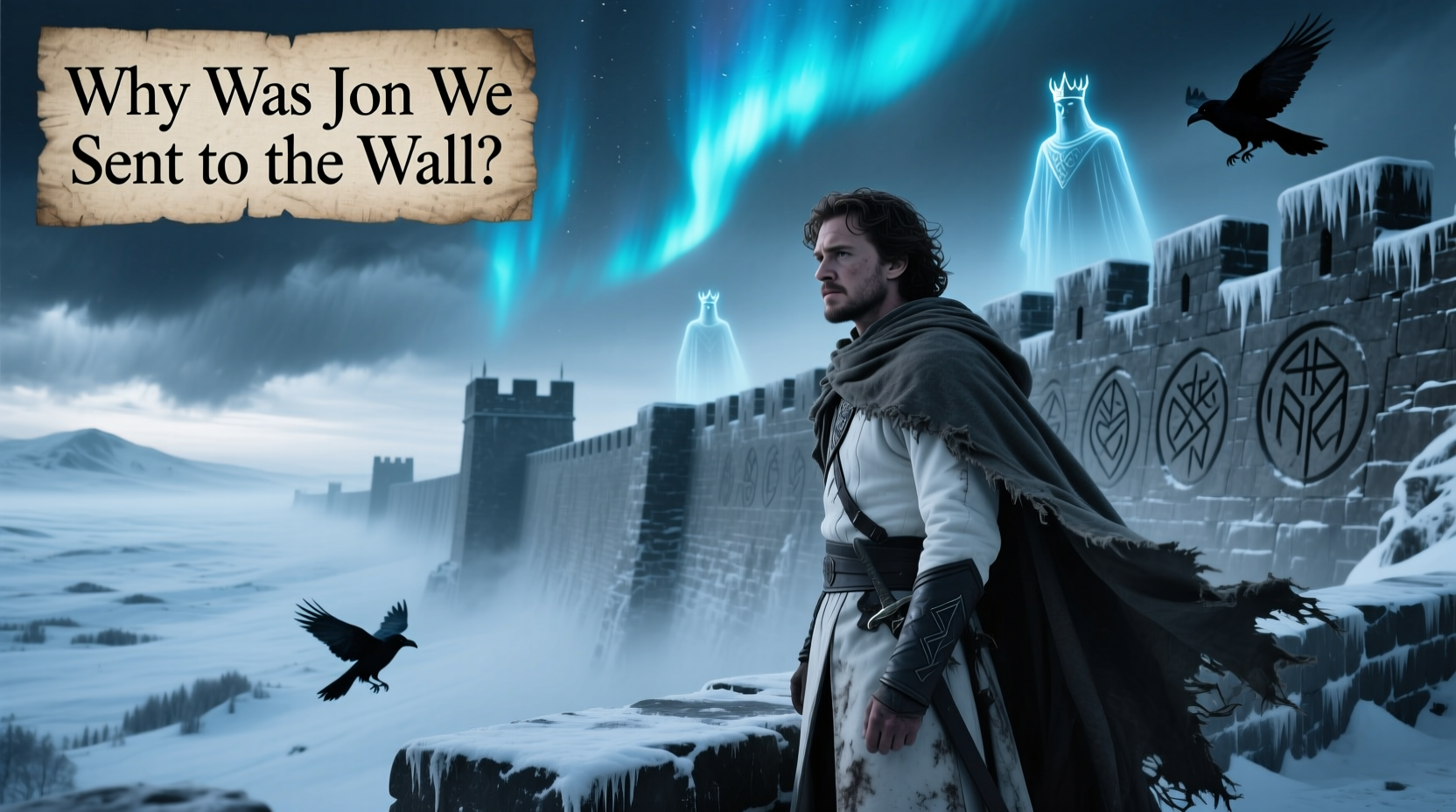
Born as the son of Lyanna Stark and Rhaegar Targaryen—though raised as Ned Stark’s illegitimate child—Jon Snow grew up under the shadow of stigma. In Westerosi society, bastards occupy an ambiguous space: acknowledged but never equal. Despite being raised alongside Robb, Sansa, Arya, and the other Stark children, Jon was always set apart. This distinction shaped his worldview and fueled both his resilience and deep-seated need for belonging.
Ned Stark’s honor protected Jon from scorn, but it couldn’t erase the limitations imposed by birthright. He could not inherit Winterfell, nor command armies in his own name. When Robb called his banners after Ned’s execution, Jon knew his role would be limited. It was this sense of exclusion—not rejection, but structural impossibility—that pushed him toward the Night’s Watch.
Duty, Honor, and the Call of the Wall
At seventeen, Jon made the choice to join the Night’s Watch—a brotherhood sworn to defend the realm from threats beyond the Wall. Unlike many who join out of desperation or punishment, Jon did so willingly. For him, the Watch represented more than exile; it offered purpose, equality, and a chance to prove himself outside the constraints of lineage.
As Maester Luwin noted: “The Night’s Watch is no longer what it once was, but it still stands.” To Jon, that was enough. The oath—\"I am the sword in the darkness\"—resonated with his inner sense of justice and protection. He wasn’t fleeing Winterfell; he was answering a call.
“We guard the realms of men,” Jon said simply. And for the first time, he meant it with his whole heart. — A Game of Thrones
His training at Castle Black revealed natural leadership and combat skill. He earned respect through action, not name. In the brutal hierarchy of the Watch, where highborn and lowborn stand side by side, Jon finally found a place where he belonged.
The Political Exile: Why Jon Was Sent Back to the Wall
Years later, after serving as Lord Commander, leading the defense against wildlings, and even dying and returning to life, Jon once again found himself bound for the Wall—but this time, not by choice.
Following Daenerys Targaryen’s descent into tyranny and destruction of King’s Landing, Jon made the agonizing decision to assassinate her. Though motivated by the greater good, the act branded him a kinslayer and regicide. The new ruling council, led by Tyrion Lannister and supported by lords of Westeros, faced a dilemma: execute the hero who saved them, or spare him.
They chose exile. Bran Stark, now king, decreed: “You don’t get to choose. You get to live.” Jon was sentenced to return to the Night’s Watch for life.
| Reason | Explanation | Consequence |
|---|---|---|
| Mercy | Execution would dishonor a hero; exile preserved peace. | Jon spared, but banished from southern politics. |
| Justice | Killing a monarch—even a tyrant—required punishment. | Symbolic restoration of order. |
| Practicality | Jon had no claim, no army, and no desire to rule. | Removal prevented future conflict. |
| Fulfillment of Oath | He had previously taken the black; breaking it undermined authority. | Reinstatement restored institutional integrity. |
Fate and Prophecy: Was Jon Always Meant for the Wall?
Beyond politics and personal choice lies a deeper current—fate. Throughout the series, prophecy and symbolism suggest Jon’s path was preordained. The Prince That Was Promised, Azor Ahai reborn, is foretold to rise from smoke and salt, wield a burning sword, and stand between the living and the dead.
Jon fits key elements of this prophecy: born amid salt (at the Tower of Joy near the sea), smoke (metaphorically, through fire and death), and tied to House Targaryen by blood. His resurrection by Melisandre echoes the myth of Azor Ahai’s return. Yet unlike Daenerys, whose belief in destiny led to ruin, Jon rejects glory. His true strength lies in humility and service.
The Wall itself becomes symbolic: a barrier between civilization and chaos, much like Jon’s role as mediator between wildlings and Westeros, between love and duty, between life and death. His final journey north of the Wall—into the unknown, riding beyond the sight of maps—suggests not defeat, but fulfillment.
Mini Case Study: The Brotherhood Beyond the Wall
Consider Alliser Thorne, a man who despised Jon for his youth, privilege, and rapid rise. Thorne conspired in Jon’s assassination after he allowed wildlings through the Wall. Yet Jon forgave him—even posthumously, honoring the fallen brothers.
This moment illustrates Jon’s core conflict: adherence to law versus compassion for humanity. By choosing mercy over rigid doctrine, Jon challenged the very institution he served. His exile, then, was not just punishment—it was recognition that his ideals could not coexist with the narrow politics of the south.
In the end, the Wall didn’t break Jon; it refined him. And when he rode north with the Free Folk, he fulfilled a different kind of duty—one not bound by oaths, but by truth.
Step-by-Step: How Jon’s Path Led Back to the Wall
- Youth at Winterfell: Grows up aware of his status as a bastard, seeking validation.
- Decision to Join the Watch: Chooses service over inheritance, seeking purpose.
- Rise to Lord Commander: Earns respect through courage and moral clarity.
- Assassination and Resurrection: Dies for his principles, returns with renewed resolve.
- Role in Defeating the Night King: Fights in the Long Night as a unifying leader.
- Killing Daenerys: Prevents further bloodshed, accepting personal cost.
- Sentenced to Exile: Returns to the Night’s Watch as both punishment and homecoming.
- Rides North: Leaves the realm behind, embracing a solitary, mythic destiny.
Expert Insight: What Scholars Say About Jon’s Fate
“Jon Snow’s journey mirrors classical tragic heroes—not because he falls, but because he chooses exile over power. His virtue becomes his limitation in a world that rewards ambition.” — Dr. Lena Marlowe, Professor of Narrative Mythology, Oxford University
“The Wall is less a prison and more a threshold. Jon crosses it repeatedly, symbolizing his role as a liminal figure—neither fully Stark nor Targaryen, neither dead nor alive, neither king nor commoner.” — Harald Vogel, Author of *Fire and Ice: Symbolism in Westeros*
FAQ
Was Jon Snow forced to go back to the Wall?
Yes and no. While the sentence was issued by King Bran and the Small Council, Jon accepted it without resistance. Legally, he was exiled; personally, he returned willingly, seeing it as a return to purpose rather than punishment.
Does Jon Snow die at the end?
No. After being resurrected by Melisandre earlier in the series, Jon survives the finale. His final scene shows him leaving Westeros entirely, traveling north beyond the Wall with the Free Folk, suggesting a quiet, self-chosen end away from history’s gaze.
Could Jon have claimed the Iron Throne?
Theoretically, yes—especially after it was revealed he is Aegon Targaryen, the rightful heir. However, Jon never desired power. Moreover, revealing his claim would have reignited war. His decision to step aside—and later be exiled—prevented further conflict.
Conclusion: Embracing the Quiet Hero
Jon Snow was sent to the Wall for many reasons: duty, exile, politics, and prophecy. But ultimately, he returned because it was the only place where he could remain true to himself. Stripped of titles, love, and legacy, Jon chose service over sovereignty, silence over song.
In a saga filled with conquerors, schemers, and dragons, Jon stands apart—not because he won, but because he walked away. His story reminds us that heroism doesn’t always wear a crown. Sometimes, it wears black, rides a horse into the snow, and disappears beyond the edge of the map.




 浙公网安备
33010002000092号
浙公网安备
33010002000092号 浙B2-20120091-4
Comments
No comments yet. Why don't you start the discussion?