
The Eiffel Tower stands as one of the most recognizable structures in the world—a symbol of Paris, France, and human ingenuity. Yet behind its elegant iron latticework lies a story of controversy, innovation, and national ambition. Built during a time of rapid industrial advancement, the tower was not always beloved. In fact, many Parisians initially despised it. Understanding why the Eiffel Tower was constructed requires delving into the historical, cultural, and technological currents of late 19th-century France.
A Monument for the 1889 Exposition Universelle
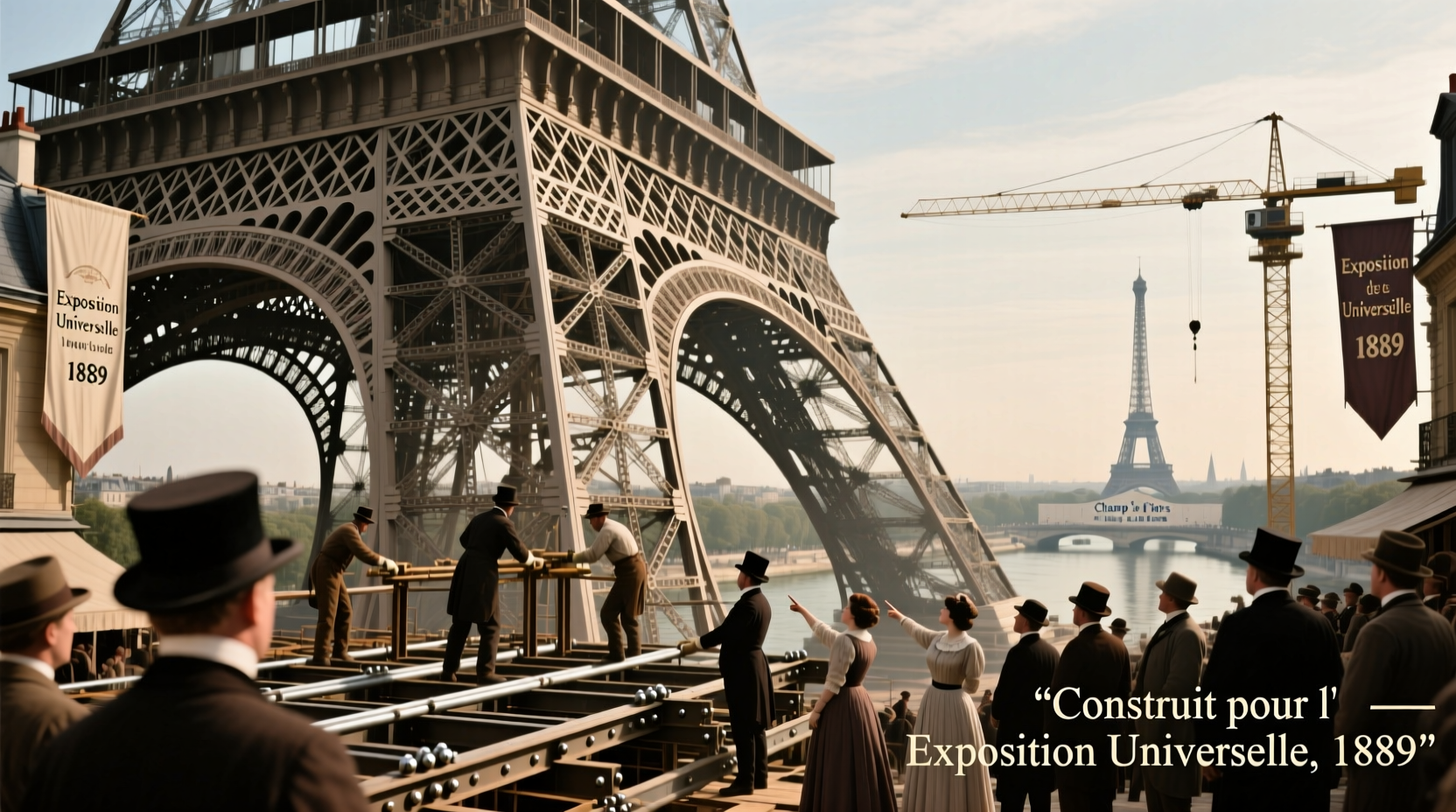
The primary reason for constructing the Eiffel Tower was to serve as the centerpiece for the 1889 Exposition Universelle (World’s Fair), held in Paris to celebrate the 100th anniversary of the French Revolution. The French government launched a competition in 1886 inviting engineers and architects to design an iron tower that would rise at least 300 meters—making it the tallest man-made structure in the world at the time.
Gustave Eiffel’s engineering firm, with key contributions from engineers Maurice Koechlin and Émile Nouguier, won the competition with a bold design: a wrought-iron lattice tower that combined structural efficiency with aesthetic daring. Though often attributed solely to Gustave Eiffel, the concept originated from his team’s calculations, refined under his leadership and business acumen.
Engineering Innovation and Industrial Pride
The construction of the Eiffel Tower represented a triumph of modern engineering. At 300 meters (later extended to 330 meters with antennas), it surpassed the Washington Monument as the tallest structure globally—a title it held until the Chrysler Building rose in New York in 1930.
What made the tower revolutionary was not just its height, but its use of prefabricated iron components. Over 18,000 pieces were manufactured off-site and assembled with precision using over 2.5 million rivets. The entire structure weighs approximately 10,100 tons, yet its open framework allows wind to pass through, minimizing structural stress.
This feat demonstrated France’s leadership in industrial technology. At a time when nations competed through grand displays of progress, the Eiffel Tower was both a functional demonstration of metallurgical skill and a statement of national pride.
“The tower will be the tallest edifice ever erected by man. Will it not also be grand in its own way? And why would something admirable in Egypt become hideous and ridiculous in Paris?” — Gustave Eiffel, defending the design against critics
Controversy and Public Backlash
Despite its technical brilliance, the Eiffel Tower faced fierce opposition before and during construction. Leading artists and intellectuals of Paris—including writer Guy de Maupassant, composer Charles Gounod, and architect Charles Garnier—signed a petition titled “Artists Against the Eiffel Tower,” calling it a “gigantic black smokestack” and a “dishonor to Paris.”
Critics argued that the industrial aesthetic clashed with the city’s classical architecture. They feared the tower would overshadow landmarks like Notre-Dame and the Arc de Triomphe. Some even predicted it would collapse or attract lightning strikes that endangered nearby residents.
Yet public opinion shifted once the tower opened. Visitors were awestruck by the panoramic views from its platforms. Over 2 million people visited during the 1889 exposition, turning skepticism into fascination. What began as a temporary installation—originally slated for demolition in 1909—was saved due to its growing popularity and emerging utility in telecommunications.
From Temporary Exhibit to Permanent Landmark
The Eiffel Tower was intended to stand for only 20 years. However, its value expanded beyond symbolism. By the early 20th century, it became crucial for radio transmission. In 1909, the French military established a radio telegraph station at its base, proving its strategic importance. During World War I, it intercepted enemy communications and jammed German signals, playing a direct role in national defense.
This practical function ensured its survival. Over time, the tower evolved into a cultural icon—appearing in films, literature, and art. It has hosted scientific experiments, daredevil stunts, and even a post office and restaurant. Today, it is one of the most visited paid monuments in the world, attracting nearly 7 million visitors annually.
Timeline of Key Events
- 1886: Design competition launched for the 1889 World’s Fair centerpiece.
- 1887: Construction begins on January 28; protests intensify among Parisian elites.
- 1889: Tower opens March 31, coinciding with the Exposition Universelle.
- 1909: Scheduled for demolition, but spared due to its radio communication capabilities.
- 1914–1918: Used for military signaling during World War I.
- 1925: Illuminated with 250,000 light bulbs for a publicity stunt by Citroën.
- Present: Recognized as a UNESCO World Heritage site and enduring symbol of France.
Purpose Beyond Aesthetics: Scientific and Practical Uses
Beyond its symbolic and touristic roles, the Eiffel Tower served multiple scientific purposes during its early decades:
- Meteorological studies: Instruments were installed to measure wind, temperature, and air pressure at various altitudes.
- Physics experiments: Scientists used the tower to study free fall, gravity, and pendulum motion.
- Radio broadcasting: Became a vital antenna for transmitting signals across Europe.
- Aerodynamics testing: Gustave Eiffel funded wind tunnel research at the tower’s base, advancing early aviation science.
These applications helped justify its continued existence and transformed it from a controversial spectacle into a hub of innovation.
| Aspect | Original Purpose | Long-Term Role |
|---|---|---|
| Height & Design | Showcase engineering prowess | Icon of architectural modernity |
| Location | Entrance arch to 1889 Expo | Central landmark of Paris |
| Public Reception | Widespread criticism | National and global admiration |
| Technology Use | Limited to observation decks | Radio, TV, digital broadcasting |
| Lifespan | Temporary (20 years) | Permanent cultural monument |
Mini Case Study: The Tower That Almost Wasn’t
In 1909, the lease for the Eiffel Tower expired, and demolition appeared inevitable. City officials saw it as an eyesore with no lasting function. However, the French military intervened, recognizing its potential as a radio transmission tower. During trials, signals from the Eiffel Tower successfully reached distances over 4,000 kilometers, far exceeding ground-based stations.
With the outbreak of World War I just five years later, this capability proved invaluable. The tower intercepted coded messages from Berlin and disrupted enemy communications during the First Battle of the Marne. This real-world impact sealed its fate—not as a relic of a past fair, but as a strategic national asset.
Frequently Asked Questions
Was the Eiffel Tower always meant to be permanent?
No. It was originally permitted for only 20 years, set for demolition in 1909. Its survival was due to its usefulness in radio communications and growing public affection.
Why is the Eiffel Tower painted every seven years?
The tower is repainted to prevent rust and corrosion. Each repaint uses about 60 tons of paint. The color has changed subtly over time—from reddish-brown to yellow-ochre and now a custom “Eiffel Tower Brown,” applied in graduated tones for visual harmony.
Did Gustave Eiffel profit from the tower?
Yes. Under the agreement, Eiffel financed 80% of the construction in exchange for full operating rights to ticket sales and commercial use for 20 years. He recouped most of his investment during the 1889 exposition and subsequent tourism boom.
Conclusion: A Legacy Forged in Iron and Vision
The Eiffel Tower was constructed not merely as a spectacle, but as a bold declaration of France’s place in the modern world. Born from a World’s Fair commission, challenged by critics, and nearly dismantled, it endured because it adapted—serving science, communication, and ultimately, the collective imagination.
Today, it stands not just as a monument to engineering, but as proof that visionary ideas can overcome resistance when they combine utility with inspiration. Whether admired from the Champ de Mars or studied as a marvel of structural design, the Eiffel Tower remains a testament to what humanity can achieve when ambition meets innovation.




 浙公网安备
33010002000092号
浙公网安备
33010002000092号 浙B2-20120091-4
Comments
No comments yet. Why don't you start the discussion?