
Every morning begins with the same ritual: checking your phone’s battery level. For many, that means deciding whether to grab a charging cable or drop the phone onto a wireless pad. While both methods power up your device, they differ significantly in speed, efficiency, and practicality—especially when time is tight and you need a quick boost before heading out. Understanding the real differences between wireless charging pads and traditional cables isn’t just about tech specs; it’s about choosing what works best for your lifestyle.
Despite the sleek appeal of wireless charging, the reality is more nuanced than marketing suggests. While convenience has improved dramatically, physics still governs how quickly energy transfers to your phone. This article breaks down the key factors affecting charge speed, compares real-world performance, and helps you decide which method suits your daily routine—without relying on hype or oversimplified claims.
How Charging Speed Actually Works
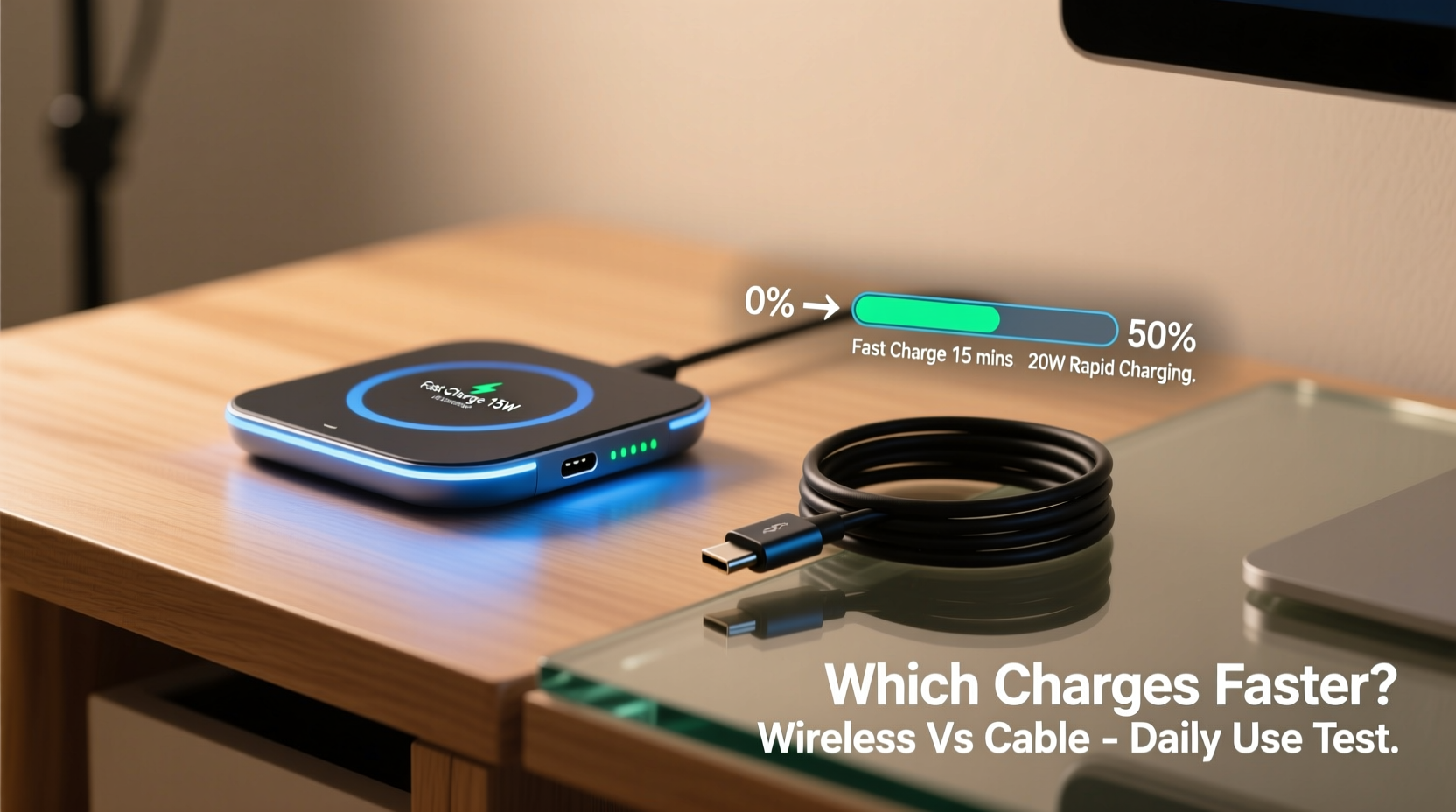
Charging speed depends on three main elements: power output (measured in watts), voltage regulation, and energy loss during transfer. Wired connections deliver electricity directly through metal contacts, minimizing resistance and maximizing efficiency. Wireless charging, by contrast, relies on electromagnetic induction—transferring energy across an air gap between the pad and the phone’s internal coil. This process inherently generates heat and loses some energy as radiation, reducing overall efficiency.
Modern smartphones support various fast-charging standards, such as USB Power Delivery (USB-PD) or Qualcomm Quick Charge. These can deliver up to 30W or more over a wired connection, enabling a 50% charge in under 30 minutes on compatible devices. Most wireless chargers, however, max out at 7.5W (iPhone) or 15W (select Android models like Samsung Galaxy), even if marketed as “fast.” Some premium options reach 30W wirelessly, but only under ideal conditions and with specific phone-case combinations.
“Even high-end wireless systems lose 20–30% more energy than wired equivalents due to inefficiencies in induction. That translates directly into slower charging.” — Dr. Lena Park, Electrical Engineer at Mobile Power Labs
Wired Charging: The Speed Champion
Cables remain the fastest way to charge most smartphones. A standard USB-C to USB-C cable paired with a 20W+ adapter delivers consistent, reliable power with minimal energy waste. High-performance setups—like those using GaN (gallium nitride) chargers—can push 65W or more, useful not only for phones but also tablets and laptops.
The direct physical connection ensures stable voltage delivery, allowing adaptive charging algorithms in modern phones to ramp up input safely. Many manufacturers design their fastest charging speeds exclusively for wired use. For example, OnePlus’ Warp Charge and Xiaomi’s HyperCharge achieve peak speeds only via cable.
Another advantage of wired charging is flexibility. You can use your phone while it charges—watch videos, reply to messages, or navigate—without disrupting the connection. This makes cables ideal for overnight charging, travel, or emergency top-ups when every minute counts.
Wireless Charging: Convenience Over Speed
Wireless pads excel in user experience, not performance. Placing your phone face-up on a pad feels effortless compared to fumbling with a cable, especially in low light or while multitasking. It also reduces wear on the charging port, which can accumulate lint or suffer mechanical damage over time.
However, convenience comes at a cost. Even Qi-certified 15W wireless chargers typically take 20–40% longer than equivalent wired setups. In real-world tests, an iPhone 15 charged from 20% to 80% in 48 minutes via cable but took 72 minutes wirelessly. Similarly, a Samsung Galaxy S24 reached 80% in 35 minutes with a cable versus 58 minutes on a 15W pad.
Performance drops further if the phone isn’t perfectly aligned or if it’s inside a thick case. Metal cases or magnetic accessories can interfere with induction, forcing the system to reduce power or disconnect entirely. Heat buildup is another issue—both the phone and charger get noticeably warmer, prompting thermal throttling that slows charging mid-cycle.
Direct Comparison: Key Differences in Daily Use
| Factor | Wired Charging | Wireless Charging Pad |
|---|---|---|
| Average Charge Time (20% → 80%) | 30–50 minutes | 50–80 minutes |
| Max Supported Power | Up to 65W (device-dependent) | 7.5W–30W (limited availability) |
| Energy Efficiency | ~90–95% | ~70–75% |
| Phone Usability During Charge | Full access | Limited (must stay flat) |
| Durability & Port Wear | Port may degrade over years | No physical wear |
| Setup Flexibility | Cable length limits placement | Must be within close range |
This table highlights the trade-offs. If speed and efficiency are priorities—say, during a rushed morning or after a long day with a drained battery—wired charging wins decisively. But if you value simplicity and consistency, particularly in fixed locations like your nightstand or desk, wireless may better fit your habits.
Real-World Scenario: Morning Rush Hour
Consider Sarah, a marketing manager who wakes up to a 15% battery. She has 45 minutes before leaving for work. Her options:
- Option A – Wireless Pad: She places her phone on the bedside charger while getting ready. After 40 minutes, it reaches 58%. Enough to last until lunch, but not ideal for GPS navigation or calls.
- Option B – Cable: She plugs in while brushing her teeth. By the time she’s dressed and eating breakfast, the phone is at 75%. With five extra minutes connected, it hits 90%, giving her confidence throughout the commute.
In this common scenario, the cable provides nearly twice the charge in the same timeframe. The difference becomes critical when unplanned delays arise or when the phone must serve as a hotspot or navigation tool immediately after waking.
When Wireless Makes Sense
Despite its speed disadvantage, wireless charging shines in specific contexts. At home or in the office, where devices spend hours stationary, the slower rate matters less. Drop your phone on the pad when you walk in, and it’ll be fully charged by the time you need it again. Nightstands, car consoles, and kitchen counters benefit from clutter-free charging zones.
Multi-device users also gain from wireless ecosystems. Modern charging pads support simultaneous charging for phones, earbuds, and smartwatches. Apple’s MagSafe ecosystem and Samsung’s Wireless Charger Trio exemplify this trend, offering seamless integration without managing multiple cables.
Step-by-Step Guide: Optimizing Your Daily Charging Strategy
- Evaluate your routine: Track when and where you charge your phone. Are most sessions short and urgent, or long and predictable?
- Test both methods: Time how long each takes to charge from 20% to 80% under normal conditions.
- Invest in quality gear: Use a reputable 20W+ USB-C PD charger and certified cable for maximum wired speed. For wireless, choose a Qi2-compatible pad with foreign object detection.
- Position strategically: Place wireless pads in high-dwell areas (bedside, desk). Keep cables near exits or in bags for on-the-go use.
- Monitor temperature: Avoid charging on soft surfaces (beds, couches) that trap heat, especially wirelessly.
- Rotate usage: Use wireless overnight and wired during mornings or travel days.
Frequently Asked Questions
Does wireless charging damage my phone’s battery over time?
No more than wired charging when done properly. However, because wireless generates more heat, prolonged exposure can accelerate battery aging. Enabling optimized charging modes (like iOS’s “Battery Health”) helps mitigate this by slowing the final charge phase.
Can I use any wireless charger with my phone?
Most modern smartphones support the Qi standard, so basic compatibility is widespread. However, fast charging (e.g., 15W) often requires matching the manufacturer’s recommended pad. iPhones, for instance, charge at only 7.5W unless using MagSafe-certified hardware.
Why does my wireless charger sometimes stop charging randomly?
This usually happens due to misalignment, overheating, or interference from thick or metallic cases. Remove the case temporarily or reposition the phone. Also ensure no metal objects (keys, coins) are between the phone and pad.
Expert Insight: Balancing Innovation and Practicality
“The future might bring resonant charging or room-scale solutions, but today’s wireless tech is still catching up to wires in performance. Consumers should see it as a lifestyle enhancement, not a replacement.” — Rajiv Mehta, Senior Analyst at TechPower Review
Engineers continue refining wireless efficiency, with new standards like Qi2 improving alignment and power delivery. But fundamental limitations remain. Until breakthroughs in energy transfer occur, cables will maintain their edge in speed and reliability.
Final Recommendation: Match Method to Moment
There’s no universal winner between wireless charging pads and cables. The answer depends on your needs in the moment. For rapid charging—when time is limited and performance matters—cables are unmatched. They offer faster speeds, greater efficiency, and full usability during charging.
Wireless pads, meanwhile, win on convenience and aesthetics. They’re perfect for low-pressure environments where you can afford to wait, or when ease of use outweighs urgency. The smartest approach is hybrid: leverage both technologies based on context.
Think of it like footwear: sneakers for running, slippers for lounging. One isn’t better than the other—they serve different purposes. Apply the same logic to charging. Keep a fast cable in your bag and car. Use a wireless pad at home. Let each tool do what it does best.




 浙公网安备
33010002000092号
浙公网安备
33010002000092号 浙B2-20120091-4
Comments
No comments yet. Why don't you start the discussion?