
When choosing between the Xbox Series X and the PlayStation 5, one of the most overlooked yet critical factors is backward compatibility. Gamers who have invested years into building libraries across previous console generations want assurance that their favorite titles won’t be left behind. While both consoles offer access to older games, the scope, depth, and functionality differ significantly. Understanding these differences can influence your decision—especially if preserving legacy gameplay is a priority.
The Evolution of Backward Compatibility in Modern Consoles
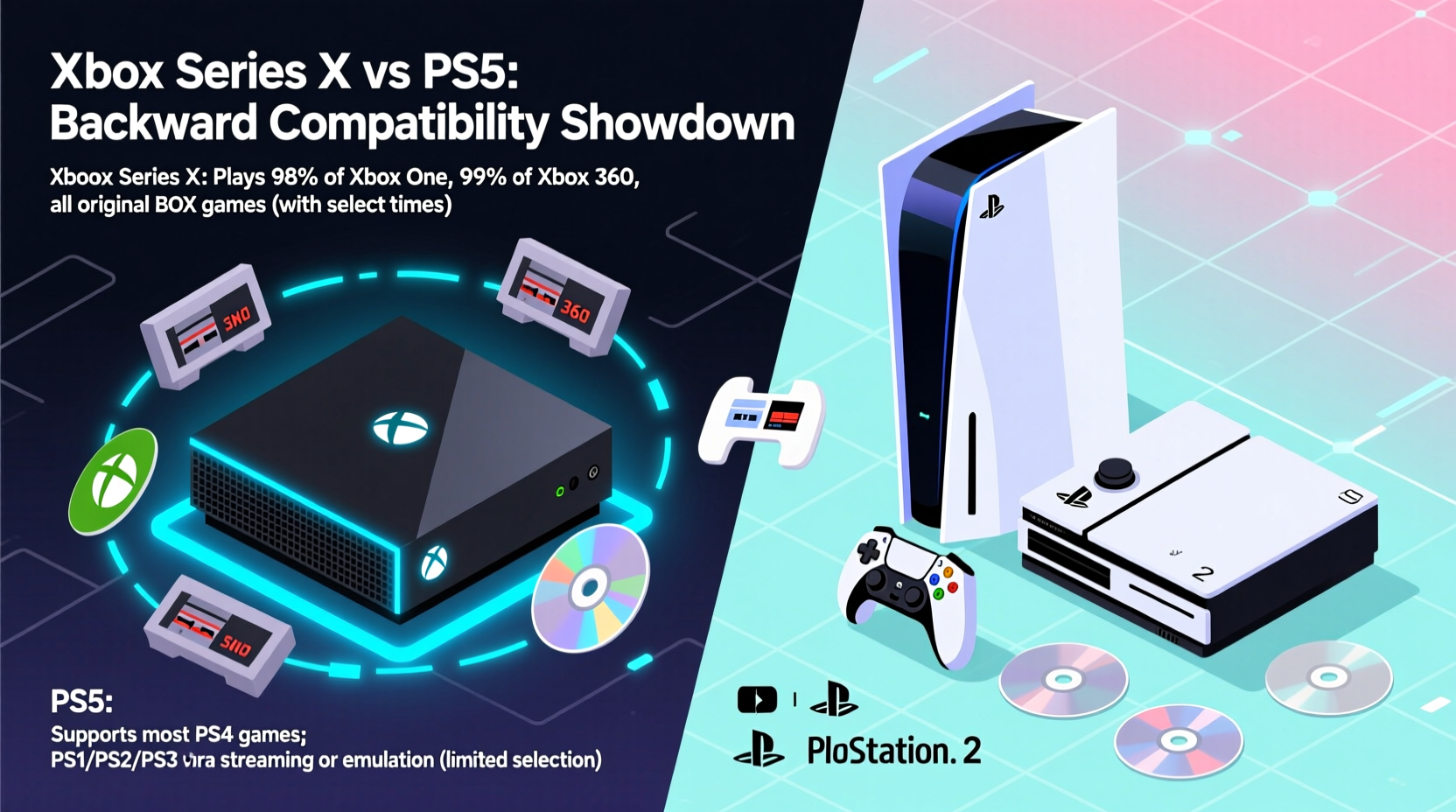
Backward compatibility is no longer a luxury—it’s an expectation. As gaming libraries grow more expansive, players demand continuity. The Xbox Series X and PS5 represent two distinct philosophies in how legacy content is preserved and enhanced.
Xbox has long championed backward compatibility as a core feature. Since the original Xbox 360 era, Microsoft has steadily built systems that allow users to carry forward their digital investments. The Xbox Series X takes this further with Smart Delivery and a robust compatibility layer that supports thousands of titles from three previous generations: Xbox One, Xbox 360, and the original Xbox.
Sony, on the other hand, has taken a more curated approach. The PS5 supports only PS4 games natively. There is no official support for PS3, PS2, or PS1 titles through direct disc insertion or local file loading. Instead, Sony relies on its PlayStation Plus Premium subscription service to offer select older games via cloud streaming or downloadable emulated versions.
Scope of Supported Games: Generations Covered
The breadth of supported titles is where the two platforms diverge most dramatically.
The Xbox Series X supports over 600 backward compatible titles from the original Xbox and Xbox 360, with many optimized for faster load times, higher frame rates, and improved resolutions up to 4K. These optimizations are part of Microsoft’s \"Enhanced\" program, which applies patches automatically when available. Even games without specific enhancements benefit from system-level improvements like Auto HDR and Quick Resume.
In contrast, the PS5 supports every digitally purchased or physically owned PS4 game, provided it isn't region-locked or explicitly excluded. This includes critically acclaimed exclusives like *The Last of Us Part II*, *Ghost of Tsushima*, and *Marvel's Spider-Man*. However, anything prior to PS4 requires either remastering (e.g., *The Last of Us Remastered*) or inclusion in the PlayStation Plus Classics Catalog—a limited, rotating selection of PS2, PS3, and PSP games.
“Microsoft’s commitment to backward compatibility sets a new standard in consumer respect for legacy content.” — Jason Schreier, Bloomberg News, gaming industry analyst
Performance Enhancements and Technical Advantages
It’s not enough to merely run old games; how well they perform matters. Both consoles leverage their powerful hardware to improve legacy titles, but the implementation varies.
On the Xbox Series X, backward compatible games benefit from:
- **Auto HDR**: Applies high dynamic range lighting to games not originally designed for it.
- **FPS Boost**: Doubles or triples frame rates in select titles (e.g., *Fallout 4* runs at 60 FPS instead of 30).
- **Resolution upscaling**: Many Xbox 360 and original Xbox titles render at higher internal resolutions.
- **Faster load times**: Thanks to the custom NVMe SSD, even decade-old games load significantly quicker.
The PS5 improves PS4 games through:
- **Game Boost**: Automatically increases performance for select titles by allowing higher or more stable frame rates.
- **Near-instant loading**: The SSD drastically reduces load times in supported games.
- **Activity Cards**: Offers quick resume-like functionality for certain PS4 titles.
However, these benefits apply only to PS4 games. For older generations, performance depends entirely on emulation quality within the PlayStation Plus app—and not all regions even have access to the full catalog.
Detailed Comparison Table: Key Backward Compatibility Features
| Feature | Xbox Series X | PS5 |
|---|---|---|
| Supported Generations | Xbox, Xbox 360, Xbox One | PS4 only |
| Total Backward Compatible Titles | 600+ (with enhancements) | All ~4,000 PS4 titles + ~40 curated classics via subscription |
| Physical Disc Support (Older Gen) | Xbox 360 & original Xbox discs supported (select titles) | PS4 discs only; no PS3/PS2 disc support |
| FPS Boost / Performance Upgrades | Yes – official FPS Boost program | Limited – Game Boost for select PS4 titles |
| Auto HDR | Yes – applied to many older titles | No – only native HDR titles |
| Cloud Streaming Required? | No – all games run locally | Yes – PS3 games require streaming (where available) |
| Free Access to Old Games | Yes – if you own them digitally or on disc | Only PS4 games; older titles require PS+ Premium ($17.99/month) |
Real-World Example: A Gamer’s Library Migration
Consider Alex, a longtime gamer with a collection spanning 15 years. He owns over 80 physical and digital games across Xbox 360, PS3, and PS4 platforms. When upgrading to a next-gen console, his priorities include retaining access to *Red Dead Redemption* (original Xbox 360), *The Orange Box*, and *Uncharted: The Nathan Drake Collection*.
With the Xbox Series X, Alex inserts his original Xbox 360 copy of *Red Dead Redemption*. The game launches instantly, now running at 4K resolution with 60 FPS thanks to Microsoft’s FPS Boost update. *The Orange Box* benefits from Auto HDR, making textures pop on his modern OLED TV. All progress syncs via cloud save.
If he chose the PS5, Alex could play *Uncharted: The Nathan Drake Collection* seamlessly—after inserting the PS4 disc. But his PS3 copy of the original *Uncharted* remains unusable unless he subscribes to PlayStation Plus Premium and finds it in the current classics lineup. Even then, playback depends on internet stability for cloud streaming.
In this scenario, the Xbox Series X clearly offers broader, more reliable access to legacy content without recurring fees or technical limitations.
Practical Checklist: Evaluating Your Needs
Use this checklist to determine which console aligns best with your backward compatibility expectations:
- ✅ Do you own games from Xbox, Xbox 360, or early digital Xbox One titles?
- ✅ Are you looking for free, local access to older games without subscriptions?
- ✅ Do you value performance upgrades like higher FPS or Auto HDR in classic titles?
- ✅ Is owning physical media important for your collection?
- ✅ Are most of your favorite older games from the PS4 era?
- ✅ Are you comfortable paying a monthly fee for limited access to pre-PS4 classics?
If the first four questions resonate strongly, the Xbox Series X is likely the better fit. If your library is primarily PS4-based and you’re open to subscription models, the PS5 suffices—but with notable limitations beyond that generation.
Limitations and Caveats
No system is perfect. Despite its strengths, the Xbox backward compatibility program has gaps. Not every Xbox 360 or original Xbox title is supported—games requiring specific peripherals (like *Scene It?* DVDs) or Kinect integration often fail to function. Additionally, while Microsoft continues to add titles, the pace has slowed since 2021.
For Sony, the biggest drawback is fragmentation. The PlayStation Plus Classics Catalog changes monthly, meaning a beloved PS2 RPG might disappear unless downloaded during its availability window. Furthermore, cloud streaming introduces latency, especially for fast-paced games, and requires a minimum 5 Mbps connection—higher for consistent 1080p quality.
Frequently Asked Questions
Can I play my old PS2 games on PS5 without a subscription?
No. The PS5 does not natively support PS2 discs. To play PS2 games, you must subscribe to PlayStation Plus Premium, which includes a rotating selection of emulated titles available for download or streaming.
Does Xbox Series X enhance all backward compatible games?
No—not all games receive official enhancements. However, even unpatched titles benefit from system-level improvements like faster loads, Auto HDR (on supported displays), and smoother performance due to increased processing power.
Are there any region restrictions for backward compatibility?
Yes. Some backward compatible titles, particularly those tied to specific regional releases or licensing agreements (e.g., music rights in rhythm games), may not be available in all countries. This affects both platforms, though Xbox tends to have fewer region-locked retro titles.
Conclusion: Which Console Delivers Better Legacy Support?
The Xbox Series X stands out as the superior choice for backward compatibility. Its support spans three generations, delivers meaningful performance upgrades, and operates without mandatory subscriptions. Whether you're revisiting *Banjo-Kazooie* or reliving *Mass Effect*, the experience is seamless, enhanced, and fully accessible.
The PS5 excels in PS4 compatibility—nearly flawless in fact—but falters beyond that. Older generations are gatekept behind a premium subscription, inconsistent availability, and reliance on internet-dependent streaming. For gamers whose history begins with PS4, this may suffice. But for those with deeper roots, the limitations feel increasingly outdated.
Ultimately, backward compatibility isn’t just about nostalgia—it’s about ownership, accessibility, and respect for player investment. In this arena, Microsoft’s long-term vision gives the Xbox Series X a decisive edge.




 浙公网安备
33010002000092号
浙公网安备
33010002000092号 浙B2-20120091-4
Comments
No comments yet. Why don't you start the discussion?