
In an age where digital payments dominate, cash still plays a vital role—especially in small businesses, markets, and personal transactions. The $50 bill, often overlooked compared to the more common $20 or $100 notes, remains a target for counterfeiters due to its high value and moderate circulation. Passing a fake $50 can result in financial loss, legal trouble, or damaged reputation. Knowing how to authenticate this denomination quickly and confidently is essential for cash handlers, retailers, and even individuals receiving change.
The U.S. Bureau of Engraving and Printing has embedded multiple security features into modern Federal Reserve Notes, particularly since the redesign of the $50 bill in 2004 and the enhanced version in 2013. These features are not just decorative—they are scientifically engineered deterrents against forgery. This guide breaks down seven proven methods experts use to verify authenticity, helping you spot fakes before they cost you.
1. Check the Color-Shifting Ink
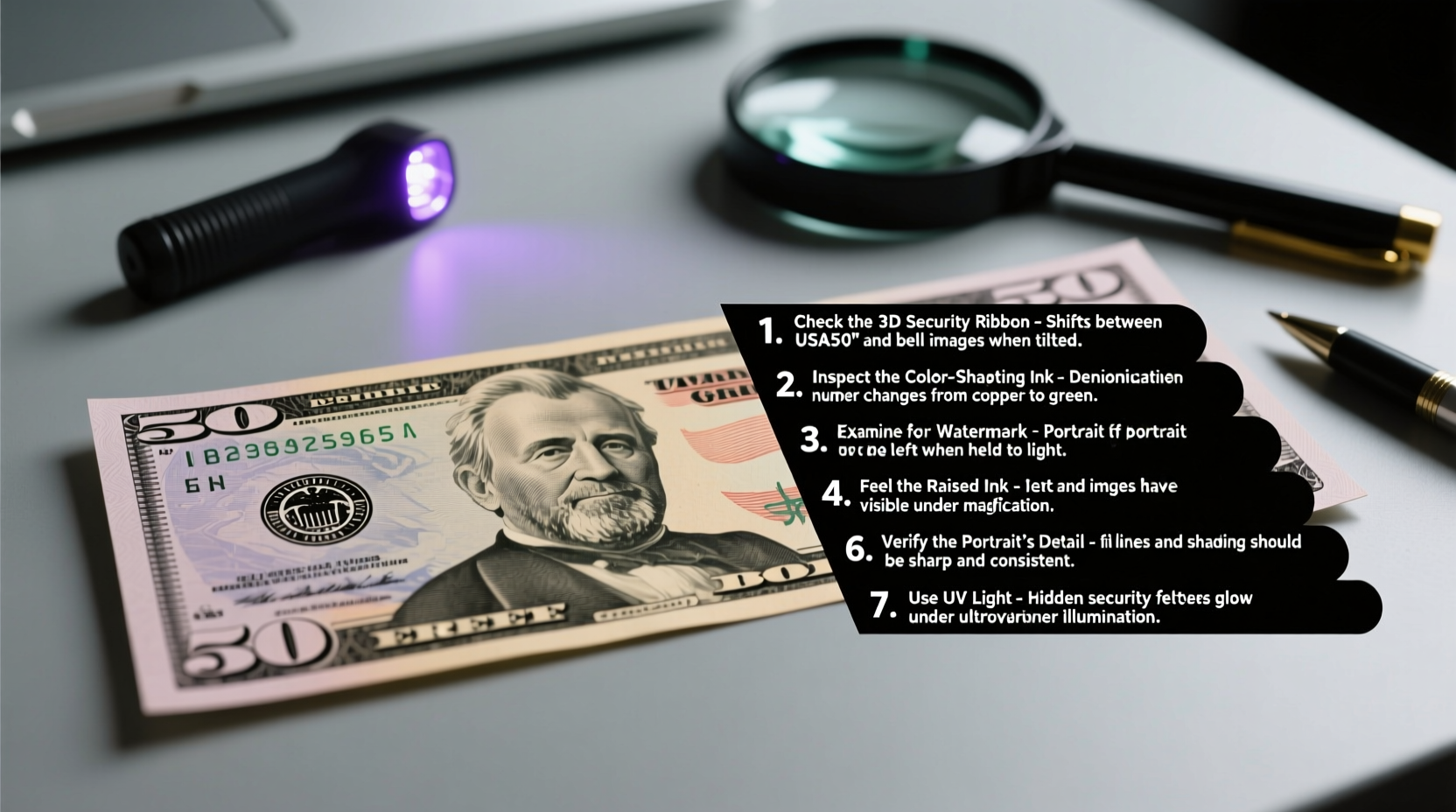
One of the most reliable visual indicators of a genuine $50 bill is the color-shifting ink used in the lower right corner on the front. This ink appears green when viewed straight on but shifts to black when tilted at an angle. The effect is created using optically variable ink (OVI), which is extremely difficult to replicate with standard printers or scanners.
Counterfeiters may attempt to mimic this feature with glossy ink or printed patterns, but these lack the true chromatic transition. Genuine OVI responds dynamically to movement and lighting, making it a trusted tool for verification.
2. Examine the Security Thread and Microprinting
Embedded vertically to the right of the portrait is a thin, embedded security thread that glows yellow under ultraviolet (UV) light. When held up to a bright light, the thread is visible from both sides and reads “USA 50” in tiny repeating text. This thread is not printed on the surface—it’s woven into the paper itself.
Additionally, microprinting appears in several locations on the bill, including along the border of Lincoln Memorial on the back and near the portrait. Using a magnifying glass, you should see clear, sharp text like “THE UNITED STATES OF AMERICA” instead of a blurred line. Fakes often replace microprinting with solid lines or poorly rendered dots.
“Security threads and microprinting are among the hardest features to reproduce accurately. Their precision separates professional currency from amateur forgeries.” — James R. Holloway, Former Forensic Document Examiner, U.S. Secret Service
3. Feel the Raised Printing
Genuine U.S. currency is printed using intaglio printing, a method that leaves ink slightly raised on the surface. This creates a distinctive texture, especially noticeable on the portrait, numerals, and scrollwork. Run your fingernail gently across Benjamin Franklin’s shoulder or the large “50” on the front—you should feel subtle ridges.
Counterfeit bills, typically produced via inkjet or laser printers, have flat, smooth surfaces. Even high-resolution scans cannot replicate the tactile depth of authentic engraving. This makes touch one of the fastest field tests available.
Quick Texture Test
- Hold the bill between your thumb and index finger.
- Drag your fingertip across Franklin’s coat and the serial numbers.
- If the surface feels slick or uniform, suspect a fake.
4. Inspect the Watermark
Every genuine $50 bill contains a watermark of Benjamin Franklin, visible when held up to light. The image appears on the right side of the bill, just beside the printed portrait, and is embedded during the papermaking process. It should be clear, well-defined, and consistent in tone whether viewed from the front or back.
Fake watermarks are often printed with pale ink or stamped onto the surface, making them visible without backlighting. A real watermark only becomes apparent under transmitted light and matches the position and detail of the printed portrait.
5. Verify the Serial Numbers
Each $50 bill has two unique serial numbers—one in the upper left and one in the lower right on the front. These consist of eight digits preceded and followed by a letter. On genuine bills, the numbers are evenly spaced, uniformly sized, and printed crisply. Fonts and alignment are precise; inconsistencies signal a problem.
Additionally, the sum of the eight digits should match on both sides. While not foolproof (some legitimate variations exist due to printing batches), mismatched totals raise red flags. Also, check that the Federal Reserve seal and letter (e.g., “A” for Boston, “K” for Dallas) correspond correctly with the first letter of the serial number.
| Feature | Genuine Bill | Counterfeit Red Flag |
|---|---|---|
| Serial Number Alignment | Perfectly aligned, same font and size | Uneven spacing, blurry edges |
| Digit Sum Match | Left and right totals usually match | Frequent mismatches |
| Color of Ink | Green-black, consistent shade | Faded, too dark, or inconsistent |
| Watermark Presence | Visible only under light | Always visible or missing |
6. Use a UV Light or Currency Detector Pen
Under ultraviolet light, a genuine $50 bill will show a glowing yellow security thread. The rest of the bill should remain dull—no widespread fluorescence. If the entire note glows blue or white, it’s likely made from standard wood-based paper, not the cotton-linen blend used by the Treasury.
Currency detector pens are another affordable option. They contain a chemical that reacts to starch in regular paper. When marked, a genuine bill turns yellow or clear; counterfeit paper turns dark brown or black. However, these pens aren’t foolproof—some high-quality fakes use starch-free paper. Use them as a preliminary test, not a definitive one.
Step-by-Step Verification Routine
- Look: Check for color-shifting ink and watermark under light.
- Feel: Run fingers over the portrait and text for raised printing.
- Tilt: Observe the security thread and ink movement.
- Compare: Match serial numbers and examine font quality.
- Verify: Use UV light or pen for secondary confirmation.
7. Stay Alert to Common Counterfeit Patterns
Some counterfeit operations specialize in specific denominations and eras. For example, older-style $50 bills without the 2004 security upgrades are frequent targets for reproduction. Be especially cautious with worn or discolored notes claiming to be vintage—many are modern fakes designed to exploit nostalgia.
Real-world case: In 2022, a convenience store chain in Ohio reported a surge in fake $50 bills passed during evening shifts. Investigation revealed the bills had crisp microprinting but failed the ink test—the “color shift” was simulated with glued foil. Staff were retrained to combine visual and tactile checks, reducing incidents by 87% within three months.
Checklist: How to Spot a Fake $50 Bill
- ✅ Tilt the bill: Does the lower right \"50\" shift from green to black?
- ✅ Hold to light: Is there a clear Franklin watermark on the right?
- ✅ Feel the surface: Can you detect raised printing on the portrait?
- ✅ Check the thread: Does it glow yellow under UV light?
- ✅ Inspect serial numbers: Are they aligned, matching, and sharp?
- ✅ Use a detector pen: Does the mark stay light?
- ✅ Look for microprinting: Is it legible under magnification?
Frequently Asked Questions
What should I do if I receive a counterfeit $50 bill?
Do not return it to the person who gave it to you. Instead, contact local law enforcement or the U.S. Secret Service. Note the individual’s description, vehicle, and any other details. Hand over the bill only to authorities, ideally in an envelope to preserve fingerprints.
Can counterfeit bills pass ATMs or vending machines?
Most modern machines use magnetic sensors, UV detectors, and size scanners to reject fakes. However, some lower-end or outdated devices may fail to catch sophisticated forgeries. Always inspect cash withdrawn from unfamiliar machines.
Are older $50 bills still valid?
Yes. All U.S. currency remains legal tender regardless of issue date. However, pre-2004 bills lack advanced security features and are more vulnerable to counterfeiting. Banks may scrutinize them more closely.
Final Thoughts: Confidence Starts with Knowledge
Verifying a $50 bill doesn’t require a lab or expensive tools—just attention to detail and familiarity with the built-in safeguards. By mastering these seven techniques, you protect not only your finances but also your credibility as a business owner or informed consumer. Currency security is a shared responsibility, and every accurate identification helps disrupt illegal operations.




 浙公网安备
33010002000092号
浙公网安备
33010002000092号 浙B2-20120091-4
Comments
No comments yet. Why don't you start the discussion?