
Polarized sunglasses are more than a fashion statement—they’re a functional tool designed to reduce glare, enhance visual clarity, and protect your eyes in bright conditions. However, not all dark lenses offer true polarization. With counterfeit products and misleading labels flooding the market, it’s essential to know whether your sunglasses deliver what they promise. Fortunately, you don’t need specialized equipment or expert knowledge to test them. Using everyday objects and straightforward methods, you can quickly determine if your shades are genuinely polarized.
Understanding Polarization: Why It Matters
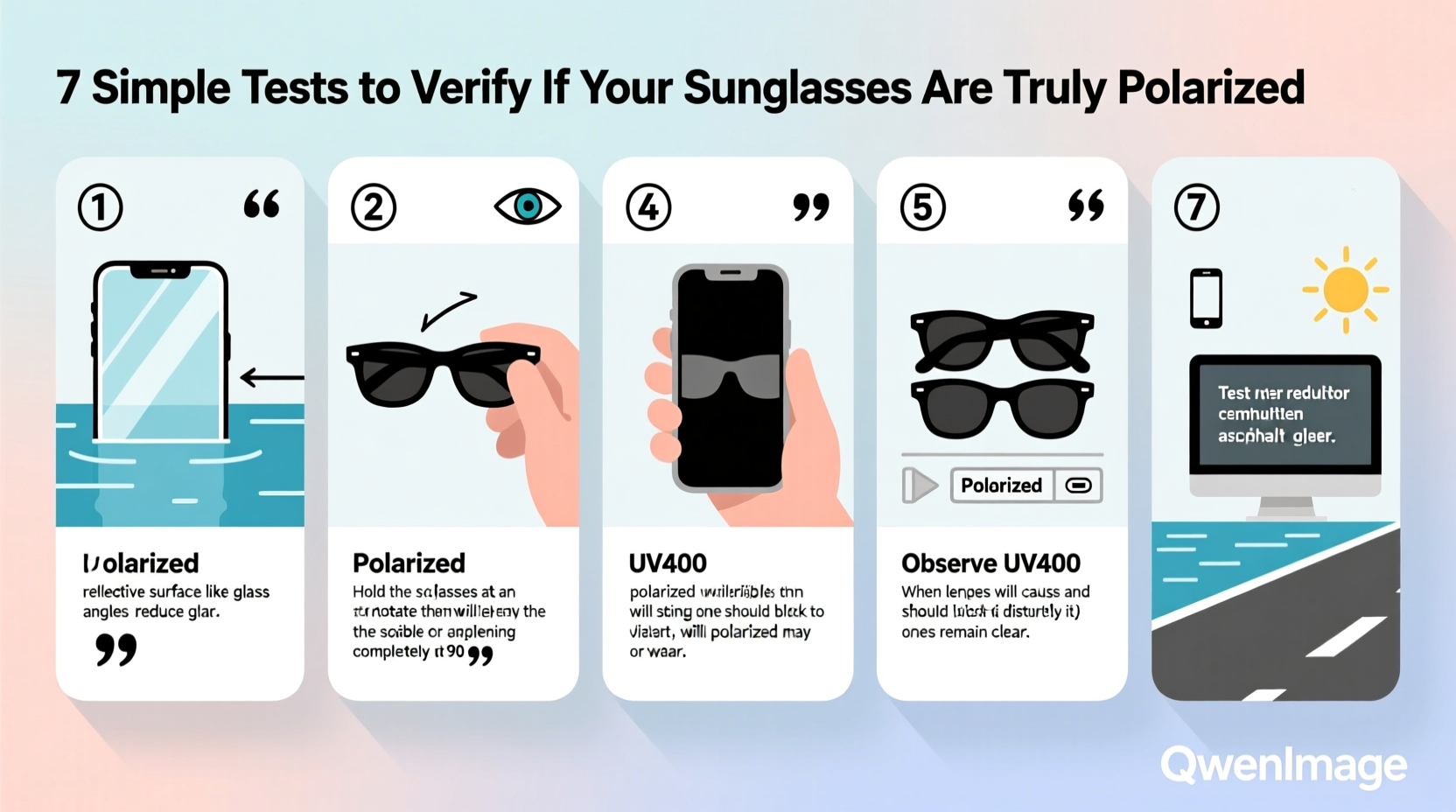
Light reflects off horizontal surfaces like water, roads, snow, and car windshields, creating intense glare that scatters in multiple directions. Polarized lenses contain a special filter that blocks horizontally oriented light waves—exactly the kind responsible for blinding glare. This selective filtering improves contrast, reduces eye strain, and increases visual comfort, especially during driving, fishing, or outdoor sports.
However, polarization is not the same as UV protection. A lens can be polarized without offering full UV blockage—or vice versa. For optimal eye safety, always ensure your sunglasses provide both 100% UVA/UVB protection and genuine polarization.
“Polarization significantly enhances visual performance in high-glare environments. But consumers should verify claims independently—many inexpensive ‘polarized’ sunglasses fail basic optical tests.” — Dr. Lena Torres, Optometrist & Vision Science Researcher
Test 1: The Reflection Test on a Smooth Surface
This test uses reflective surfaces like glass or water to detect glare reduction. Find a shiny horizontal surface—such as a car hood, window, or body of water—and stand at an angle (around 45–60 degrees) to it.
Put on your sunglasses and observe the reflection. Then, tilt your head sideways (approximately 60 degrees). If the lenses are polarized, the intensity of the reflected glare should noticeably decrease when upright and increase when tilted. This happens because the polarization filter's orientation changes relative to the incoming light.
Test 2: The LCD Screen Test
Most digital screens—including smartphones, tablets, laptops, and car dashboards—emit polarized light. When you view them through polarized lenses, rotating your head will cause the screen to appear darker or even black at certain angles.
Hold your phone screen on and look at it through your sunglasses. Slowly tilt your head to one side. If the screen dims significantly or turns almost black, your lenses are polarized. Non-polarized lenses will show little to no change in brightness regardless of head angle.
This test is especially reliable because nearly all modern displays use liquid crystal technology that interacts predictably with polarized filters.
Test 3: The Second Pair Comparison Method
If you have access to a known pair of polarized sunglasses, you can use them to test another pair. Hold both pairs of glasses with the lenses facing each other. Look through the two sets of lenses while slowly rotating one pair over the other.
As you rotate, watch for changes in light transmission. When the polarization axes are aligned, light passes through normally. When one lens is rotated 90 degrees relative to the other, the view should become very dark or completely black. This “crossed polarizers” effect confirms that both lenses are polarized.
If there’s no significant dimming during rotation, at least one pair lacks true polarization.
Test 4: The Car Window Observation
Modern car windows often have a slight tint or anti-glare coating that enhances the visibility of polarized lens effects. Sit near a vehicle (or look at parked cars) and observe the side or rear windows through your sunglasses.
While wearing the sunglasses, tilt your head slightly. You should notice rainbow-like patterns or shifting color distortions on tempered glass due to stress birefringence—a phenomenon visible only when viewing through polarized lenses.
This isn’t a standalone confirmation, but combined with other tests, it strengthens the evidence of true polarization.
Real Example: A Driver’s Experience
Mark, a daily commuter in Arizona, bought a new pair of budget sunglasses advertised as “polarized.” On his drive home, he noticed persistent glare on wet roads despite wearing them. Curious, he tried the LCD test using his GPS screen. When he tilted his head, the display didn’t darken. He repeated the test with his old Ray-Ban pair—immediate dimming occurred. Mark returned the new sunglasses the next day, realizing they were falsely labeled.
Test 5: The Polarized Light Filter Chart (DIY Grid Test)
Create or print a grid pattern with alternating black and white lines (like a checkerboard or striped design). View this chart through your sunglasses under bright light. Now, rotate the chart 90 degrees while keeping your head still.
If the contrast between the lines appears to shift dramatically—especially becoming less distinct at certain angles—it suggests the lenses are filtering polarized light. While not definitive alone, this method works best when paired with others.
Test 6: The Camera Lens Trick
Digital camera sensors and some smartphone lenses are sensitive to polarized light. Point your phone camera at a bright reflective surface (like a computer monitor or glossy magazine) while wearing the sunglasses. Record video or take photos as you tilt your head.
Observe the footage: if dark bands, flickering, or shifting shadows appear during motion, it indicates interaction between the camera sensor and the polarized filter—confirming polarization.
Test 7: Professional Optical Verification
The most accurate way to verify polarization is through an optician or optical lab. They use a device called a polariscope, which measures the alignment and efficiency of the polarization filter within the lens.
Many eyewear retailers offer free lens testing services, even if you didn’t purchase your glasses there. Ask for a “polarization axis check” and “glare reduction assessment.” A legitimate polarized lens will show a clear, uniform filter direction and measurable glare suppression.
Do’s and Don’ts of Testing Sunglass Polarization
| Action | Recommended? | Reason |
|---|---|---|
| Tilt head while viewing LCD screens | ✅ Yes | Reliable indicator of polarization effect |
| Use fluorescent lights for reflection tests | ❌ No | Poor reflectivity; inconsistent results |
| Compare with known polarized lenses | ✅ Yes | High accuracy via crossed-filter method |
| Assume dark lenses = polarized | ❌ No | Darkness does not imply polarization |
| Visit an optician for verification | ✅ Yes | Most precise and trustworthy result |
Frequently Asked Questions
Can sunglasses be polarized without being expensive?
Yes. Price doesn’t guarantee polarization. Many affordable brands offer genuine polarized lenses, but so do counterfeit sellers. Always verify independently, regardless of cost.
Do polarized lenses affect night vision?
Generally, polarized lenses are not recommended for nighttime use. They reduce overall light transmission and may make it harder to see wet roads or dashboard displays clearly in low-light conditions.
Are all Ray-Ban or Oakley sunglasses polarized?
No—not all models are polarized. Both brands offer polarized versions, but they must be specifically labeled as such. Check the product description or packaging for “polarized” designation.
Final Checklist: Confirming True Polarization
- Perform the LCD screen test with head tilt – expect dimming.
- Check reflections on water or glass – glare should reduce when upright.
- Compare with a verified polarized pair – look for darkening when crossed at 90°.
- Look for rainbow patterns on car windows – a sign of polarization interaction.
- Verify UV protection separately – polarization ≠ UV blocking.
- Avoid relying solely on price or branding – test objectively.
- When in doubt, consult an optician for professional analysis.
Take Action Today for Better Eye Protection
Don’t assume your sunglasses are doing their job just because they look the part. With rising sun exposure and increased screen time, proper eye protection has never been more critical. These seven simple tests empower you to separate marketing hype from real optical performance. Whether you're shopping online, picking up a roadside bargain, or passing down old shades, take a few minutes to verify polarization. Your eyes—and your safety—depend on it.




 浙公网安备
33010002000092号
浙公网安备
33010002000092号 浙B2-20120091-4
Comments
No comments yet. Why don't you start the discussion?