
Driving demands constant visual adaptation—sunlight shifts, tunnels appear, weather changes, and glare from wet roads or snow can impair visibility. Traditional fixed-tint sunglasses often fall short when conditions change rapidly. That’s where photochromic (color changing) sunglasses come in. Designed to adjust their lens tint based on ambient light, they offer a dynamic solution for drivers. But not all models are created equal. Choosing the wrong pair can compromise safety, comfort, and clarity. This guide breaks down what you need to know to select the best color changing sunglasses specifically for driving.
How Photochromic Lenses Work: The Science Behind the Shift
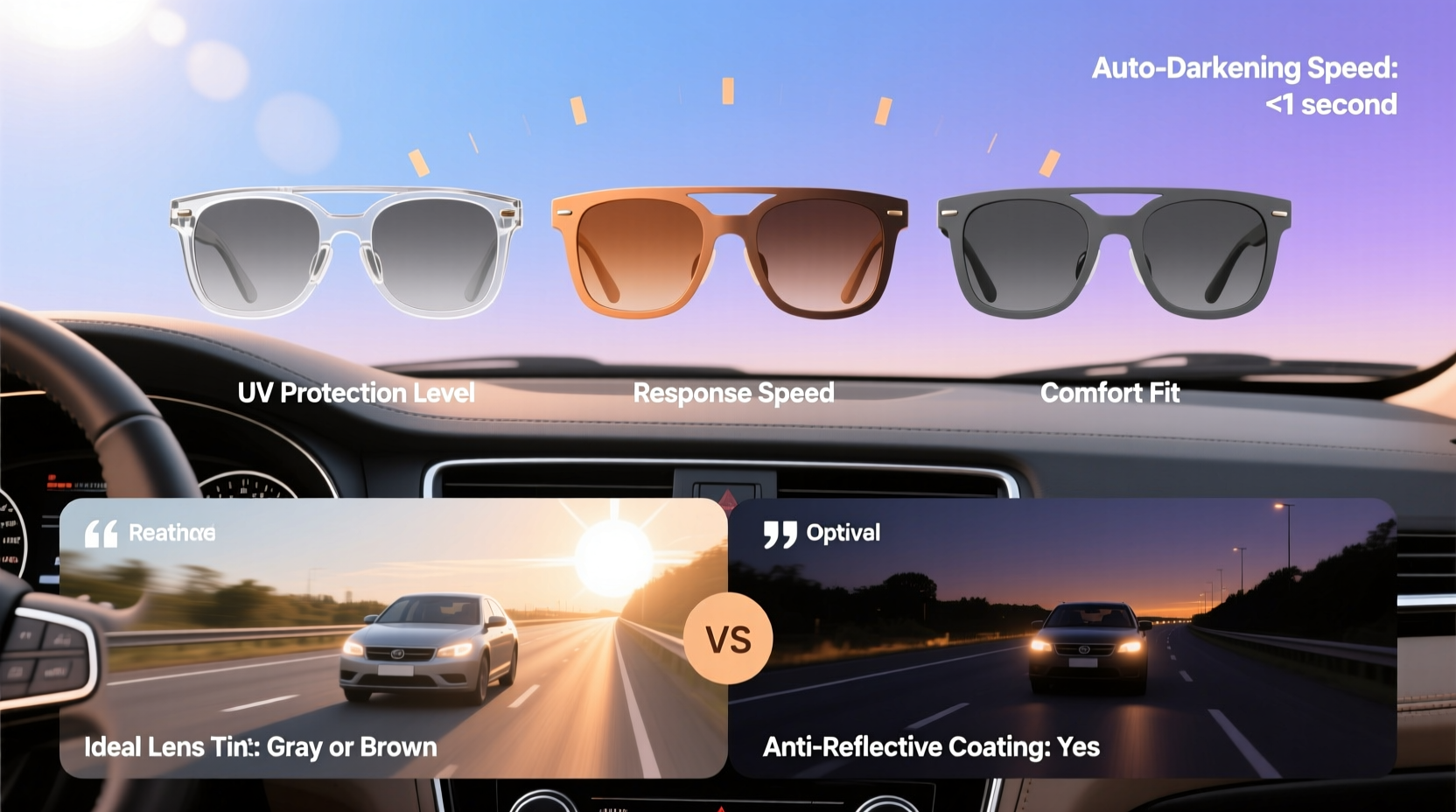
Photochromic lenses contain special molecules—typically silver halide or organic photochromic dyes—that react to ultraviolet (UV) radiation. When exposed to UV light, these molecules undergo a chemical change that causes the lens to darken. As UV exposure decreases—such as when entering a tunnel or at dusk—the molecules revert to their original state, lightening the lens.
However, a critical limitation exists: most car windshields block over 96% of UV rays. This means that traditional photochromic lenses may not activate properly while driving, remaining too light even in bright sunlight. Modern advancements have addressed this issue with UV-independent activation systems and polarized photochromic hybrids, making them far more effective behind the wheel.
“Early photochromics were unreliable in vehicles, but newer generations use visible light sensitivity to maintain responsiveness—even through UV-filtered glass.” — Dr. Alan Reed, Optometric Vision Scientist
Key Features to Look for in Driving-Oriented Photochromic Sunglasses
Not every pair labeled “photochromic” is suitable for driving. To ensure optimal performance, prioritize these five features:
- Polarization: Reduces glare from reflective surfaces like water, snow, and asphalt, improving contrast and visual comfort.
- Fast Transition Speed: Lenses should darken within 30 seconds of sunlight exposure and clear up in under 2 minutes when moving indoors.
- Wide Tint Range: A good range (e.g., from 15% to 80% light transmission) ensures usability in both bright sun and overcast conditions.
- Visible Light Activation: Ensures the lenses respond to brightness levels, not just UV, so they work effectively inside vehicles.
- Anti-Reflective Coating: Minimizes internal reflections that can cause eye strain during long drives.
Comparing Top Lens Technologies for Drivers
| Lens Type | UV Activation Only? | Works Inside Car? | Polarization Available? | Best For |
|---|---|---|---|---|
| Standard Photochromic (e.g., older Transitions) | Yes | No | Rarely | Walking, cycling—outdoor use only |
| Photochromic + Polarized Hybrid | No (uses visible light) | Yes | Yes | Driving, variable light conditions |
| Electrochromic (smart lenses) | No (electric current) | Yes | Sometimes | High-tech users; customizable tints |
| Non-Adaptive Polarized | N/A | Yes | Yes | Consistent bright conditions only |
The standout choice for drivers is the photochromic + polarized hybrid. These lenses adapt to changing light, reduce glare, and function reliably even when UV is blocked by windshield glass.
Real-World Scenario: Navigating Mountain Roads Safely
Consider Sarah, a weekend driver who commutes from Denver to mountain trails. Her route includes open highways, forested switchbacks, and sudden elevation changes affecting light intensity. She used standard sunglasses but struggled with glare on lakes and poor visibility in shaded curves.
After switching to a pair of photochromic polarized sunglasses with visible-light activation, she noticed immediate improvements. The lenses darkened on sunny stretches, reduced blinding reflections off wet rocks, and gradually lightened in tunnels and tree-covered paths. Most importantly, her eyes felt less fatigued after a four-hour drive.
This case illustrates how adaptive lenses enhance safety by maintaining consistent visual clarity across unpredictable environments—exactly what drivers need.
Step-by-Step Guide to Choosing Your Ideal Pair
- Determine your primary driving environment: Urban, rural, mountainous, or mixed? High-glare areas demand polarization.
- Check lens technology: Avoid basic UV-dependent photochromics if you spend significant time in a car.
- Test transition performance: If possible, try the glasses outdoors and then move indoors to assess speed and depth of tint change.
- Evaluate fit and coverage: Wraparound styles prevent peripheral light leakage, crucial for reducing eye strain.
- Consult an optician: If you wear prescription lenses, confirm compatibility with photochromic options.
- Review warranty and durability: Look for scratch-resistant coatings and manufacturer guarantees against delamination.
Common Mistakes to Avoid
- Assuming all \"transition lenses\" work in cars: Many do not. Verify the product description specifies vehicle compatibility.
- Ignoring nighttime performance: Some photochromic lenses remain slightly tinted in low light, which can reduce visibility after sunset.
- Overlooking frame ergonomics: Heavy or poorly balanced frames cause discomfort on long drives.
- Buying non-polarized photochromics for driving: Without polarization, glare remains a hazard on wet or shiny surfaces.
Frequently Asked Questions
Can photochromic sunglasses be used at night?
They are not recommended for nighttime driving. Even in their clearest state, some residual tint may remain, reducing contrast and depth perception in low-light conditions. Clear or yellow-tinted lenses are better suited for night use.
Do photochromic lenses last forever?
No. Most high-quality photochromic lenses maintain optimal performance for 2–3 years before gradually losing sensitivity due to molecular fatigue. Exposure to extreme heat (like leaving them on a dashboard) accelerates degradation.
Are there prescription photochromic options for drivers?
Yes. Many optical brands now offer prescription lenses with photochromic and polarized technology designed specifically for driving. Ensure your optometrist specifies \"driving-grade\" or \"indoor/outdoor adaptive\" lenses during ordering.
Final Checklist Before You Buy
- ✅ Visible-light activated photochromics (not UV-only)
- Ensures responsiveness inside vehicles.
- ✅ Integrated polarization
- Critical for reducing road glare and improving contrast.
- ✅ Fast transition time (under 60 seconds to darken)
- Prevents temporary blindness during rapid light changes.
- ✅ Scratch-resistant and anti-reflective coating
- Enhances longevity and reduces distracting reflections.
- ✅ Proper fit with full coverage
- Blocks peripheral light and stays secure during motion.
Drive Smarter, See Better
Selecting the right color changing sunglasses isn’t just about convenience—it’s a decision that directly impacts your reaction time, visual comfort, and overall safety on the road. With today’s advanced lens technologies, drivers no longer have to choose between protection and adaptability. By prioritizing visible-light activation, polarization, and proper fit, you equip yourself with eyewear that works as hard as you do.
Don’t settle for outdated solutions that fail behind the wheel. Invest in a pair engineered for real driving conditions, and experience the difference dynamic vision can make.




 浙公网安备
33010002000092号
浙公网安备
33010002000092号 浙B2-20120091-4
Comments
No comments yet. Why don't you start the discussion?