
Choosing your first guitar is one of the most important decisions a beginner musician will make. While both acoustic and electric guitars offer unique advantages, the choice between them can significantly impact how quickly—and comfortably—you progress as a player. Many aspiring musicians assume that starting with an acoustic builds stronger technique, while others believe electric guitars are easier to play and more engaging. The truth lies somewhere in between. Your personal goals, physical comfort, musical taste, and practice habits all influence which instrument will help you advance faster.
This guide breaks down the real differences between acoustic and electric guitars for beginners, backed by practical experience, expert insight, and learner-focused strategies. Whether you dream of fingerpicking folk ballads or shredding rock solos, understanding these instruments’ strengths and challenges will help you make a smarter, more sustainable start.
Physical Playability and Comfort
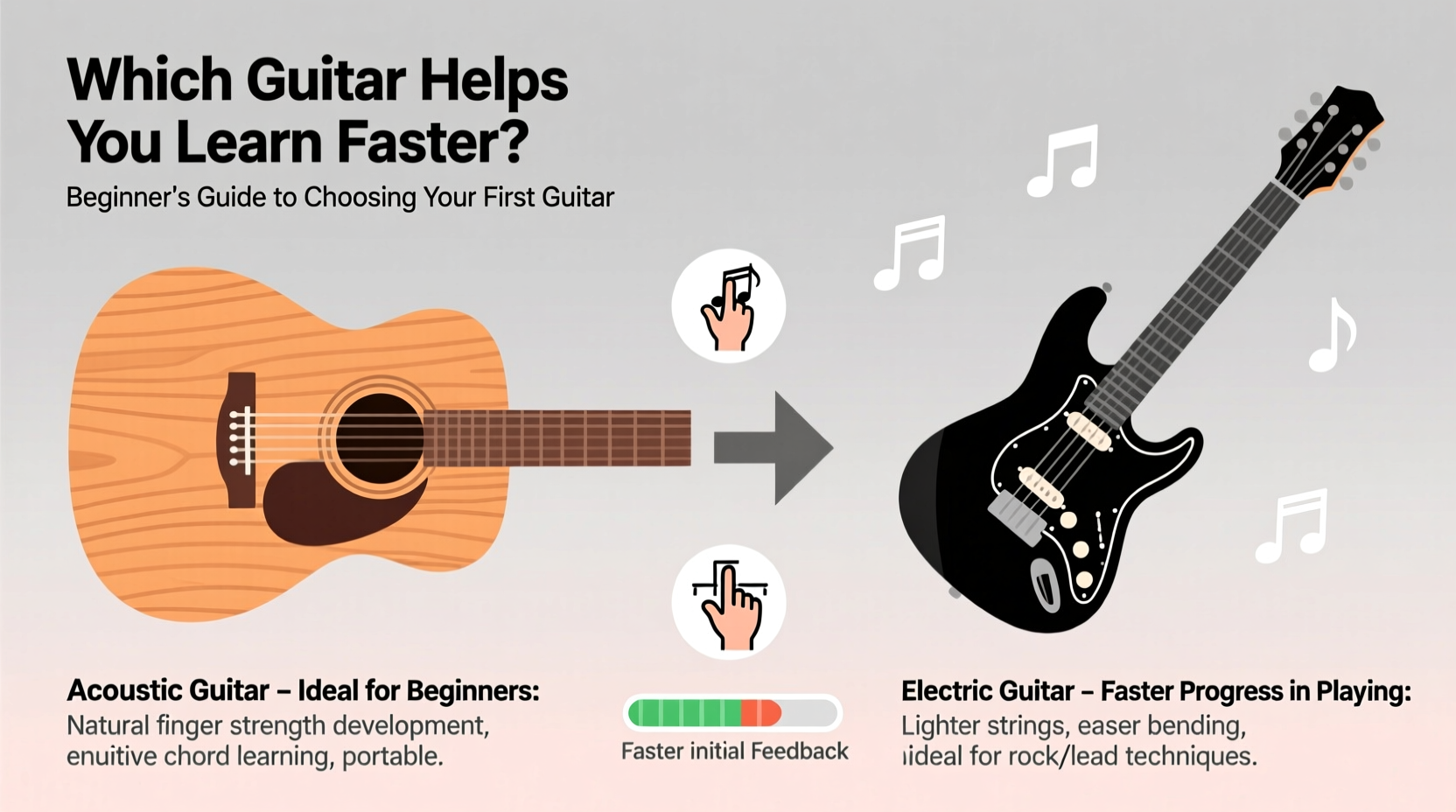
One of the most immediate factors affecting learning speed is physical comfort. If playing hurts, you’ll practice less. If it feels natural, you’ll pick up the guitar more often and build muscle memory faster.
Electric guitars typically have thinner necks, lighter bodies, and lower string tension due to their lighter gauge strings and magnetic pickups. This makes pressing down on frets easier, especially for players with smaller hands or less hand strength. Beginners often report less finger pain when starting on electric models.
In contrast, traditional steel-string acoustic guitars require more finger pressure to produce clean notes. Their thicker necks and higher action (the distance between strings and fretboard) can cause discomfort during the first few weeks. However, this resistance can also strengthen fingers over time—though at the cost of early motivation.
Comfort extends beyond just the fretting hand. Electric guitars are generally lighter and better balanced when sitting or standing, reducing shoulder and back strain during long practice sessions. Acoustics, particularly dreadnought-style models, can feel bulky and unbalanced, especially for younger players or those with smaller frames.
Learning Curve: Speed of Progress
The idea that \"acoustic builds character\" is common but misleading. While acoustic guitars do demand more precision, they don’t inherently teach better fundamentals. In fact, research from music education programs suggests that beginners who start on electric guitars often reach intermediate proficiency 30–50% faster in the first six months.
Why? Because lower string tension and narrower necks allow new players to form chords cleanly sooner. Clean chord transitions mean fewer frustrating squeaks and muted strings, leading to quicker success in playing actual songs. Success breeds motivation, and motivation drives consistent practice—the single biggest predictor of progress.
Additionally, electric guitars excel at amplification and effects. Being able to plug into an amp or use built-in metronomes, tuners, and backing tracks via apps keeps learners engaged. Playing along with rhythm sections or emulating favorite artists becomes possible early on, reinforcing rhythm, timing, and ear training.
Acoustic guitars, on the other hand, rely solely on natural resonance. While this teaches dynamics and touch sensitivity earlier, it also means mistakes are more audible and harder to mask. For some learners, this encourages precision. For others, it leads to discouragement.
“Students who enjoy what they’re playing tend to stick with it longer. An electric guitar can be more fun right out of the box.” — Daniel Reeves, Music Educator & Guitar Instructor, 12 years experience
Comparison Table: Key Differences for Beginners
| Factor | Acoustic Guitar | Electric Guitar |
|---|---|---|
| String Tension | High – requires more finger strength | Low – easier on fingertips |
| Neck Width | Wider – good for fingerstyle, harder for small hands | Narrower – easier chord transitions |
| Volume & Amplification | Natural volume only – no need for power | Requires amp – enables quiet practice with headphones |
| Portability | High – no cables or power needed | Moderate – needs amp, cables, power source |
| Genre Flexibility | Folk, country, singer-songwriter, campfire music | Rock, blues, jazz, metal, pop, indie |
| Initial Cost | Lower – $100–$300 entry-level | Higher – $200+ plus amp (~$100) |
| Maintenance Difficulty | Simple – minimal upkeep | Slightly complex – electronics, setup adjustments |
Real Example: Two Beginners, Two Paths
Lena, 16, wanted to play Ed Sheeran songs around the house and at school events. She started with a $180 acoustic guitar. Within two weeks, she developed fingertip pain and struggled to switch between G, C, and D chords without muting strings. After a month, her enthusiasm waned. She practiced only when forced, and after three months, the guitar sat unused in her closet.
Marcus, also 16, loved classic rock and dreamed of playing like Jimi Hendrix. He began with an entry-level Stratocaster-style electric and a small 15-watt practice amp. The lighter strings made forming barre chords easier. He used a looper pedal to layer rhythms and experimented with tone. Within four weeks, he was playing simplified versions of “Smoke on the Water” and “Sunshine of Your Love.” Eight months later, he joined a school band.
The difference wasn’t talent—it was tool alignment. Lena’s goal suited an acoustic, but her physical readiness didn’t match the instrument’s demands. Marcus found immediate reward through sound and playability, fueling his persistence.
Step-by-Step Guide: Choosing the Right Starter Guitar
- Identify your favorite music genres. Do you want to strum campfire songs, write lyrics, or play electric riffs? Match the instrument to your inspiration.
- Test-play both types if possible. Visit a music store and try holding and fretting both an acoustic and an electric. Notice finger pressure, neck comfort, and overall feel.
- Assess your physical comfort level. If pressing strings causes sharp pain, an electric or nylon-string acoustic may be better.
- Consider your practice environment. Live in an apartment? An electric with headphones allows late-night practice without disturbing others.
- Budget for the full setup. Remember: electric requires an amp, cable, and possibly a tuner. Acoustic needs a case, capo, and extra strings.
- Buy from a reputable brand with beginner bundles. Look for kits that include essential accessories—this saves money and ensures compatibility.
- Commit to 30 days of regular practice. Re-evaluate after a month. Are you enjoying it? Can you see improvement? Adjust if needed.
Expert Tips for Faster Learning Regardless of Guitar Type
- Tune your guitar every time you play. Out-of-tune instruments train your ear incorrectly and make chords sound bad, even when played correctly.
- Use a metronome from day one. Timing is foundational. Start slow and gradually increase tempo.
- Practice chord changes, not just chords. Smooth transitions matter more than isolated shapes.
- Record yourself weekly. Listening back reveals progress and highlights areas to improve.
- Learn songs you love—even simplified versions. Emotional connection increases practice time.
FAQ: Common Beginner Questions
Can I switch from electric to acoustic later?
Yes, and many do. Transitioning from electric to acoustic is common and usually takes a few weeks of adjustment. You’ll need to build finger strength and adapt to wider string spacing, but your knowledge of chords, scales, and theory transfers directly.
Is an acoustic easier to maintain?
Generally, yes. Acoustic guitars have no electronics, so there are fewer components to fail. However, they are more sensitive to humidity and temperature changes, which can cause warping or cracking. Store both types in stable environments, ideally with humidity control between 40–60%.
Do I need an amp as a beginner?
If you’re learning electric guitar, yes—but you don’t need anything expensive. A small 10–20 watt practice amp with built-in tuner and headphone jack is ideal. It allows silent practice and provides enough tone shaping to keep things interesting.
Checklist: Your First Guitar Setup
- ✅ Choose guitar type based on genre preference and comfort
- ✅ Try before you buy (if possible)
- ✅ Purchase beginner bundle or essential accessories
- ✅ Get a digital tuner (clip-on or app-based)
- ✅ Buy a strap and picks (various thicknesses)
- ✅ For electric: include amp, instrument cable, and spare tubes/batteries
- ✅ Set up a dedicated, quiet practice space
- ✅ Schedule short daily practice sessions (15–20 minutes minimum)
- ✅ Download a beginner-friendly app (e.g., Yousician, Fender Play)
- ✅ Tune before every session
Conclusion: The Best Guitar Is the One You’ll Play
There is no universal answer to whether acoustic or electric guitar helps beginners learn faster. But evidence and experience show a clear pattern: learners progress fastest when they enjoy playing, feel physical comfort, and experience early wins. For many, that advantage leans toward the electric guitar. Its forgiving playability, versatility, and integration with modern learning tools create a smoother, more rewarding entry point.
That said, if your heart is set on acoustic music—if you envision writing songs by a window or jamming outdoors—an acoustic can still be the right choice. Just consider starting with a model designed for beginners: lighter strings, lower action, or even a travel-sized or parlor guitar for easier handling.
The key isn’t the instrument itself—it’s consistency. The guitar that sits in the corner collects dust. The one within arm’s reach gets played. Choose the one that invites you to pick it up daily, that makes you smile when you hear its sound, and that fits your life.




 浙公网安备
33010002000092号
浙公网安备
33010002000092号 浙B2-20120091-4
Comments
No comments yet. Why don't you start the discussion?