
Commuting in cities often means enduring a relentless soundtrack of subway rumbles, engine drones, chattering passengers, and overhead announcements. In response, many turn to headphones as a personal escape pod. But with so many options on the market, a critical question arises: should you invest in active noise cancelling (ANC), or is passive noise isolation enough? Understanding the difference — and how each performs in real-world transit scenarios — can save you money, improve comfort, and determine whether high-end tech truly enhances your daily journey.
How Noise Reduction Works: The Core Principles
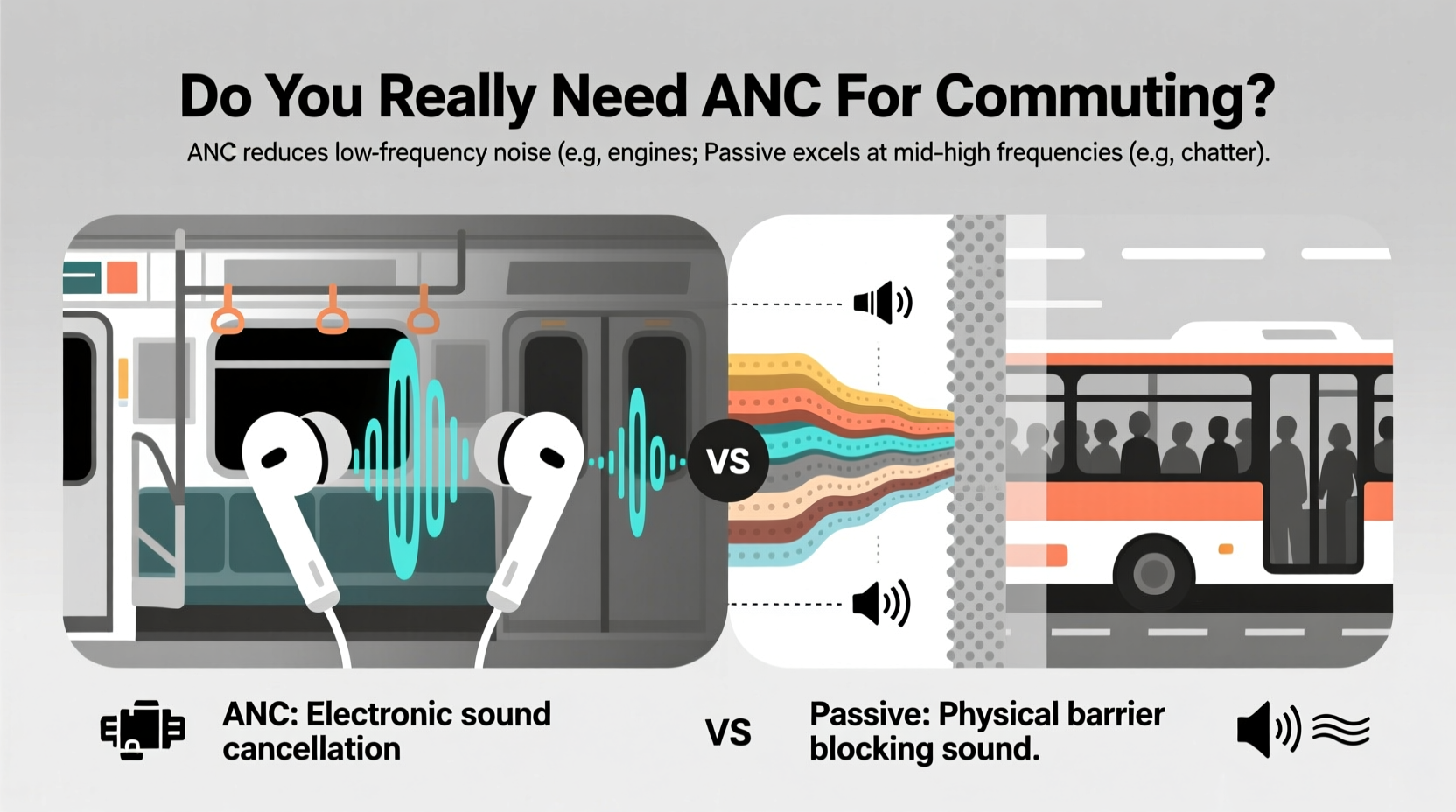
Noise reduction in headphones operates through two fundamentally different mechanisms: physical blocking and electronic interference. Passive noise isolation relies solely on materials and design to physically block external sounds from reaching your ears. This includes earcup padding, seal tightness, over-ear or in-ear fit, and even the density of the housing material. Think of it like closing a window to muffle street noise — no power required, just effective barriers.
Active noise cancelling, on the other hand, uses microphones, processors, and phase-inverted audio signals to neutralize incoming sound waves. When ambient noise enters the earcup, the ANC system captures it via external mics, analyzes the frequency, and generates an “anti-noise” wave that cancels it out. This process happens in real time and is particularly effective against low-frequency, continuous sounds like airplane engines, train rumble, or HVAC systems.
“Passive isolation is your first line of defense. ANC builds on that foundation by targeting what physical barriers can’t stop.” — Dr. Lena Torres, Audio Engineer at Acoustic Insights Lab
Comparing Performance: Where Each Excels
The effectiveness of noise reduction depends heavily on the type of noise encountered during a commute. Let’s break down common transit environments and how each technology handles them.
| Noise Type | Passive Isolation Effectiveness | Active Noise Cancelling Effectiveness |
|---|---|---|
| Low-frequency rumble (subway, bus engine) | Moderate – some attenuation if seal is strong | High – ANC excels here due to predictable wave patterns |
| Mid-frequency chatter (passenger conversations) | Low to moderate – speech frequencies often leak through | Moderate – newer hybrid ANC improves mid-range suppression |
| High-frequency sounds (announcements, beeping) | Variable – depends on ear tip or cushion quality | Low – difficult to cancel sharp, transient tones effectively |
| Sudden noises (door slams, horns) | Poor – too abrupt for physical damping | Poor to fair – latency limits real-time response |
From this comparison, a clear pattern emerges: passive isolation works best across broad spectrums when properly sealed, while ANC provides targeted relief from constant, low-pitched background noise. For most urban commuters, the combination of both technologies — such as ANC headphones with excellent passive seals — delivers the most comprehensive protection.
Real Commuter Scenarios: Does ANC Make a Difference?
To understand the real impact, consider a typical morning commute using New York City’s subway system. Sarah, a marketing analyst, takes the 7 train from Queensboro Plaza to Midtown every weekday. Her journey includes 15 minutes underground, where the train emits a constant 80–85 dB low-frequency hum. She used basic earbuds for months but found herself increasing volume to unsafe levels just to focus.
After switching to over-ear ANC headphones, she noticed an immediate drop in perceived noise. The rumble didn’t vanish, but it receded into the background. She could listen to podcasts at 50% volume instead of 80%, reducing ear fatigue. More importantly, she arrived at work feeling less mentally drained. “It’s not about total silence,” she says. “It’s about removing that constant pressure. I feel more alert now.”
In contrast, her colleague Mark uses high-isolation in-ear monitors without ANC. He commutes via the same line but swears by memory foam ear tips and a well-fitted shell design. While he acknowledges occasional intrusion from sudden noises, he finds the consistent low-end noise manageable and prefers not to rely on battery-powered tech. His solution costs less than half of Sarah’s, requires no charging, and performs reliably.
This divergence highlights a crucial point: the necessity of ANC depends not only on environment but also on personal sensitivity, listening habits, and priorities. For those overwhelmed by persistent mechanical noise, ANC offers tangible cognitive relief. For others, especially those who prioritize simplicity and cost, high-quality passive isolation may suffice.
Practical Considerations: Cost, Comfort, and Trade-offs
Choosing between ANC and passive isolation isn’t just about performance — it’s also about practicality. Here are key factors to weigh before making a decision.
- Battery dependency: ANC headphones require regular charging. A dead battery turns premium headphones into mediocre ones, potentially worse than passive-only models due to compromised acoustics.
- Price: ANC models typically start at $100+ and go well beyond $300. High-isolation passive headphones can deliver strong performance under $80.
- Weight and comfort: Over-ear ANC headphones tend to be bulkier and heavier. Long commutes may lead to ear fatigue or overheating, especially in summer.
- Durability: Passive designs have fewer components to fail. No mics, no processors, no firmware issues — just consistent function over time.
- Sound quality trade-offs: Some ANC headphones color the audio output slightly due to processing latency or internal resonance. Audiophiles often prefer passive models for transparency.
Do You Really Need ANC for Commuting? A Step-by-Step Decision Guide
Instead of assuming ANC is essential, follow this practical sequence to determine what suits your needs.
- Assess your commute environment. Is it dominated by low-frequency drone (train, bus, plane) or intermittent high-frequency noise (street traffic, crowds)? Low drone favors ANC; mixed noise may not.
- Evaluate your current gear. Try sealing your existing headphones better — swap ear tips, adjust fit, or use over-ear covers. If noise drops significantly, passive improvements might be enough.
- Test sensitivity to noise fatigue. Do you arrive at work feeling mentally exhausted? Persistent noise increases cognitive load. ANC can reduce this burden.
- Consider usage patterns. Will you use headphones mostly for calls, music, or silence? ANC adds value for media consumption but less so if you’re just blocking noise without audio.
- Set a budget and maintenance tolerance. Can you afford a $250 pair requiring weekly charging? Or would a $60 passive model that lasts years with no upkeep serve you better?
- Try before you buy. Visit a store to test both types. Many electronics retailers offer demo units with simulated transit noise.
Checklist: Choosing the Right Option for Your Commute
Use this checklist to make an informed choice:
- ✅ My commute involves long stretches of consistent low-frequency noise (e.g., subway, bus, train)
- ✅ I frequently increase volume to drown out background sound
- ✅ I’m sensitive to noise-related stress or mental fatigue
- ✅ I’m willing to charge my headphones regularly
- ✅ I can invest $150+ in a durable pair
- ✅ I value situational awareness and want transparency mode
- ✅ I prefer lightweight, low-maintenance gear and avoid electronics when possible
If most checked items align with ANC benefits, it’s likely worth the investment. If you prioritize durability, simplicity, and lower cost, high-isolation passive headphones remain a smart, proven solution.
Frequently Asked Questions
Can passive isolation be as effective as ANC?
Yes — in certain conditions. High-quality in-ear monitors with custom or memory foam tips can block 20–30 dB of noise across frequencies, rivaling mid-tier ANC. However, they struggle with very low frequencies where ANC has a distinct advantage. The best results often come from combining both: passive sealing as the base, enhanced by ANC processing.
Does ANC damage hearing over time?
No direct evidence suggests ANC damages hearing. In fact, by reducing the need to raise volume in noisy environments, ANC may help protect hearing. However, improper fit or overly aggressive cancellation can create pressure sensations (\"ear suck\") that cause discomfort. Choose models with adjustable ANC strength to mitigate this.
Are there non-headphone alternatives for commuters?
Absolutely. High-fidelity earplugs designed for musicians or travelers offer up to 25 dB of flat attenuation, preserving sound clarity while reducing overall volume. Brands like Etymotic and Loop produce reusable options that fit discreetly and don’t require batteries. These are ideal for commuters who want quiet without audio playback.
Final Verdict: ANC Isn’t Always Necessary — But It Helps
The truth is, you don’t *need* active noise cancelling to commute comfortably. Millions do it every day with simple earbuds, foam plugs, or nothing at all. However, if your commute involves prolonged exposure to droning transport noise and you consume audio regularly, ANC provides measurable benefits: reduced listening fatigue, safer volume levels, and improved focus.
That said, ANC should not be seen as a magic fix. It works best when layered on top of good passive isolation. A poorly sealed ANC headphone will underperform a well-designed passive model. Technology enhances — it doesn’t replace — fundamental acoustic principles.
Ultimately, the decision comes down to personal experience and priorities. For frequent travelers, remote workers on trains, or anyone seeking mental respite during transit, ANC is a worthwhile upgrade. For short commutes, budget-conscious users, or minimalists, investing in high-isolation passive gear — or even premium earplugs — may deliver equal satisfaction with fewer compromises.




 浙公网安备
33010002000092号
浙公网安备
33010002000092号 浙B2-20120091-4
Comments
No comments yet. Why don't you start the discussion?