
In an age of smartwatches and hyper-functional timepieces, the simple act of telling time has become a battleground between two distinct philosophies. On one side: the analog watch, with its sweeping hands, mechanical heartbeat, and heritage stretching back centuries. On the other: the digital display, crisp, efficient, and unapologetically modern. While both serve the same basic function, only one consistently earns admiration not just for what it does—but for how it makes us feel. When it comes to personality and style, the analog watch doesn’t merely compete; it often defines the standard.
This isn’t about precision or battery life. It’s about presence. About the quiet confidence of a well-crafted dial catching the light under a shirt cuff. It’s about the subtle statement that says you value tradition, attention to detail, and the artistry of motion. Digital watches may win on utility, but analog wins on soul.
The Language of Design: How Watches Communicate Identity
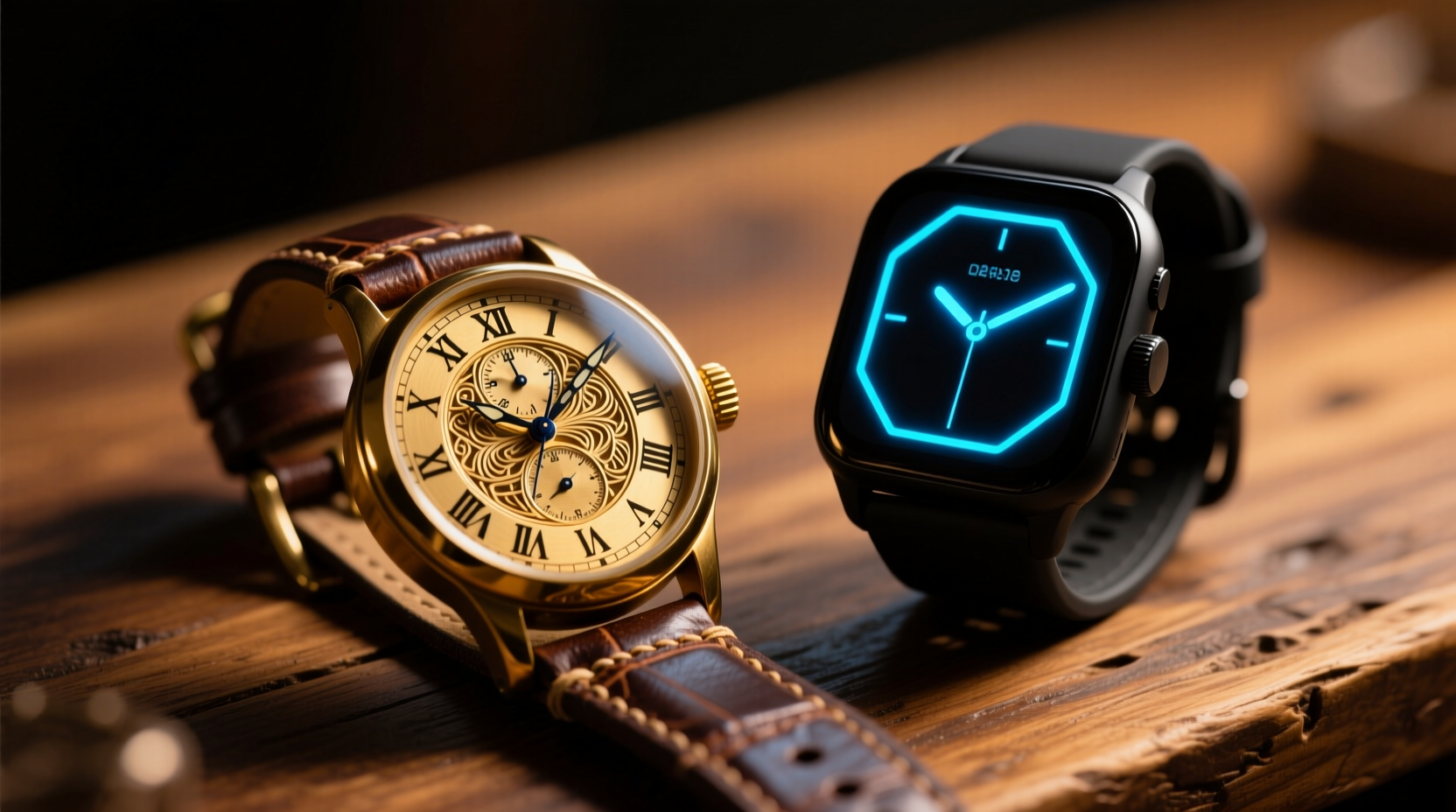
A watch is more than a tool—it’s an extension of personal identity. The choice between analog and digital reflects deeper values: efficiency versus elegance, minimalism versus craftsmanship, innovation versus legacy.
Analog watches speak in visual metaphors. The movement of the second hand is a literal heartbeat. The balance wheel, visible through a sapphire caseback on fine models, mimics the rhythm of breath. Even the texture of the dial—guilloché patterns, sunburst finishes, or matte enamel—invites closer inspection. These are details designed not just to be seen, but to be appreciated over time.
Digital watches, by contrast, prioritize clarity and immediacy. A numeric display conveys information without ornament. There’s no ambiguity, no subtlety—just data. This functional purity appeals to engineers, athletes, and tech enthusiasts who prize accuracy above aesthetics. But in doing so, it often sacrifices emotional resonance.
Craftsmanship as Character: Why Mechanical Matters
The soul of the analog watch lies in its mechanics. A mechanical movement—whether manually wound or self-winding (automatic)—is a marvel of micro-engineering. Hundreds of tiny components work in concert, calibrated to within microns. Each tick is the result of deliberate, physical interaction: springs unwinding, gears turning, levers engaging.
This complexity isn’t hidden. Luxury brands like Patek Philippe, Jaeger LeCoultre, and Grand Seiko showcase their movements through exhibition casebacks, treating them like miniature sculptures. Enthusiasts admire the perlage, anglage, and blued screws not because they improve accuracy, but because they reflect intentionality. They signal that someone cared enough to make something beautiful, even where few would notice.
Digital watches, powered by quartz crystals and integrated circuits, achieve superior accuracy at a fraction of the cost. Yet their inner workings are sealed in silicon—impersonal, invisible, and replaceable. There’s no romance in a circuit board. No poetry in a battery change. As Antoine Preziuso, independent Swiss watchmaker, puts it:
“Mechanical watches are not about telling time—they’re about celebrating it. Every component is a tribute to human ingenuity.” — Antoine Preziuso, Master Watchmaker
This reverence for process translates into perceived value. A well-made analog watch can appreciate in worth, passed down as heirlooms. A digital watch, no matter how advanced, is typically obsolete within a few years.
Style Through the Decades: A Cultural Timeline
The cultural footprint of analog watches is undeniable. From James Bond’s Rolex Submariner in *Dr. No* to Steve McQueen’s TAG Heuer Monaco in *Le Mans*, analog timepieces have defined eras and icons. They’ve been worn by astronauts on the moon (Omega Speedmaster), presidents in the Oval Office (Ronald Reagan’s Timex Ironman aside), and explorers navigating uncharted terrain.
Consider the evolution:
- 1950s–60s: Dress watches with slim cases and leather straps symbolized postwar sophistication.
- 1970s: The “Quartz Crisis” introduced affordable digital displays, threatening Swiss dominance.
- 1980s: Digital peaked with Casio calculators, LED faces, and fitness trackers for the emerging tech-savvy generation.
- 1990s–2000s: Analog resurgence led by luxury revival and vintage appreciation.
- 2010s–Present: Hybrid models emerge, but high-end analog remains the gold standard for style.
While digital watches had their moment—especially in sports and military applications—their cultural staying power pales next to analog’s enduring symbolism. An Omega worn at a black-tie gala commands respect. A Casio F-91W at the same event might raise eyebrows, even if it's famously durable and favored by some unconventional figures.
Comparative Analysis: Analog vs Digital in Style & Personality
To understand the stylistic gap, consider key dimensions beyond mere timekeeping.
| Feature | Analog Watch | Digital Watch |
|---|---|---|
| Visual Appeal | Rich textures, depth, color gradients, hand-finished details | Flat, uniform display; limited aesthetic variation |
| Emotional Connection | Strong—linked to heritage, craftsmanship, ritual | Weak—functional, disposable perception |
| Versatility in Fashion | High—pairs with suits, casual wear, formal attire | Limited—best suited for sportswear or utilitarian looks |
| Conversation Starter | Frequent—people notice and ask about the brand, history | Rare—unless it’s a retro model or cult favorite |
| Perceived Value | High—even modest models suggest taste and care | Low—often associated with affordability and mass production |
The table reveals a clear pattern: analog watches excel in areas tied to expression and impression. They are curated objects. Digital watches, while practical, are tools first and fashion statements second.
Real-World Example: The Interview That Changed Everything
Take the case of Daniel Reyes, a 32-year-old software engineer in Berlin. For years, he wore a rugged Casio G-Shock—durable, accurate, and perfectly suited to his active lifestyle. But when he transitioned into a client-facing role at a fintech startup, he noticed something subtle: executives and senior consultants almost universally wore analog watches.
“I didn’t think much of it until a client complimented my colleague’s watch—a vintage Hamilton,” Daniel recalls. “Then he barely glanced at mine. Not out of disrespect, but because there was nothing to see.”
Within weeks, Daniel invested in a simple automatic watch—a Tissot PRX. The change wasn’t just external. He found himself dressing more deliberately, standing straighter in meetings, even speaking with more confidence. The watch became a silent anchor of professionalism.
“It’s not magic,” he says. “But wearing something that feels intentional changes how you carry yourself. My Casio told time. My Tissot tells people I care.”
How to Build a Stylish Watch Wardrobe: A Step-by-Step Guide
Choosing a watch shouldn’t be random. Like selecting a suit or pair of shoes, it should align with lifestyle and image goals. Follow these steps to curate a collection with character.
- Assess Your Daily Context
Do you work in finance, creative fields, or outdoors? A dress watch suits formal environments; a field or diver’s watch works better for rugged use. - Define Your Style Archetype
Are you classic, minimalist, adventurous, or avant-garde? Match your watch to your broader aesthetic. - Start with One Signature Piece
Choose a mid-range automatic watch (e.g., Seiko 5, Hamilton Khaki) that reflects your taste and budget. - Consider Proportions
A 38mm case fits most wrists subtly; 40–42mm offers modern presence. Avoid oversized digital cases unless intentional. - Rotate Thoughtfully
Alternate between metal bracelets, leather straps, and NATO bands to refresh the look without buying new watches. - Add Depth Over Time
Graduate to complications (date, chronograph, moonphase) or vintage pieces as your interest grows.
This approach ensures each watch serves a purpose—not just in function, but in storytelling.
Checklist: Choosing an Analog Watch with Personality
- ✅ Does the dial design invite close inspection? (e.g., textured, layered, or colored)
- ✅ Is the movement visible or mentioned as a point of pride?
- ✅ Does the brand have a heritage or narrative that resonates?
- ✅ Can it transition from day to evening with minimal adjustment?
- ✅ Will it still look relevant in 5–10 years?
- ✅ Does it feel balanced on your wrist—neither too heavy nor too light?
Frequently Asked Questions
Can a digital watch ever be stylish?
Yes—but selectively. Retro models like the Casio F-91W or modern hybrids like the Matrix Watch have developed cult followings due to nostalgia or unique features. However, their style leans toward irony, minimalism, or subculture rather than universal elegance.
Are analog watches less accurate than digital?
Generally, yes. A standard mechanical watch may gain or lose several seconds per day, while quartz digital watches are accurate to within a second per month. But for most wearers, this difference is imperceptible and irrelevant to daily life.
Is wearing an analog watch outdated in the smartphone era?
Not at all. Just as fountain pens persist despite word processors, analog watches endure as symbols of intentionality. They represent a choice to slow down, to appreciate craft, and to carry a personal object in a world of ephemeral digital interactions.
Conclusion: Time Is More Than Numbers
In the end, the debate isn’t really about timekeeping. It’s about what we choose to carry—and what we allow to carry us. A digital watch delivers information efficiently. An analog watch offers a relationship: with the machine, with history, with oneself.
Personality isn’t programmed. It’s cultivated. It lives in the sweep of a second hand, the warmth of a leather strap, the quiet pride of winding a watch each morning. Style isn’t just appearance—it’s consistency, care, and the courage to move differently in a world obsessed with speed.
If you’ve been wearing digital out of habit, consider this an invitation. Try an analog watch. Not for accuracy, but for awareness. Let it remind you that time isn’t just something to track—it’s something to honor.




 浙公网安备
33010002000092号
浙公网安备
33010002000092号 浙B2-20120091-4
Comments
No comments yet. Why don't you start the discussion?