
In recent years, interior design has seen a surge in the popularity of irregularly shaped carpets—pieces with organic edges, asymmetrical forms, or custom contours that break from the traditional rectangle. While some dismiss them as fleeting fashion statements, others argue they offer superior functionality and aesthetic flexibility. The real question isn't just about style; it's whether these non-traditional floor coverings provide tangible benefits over their rectangular counterparts. To understand their true value, we need to examine how they perform in real homes, how they influence spatial perception, and what practical trade-offs exist.
The Rise of Irregular Carpets in Modern Design
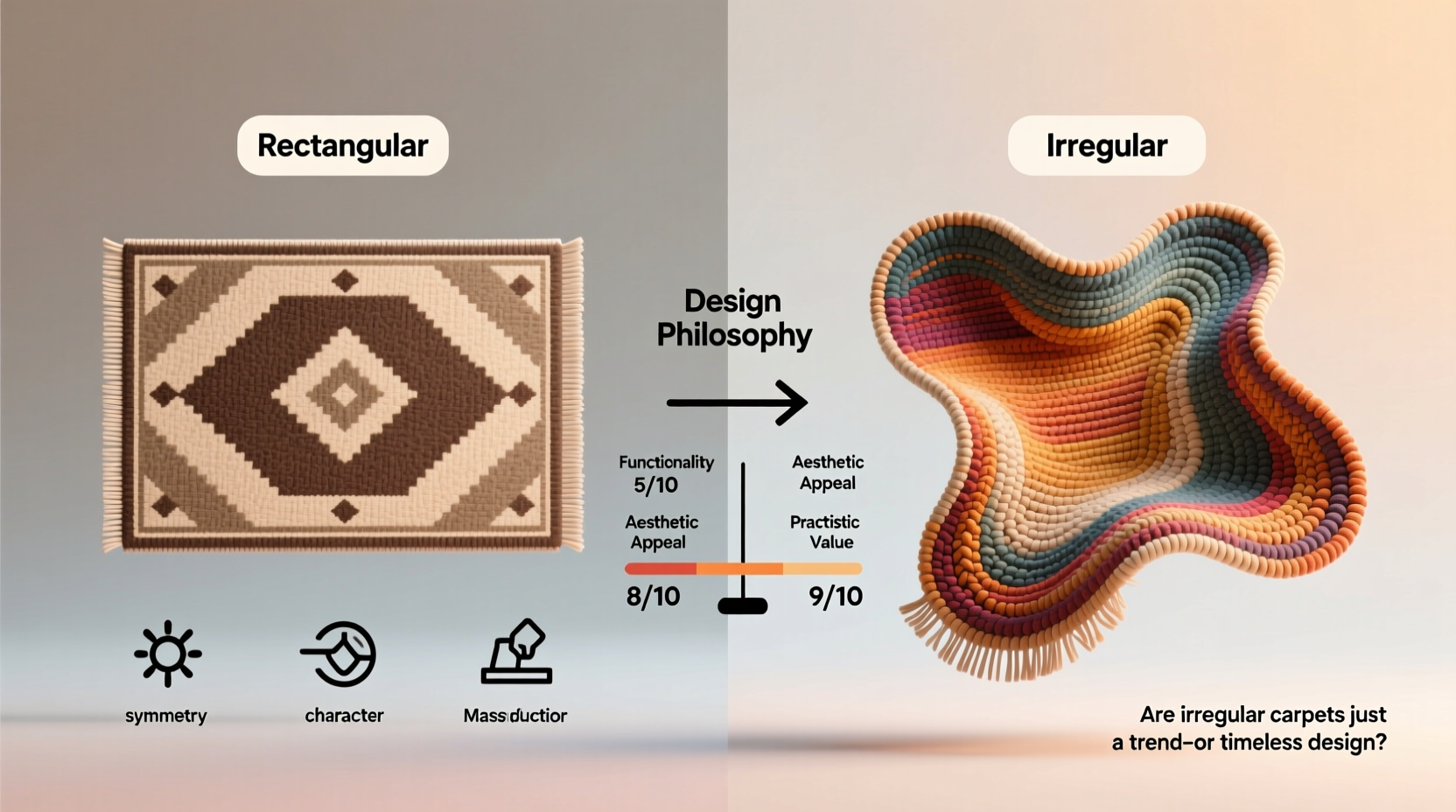
Irregular carpets have moved from art galleries and avant-garde lofts into mainstream living rooms, dining areas, and even bedrooms. Their appeal lies in their ability to disrupt visual monotony. In spaces dominated by straight lines—walls, furniture, ceiling beams—a carpet with curved or jagged edges introduces movement and softness. Designers increasingly use them as focal points, treating them like paintings on the floor.
This shift reflects broader trends toward personalized, expressive interiors. Mass-produced rectangular rugs often feel generic. In contrast, an irregular piece—especially one handcrafted—carries uniqueness. It suggests intentionality. But beyond aesthetics, does this deviation from standard shapes offer measurable advantages?
Functional Benefits: Beyond Aesthetic Appeal
One of the most compelling arguments for irregular carpets is their adaptability to unconventional room layouts. Many modern homes feature angled walls, bay windows, or L-shaped living zones where a rectangular rug either leaves gaps or forces awkward furniture placement. An irregularly shaped carpet can follow the room’s natural flow, anchoring furniture more effectively.
Consider a sunroom with a hexagonal footprint. A round or polygonal carpet can echo the geometry, creating harmony. A rectangular rug would leave exposed corners, visually unbalancing the space. Similarly, in a narrow hallway that widens at one end, a tapering oval rug can guide movement and enhance proportion.
Moreover, irregular shapes allow for creative zoning. In studio apartments or multifunctional rooms, a kidney-shaped or amoeba-like rug under a sofa and coffee table subtly separates the lounge area from a workspace or dining nook without physical barriers.
“An irregular carpet isn’t just decorative—it’s a spatial tool. It can correct imbalances, soften hard architecture, and create intimacy in large rooms.” — Lena Torres, Interior Architect & Spatial Designer
Comparative Analysis: Irregular vs. Rectangular Carpets
| Feature | Irregular Carpets | Rectangular Carpets |
|---|---|---|
| Design Flexibility | High – adapts to unique spaces and artistic visions | Moderate – limited to standard configurations |
| Furniture Anchoring | Excellent in asymmetric layouts | Better in symmetrical, grid-based rooms |
| Space Optimization | Superior in non-rectangular or open-plan areas | Can leave awkward gaps in irregular rooms |
| Manufacturing Cost | Higher – often handcrafted or custom-made | Lower – mass-produced efficiently |
| Replacement & Resale | Limited availability; harder to replace | Easily replaced; widely available |
| Durability (Edge Wear) | Potential weak points at complex curves | Even wear; reinforced straight edges |
Practical Considerations and Challenges
Despite their advantages, irregular carpets come with notable drawbacks. Maintenance is one concern. Vacuuming along intricate edges requires more time and care. Some vacuum models struggle with tight curves, increasing the risk of fraying. Cleaning services may charge more due to the complexity of handling non-standard shapes.
Another issue is longevity. Because many irregular rugs are bespoke or artisan-made, replacing them when worn out can be difficult. Finding an exact match in color, texture, and shape is unlikely. This makes them less ideal for high-traffic homes with children or pets unless protected with durable materials like wool blends or performance fibers.
Installation also presents challenges. Underlay must be custom-cut, and securing edges—especially on hardwood or tile—requires specialized tape or grippers to prevent tripping hazards. Poorly fitted irregular rugs are more prone to curling or shifting than their rectangular equivalents.
Mini Case Study: A Brooklyn Loft Transformation
A 750-square-foot Brooklyn loft had an open layout with exposed brick, steel beams, and a diagonal ceiling slope. The owner initially used a large rectangular rug in the living area, but it ended abruptly before reaching the reading chair tucked into the angled wall, making the space feel disjointed.
After consulting a designer, they commissioned a custom trapezoidal wool rug that extended precisely under the sofa and wrapped around the chair. The new shape followed the room’s incline, creating a cohesive island. Guests now naturally gravitate toward the seating zone, and the owner reports the room feels “more intentional and inviting.” This case illustrates how an irregular carpet solved a spatial problem a standard shape could not.
Step-by-Step Guide to Choosing the Right Carpet Shape
- Assess Your Room’s Geometry: Measure wall angles, note architectural quirks, and identify natural gathering zones.
- Map Furniture Placement: Outline your key pieces (sofa, dining table) to see which shape best anchors them.
- Consider Traffic Flow: Ensure the carpet doesn’t obstruct pathways, especially in high-use areas.
- Evaluate Long-Term Practicality: Ask if the rug can be cleaned easily and whether replacement options exist.
- Test with Tape: Use painter’s tape on the floor to outline potential rug shapes before committing.
- Consult a Professional: For custom designs, work with a rug maker or interior designer to balance form and function.
FAQ
Are irregular carpets more expensive than rectangular ones?
Generally, yes. Custom shapes require more labor, precise cutting, and often hand-finishing. Prices can be 30–100% higher than comparable rectangular rugs, depending on material and craftsmanship.
Can I use an irregular carpet in a traditional home?
Absolutely. When used thoughtfully, an irregular rug can add subtle contrast to a classic space. For example, a softly scalloped edge in a formal sitting room can soften the rigidity of antique furniture without clashing with traditional decor.
Do irregular carpets make rooms look bigger?
They can—if designed intentionally. A well-placed organic shape can guide the eye and improve flow, enhancing perceived space. However, a poorly sized or overly complex shape may fragment the floor and make a room feel cluttered.
Final Verdict: Trend or Timeless Advantage?
Irregular carpets are more than a passing trend—they represent a growing emphasis on tailored, human-centered design. While rectangular rugs remain practical, affordable, and versatile, irregular shapes fill a niche where standard options fall short. They excel in non-conforming spaces, serve as powerful design statements, and offer unique solutions to common layout challenges.
However, they are not universally superior. Their value depends on context: the room’s architecture, lifestyle needs, and long-term maintenance willingness. For those seeking personalization and spatial intelligence in their interiors, an irregular carpet can be a functional masterpiece. For others prioritizing convenience and cost-efficiency, a well-chosen rectangle remains a smart choice.
The future of flooring lies not in choosing one shape over another, but in selecting the right shape for the space. As homes become more diverse in layout and purpose, so too should the elements that ground them.




 浙公网安备
33010002000092号
浙公网安备
33010002000092号 浙B2-20120091-4
Comments
No comments yet. Why don't you start the discussion?