
Every holiday season, homes light up with festive cheer. But increasingly, a new kind of sparkle is emerging—not just from bulbs, but from pixels. Programmable Christmas lights, powered by microcontrollers and addressable LEDs, now allow homeowners to create dynamic light shows synchronized to music, animated patterns, or seasonal themes. While dazzling, these systems come with a catch: they require time, technical understanding, and patience to master. For many, the question isn’t whether the end result looks impressive—it’s whether the effort required is justified.
The answer depends on your goals, tech comfort level, and how you define value. For some, the joy lies in the process; for others, it’s purely about the visual payoff. Let’s explore what programmable lights truly offer, the learning curve involved, and whether they’re worth it for the average enthusiast.
Understanding Programmable Christmas Lights
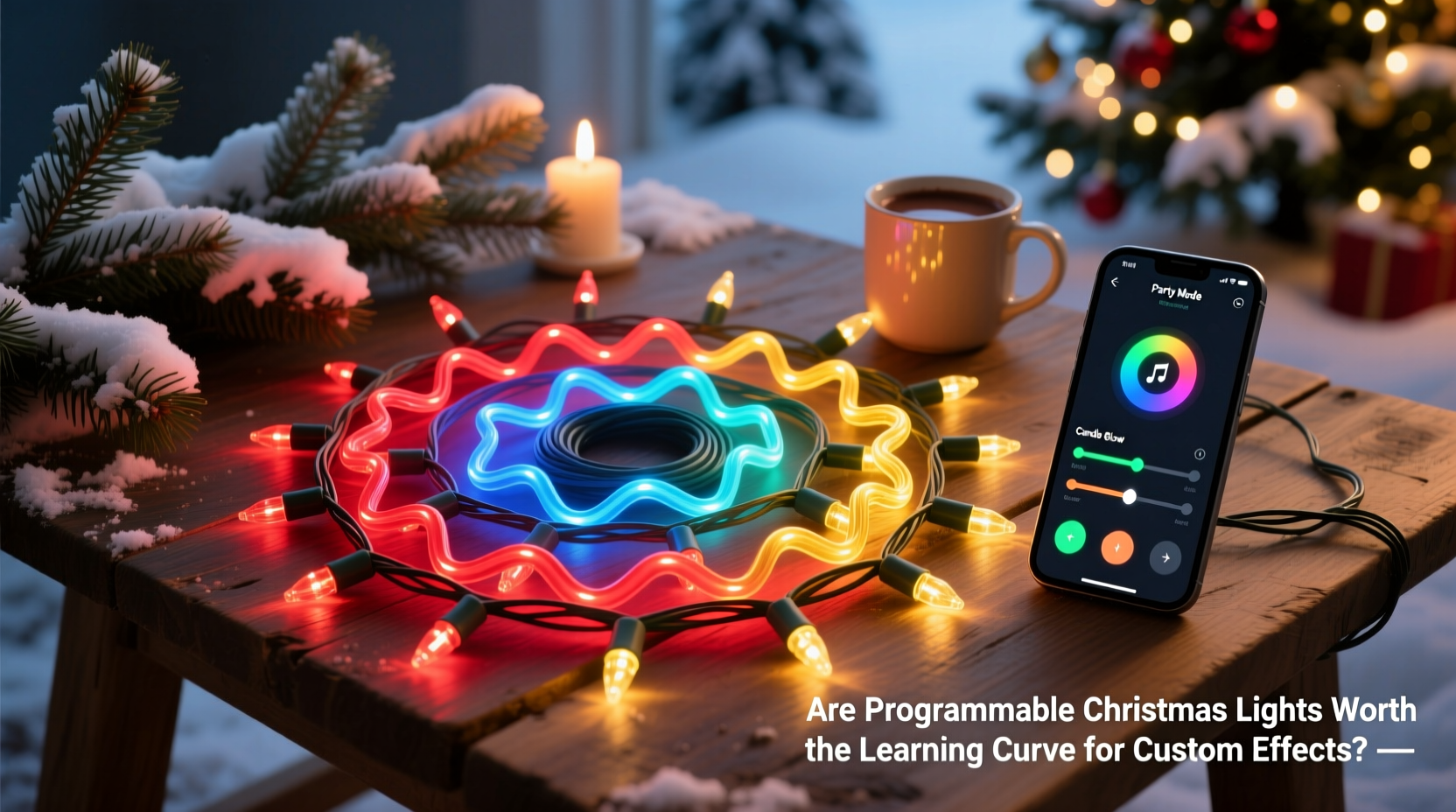
Unlike traditional string lights that simply turn on and off—or blink in preset sequences—programmable Christmas lights use individually addressable LEDs, most commonly WS2812B (also known as NeoPixels). Each bulb can be controlled independently, allowing for complex animations like color waves, chases, fades, and even pixel-mapped displays across eaves, trees, and yard installations.
These systems typically rely on a microcontroller such as an ESP8266, ESP32, or Arduino, paired with software like WLED, xLights, or Falcon Player. Some users design their own sequences using audio-reactive tools, while others rely on pre-built firmware that enables Wi-Fi control via smartphone apps or voice assistants.
The flexibility is unmatched. You can make your roof ripple like ocean waves, simulate falling snow, pulse to holiday music, or display scrolling text messages. Entire neighborhoods have turned into synchronized light spectacles during December, with multiple homes playing coordinated shows broadcast over FM transmitters.
Weighing the Learning Curve Against the Rewards
The appeal of programmable lights is obvious: customization at a level previously reserved for commercial displays. But the barrier to entry remains steep for non-technical users. Setting up even a basic system involves several unfamiliar steps:
- Identifying compatible hardware components
- Soldering or crimping connectors (if not using plug-and-play kits)
- Configuring Wi-Fi-enabled controllers
- Mapping physical light layouts in software
- Designing or uploading light sequences
- Troubleshooting signal issues or power drops
This process can take hours or even days for beginners. A miswired data line, insufficient power supply, or incorrect LED count in configuration can render the entire setup inoperative. Unlike plugging in a store-bought light strand, failure points are numerous and often subtle.
Yet, those who persist often describe a strong sense of accomplishment. “There’s something deeply satisfying about coding a light sequence and seeing it play out perfectly on your house,” says Mark R., a DIY holiday lighting enthusiast from Colorado. “It’s part art, part engineering. Once it works, people stop in the street to watch.”
The reward isn’t just aesthetic—it’s experiential. Many users report that once they cross the initial threshold, ongoing updates become easier. Firmware like WLED offers web-based interfaces that simplify daily operation. After setup, changing effects can be as simple as selecting a preset on a phone app.
Key Considerations Before Diving In
Before investing time and money, assess your expectations and constraints. The following checklist can help determine if programmable lights align with your needs.
✅ Pre-Investment Checklist
☐ Define your goal: Are you aiming for simple color changes or full music-synced shows?
☐ Assess your technical comfort: Are you comfortable with basic electronics and software setup?
☐ Budget for more than lights: Include controllers, power supplies, extension cables, and weatherproof enclosures.
☐ Plan for storage: Programmable setups require careful disassembly and labeled organization for reuse.
☐ Check local regulations: Some areas restrict outdoor electrical loads or amplified sound from displays.
One often overlooked factor is scalability. A single window outline may seem manageable, but expanding to gutters, trees, and lawn decor multiplies complexity. Power injection—adding additional power sources along long LED runs—is essential beyond 5 meters to prevent color distortion or flickering.
Comparing Traditional vs. Programmable Lighting Systems
To better understand the trade-offs, here's a comparison of standard and programmable Christmas lights across key dimensions.
| Feature | Traditional Lights | Programmable Lights |
|---|---|---|
| Setup Time | Minutes per strand | Hours to days (initial), faster later |
| Customization | Limited to built-in modes | Full control over color, pattern, timing |
| Cost (per 100 lights) | $10–$20 | $30–$70 (with controller & accessories) |
| Maintenance | Replace fused bulbs or strands | Troubleshoot connections, firmware, power |
| Lifespan | 3–5 seasons (if stored well) | 5+ seasons (if protected from moisture) |
| Energy Use | Low to moderate | Moderate to high (depends on brightness/length) |
| Kid/Family Friendly | Yes—plug and play | Limited—requires adult oversight |
The data shows that programmable lights demand higher upfront investment in both cost and effort. However, they also offer significantly greater creative freedom and longevity when properly maintained.
A Real-World Example: From Skeptic to Superfan
Jamie T., a middle school teacher from Portland, was initially skeptical about programmable lights. “I saw these crazy light shows online and thought, ‘No way I could do that.’ I’m not an engineer.” But after watching her neighbor’s display draw crowds two Christmases in a row, she decided to try a modest setup.
She started with a 2-meter strip of WS2812B LEDs, an ESP8266 board, and followed a YouTube tutorial to install WLED. The first attempt failed—she reversed the data and ground wires. The second try worked, but only half the strip lit up due to voltage drop. After adding a 5V power injector, everything functioned smoothly.
By December, she had programmed five different effects: a slow rainbow cycle, a twinkling starfield, a pulsing red-and-green heartbeat, a snowfall simulation, and a music-synchronized jingle bell routine. Her porch became a neighborhood attraction.
“Was it worth it? Absolutely,” she says. “The kids loved it. My students asked about it at school. And honestly, I felt proud. It wasn’t just decoration—it was something I made.”
Step-by-Step: Your First Programmable Light Setup
If you're ready to begin, follow this simplified guide to launch your first programmable lighting project safely and effectively.
- Choose Your Lights: Buy a waterproof, 5V addressable LED strip (WS2812B) with at least 30 LEDs per meter. Look for pre-wired connectors to reduce soldering.
- Select a Controller: Use an ESP8266 or ESP32 with Wi-Fi capability. Boards like NodeMCU are beginner-friendly and widely supported.
- Install Firmware: Flash WLED onto your controller using a tool like WLED Flasher (available online). This gives you a user-friendly interface without coding.
- Wire the Components: Connect the data pin from the LED strip to the controller (usually GPIO2 or D4). Ensure power and ground are correctly aligned. Use heat shrink tubing or electrical tape for insulation.
- Power the System: Use a regulated 5V power supply rated for at least 20% more than your strip’s maximum draw (e.g., 60W for a 5-meter strip).
- Test Indoors First: Power on the setup indoors. Connect to the WLED access point or home Wi-Fi. Open the web interface in a browser.
- Configure Effects: In WLED, set the number of LEDs, choose a color palette, and experiment with built-in effects like “Fireworks” or “Meteors.”
- Mount Outdoors: Secure the strip with clips or adhesive, keeping connections elevated and covered. Place the controller in a sealed enclosure.
- Schedule & Share: Use WLED’s timer feature to automate on/off times. Optionally, link to Google Assistant or Alexa for voice control.
This process, while detailed, becomes intuitive with practice. Most users complete their first build in a weekend.
Frequently Asked Questions
Can I mix programmable lights with regular Christmas lights?
Yes, but they must be on separate circuits. Programmable lights require dedicated controllers and cannot be plugged into the same outlet chain as incandescent or standard LED strings without risking interference or overload.
Do I need to know how to code to use programmable lights?
No. Modern firmware like WLED, Home Assistant integrations, and mobile apps allow full control through graphical interfaces. Coding is only necessary for advanced customizations or unique animations.
How long do programmable lights last outdoors?
With proper sealing and protection from direct water exposure, quality strips can last 5–7 holiday seasons. UV-resistant coatings help prevent yellowing. Always disconnect during storms and store carefully after the season.
Final Verdict: Are They Worth It?
For casual decorators who enjoy setting up lights quickly and taking them down after the holidays, programmable systems may feel like overkill. The initial effort outweighs the benefit if your goal is simple ambiance.
But for hobbyists, tech enthusiasts, or anyone seeking a standout display, programmable lights offer unmatched creative potential. The learning curve is real—but surmountable. Each challenge overcome, from wiring to Wi-Fi pairing, builds competence and confidence. Over time, the process transforms from frustrating to fulfilling.
Moreover, the community support is robust. Reddit forums like r/WLED and r/lightshow have thousands of active users sharing configurations, troubleshooting advice, and inspiration. You’re never truly on your own.
As one veteran builder put it: “You don’t buy programmable lights because they’re easy. You buy them because you want to create something no one else has. And when your house pulses to Mariah Carey at midnight, and strangers film it from the sidewalk—you realize the hours were worth every minute.”




 浙公网安备
33010002000092号
浙公网安备
33010002000092号 浙B2-20120091-4
Comments
No comments yet. Why don't you start the discussion?