
When it comes to facial masking, few skincare rituals feel as indulgent—or promising—as slipping on a mask and waiting for your complexion to transform. But with so many types available, choosing between a sheet mask and a clay mask can be confusing, especially if your primary goal is hydration. While both are popular in beauty routines worldwide, they serve fundamentally different purposes. Understanding their mechanisms, ingredients, and effects on the skin reveals a clear answer: for a true hydration boost, sheet masks are generally more effective than clay masks.
This doesn’t mean clay masks have no place in a well-rounded routine. They excel in other areas—particularly oil control and deep cleansing—but when it comes to delivering moisture that penetrates and remains in the skin, sheet masks hold a distinct advantage. Let’s break down why, compare their strengths, and help you make an informed decision based on your skin’s needs.
How Hydration Works in Skincare
True hydration refers to the skin’s ability to retain water within its layers, particularly in the stratum corneum—the outermost layer of the epidermis. Well-hydrated skin appears plump, smooth, and radiant, while dehydrated skin often looks dull, feels tight, and may flake or show fine lines more prominently.
Hydration isn’t just about surface-level dampness; it involves attracting water into the skin (via humectants), locking it in (with occlusives), and supporting the skin barrier to prevent transepidermal water loss (TEWL). Ingredients like hyaluronic acid, glycerin, panthenol, and ceramides play key roles in this process.
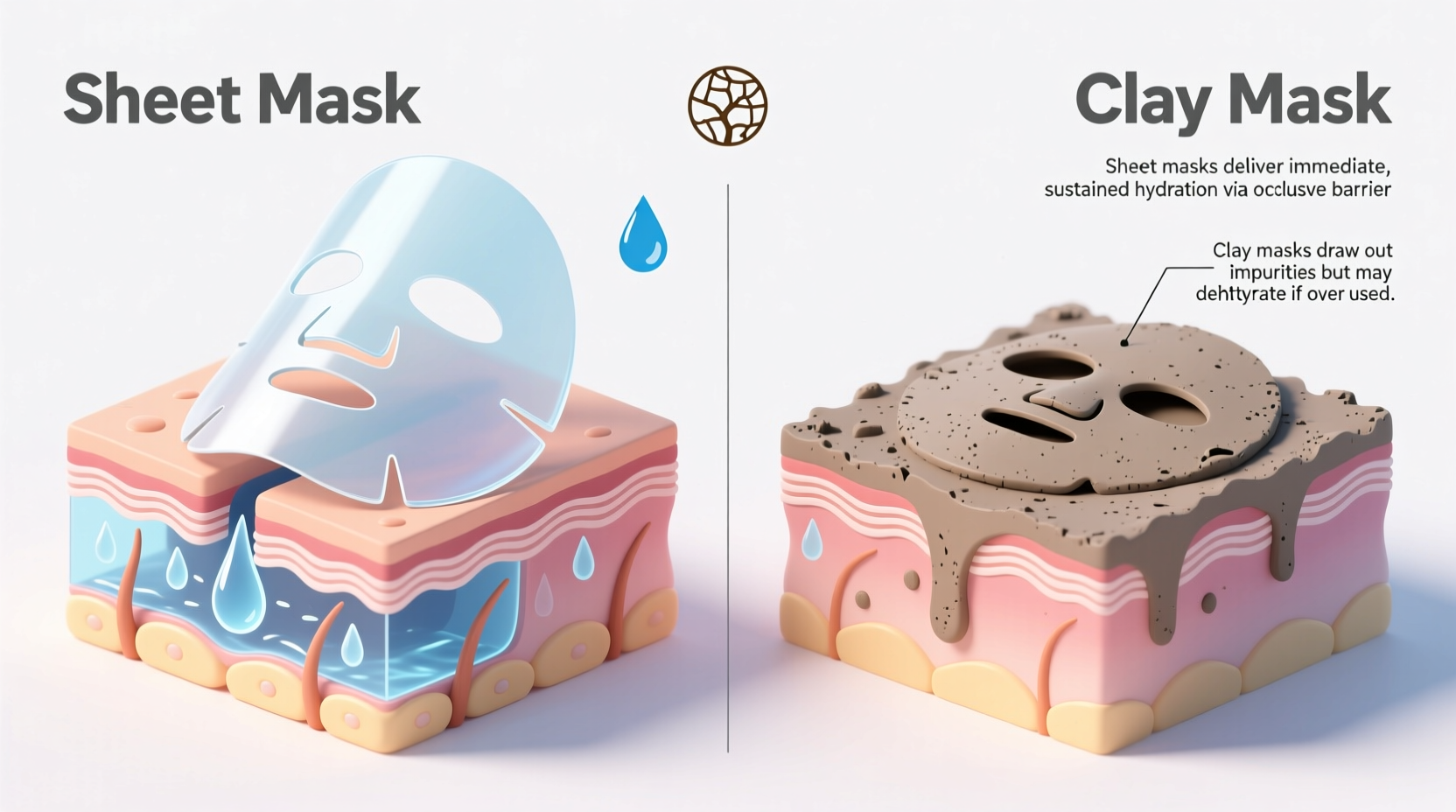
Clay masks and sheet masks interact with these hydration principles differently. One draws moisture out, while the other floods the skin with it. Recognizing this distinction is essential before deciding which is better for your goals.
Sheet Masks: The Hydration Powerhouse
Sheet masks are thin, fiber or cellulose-based sheets soaked in a concentrated serum. They are designed to deliver high concentrations of active ingredients directly to the skin, with the physical sheet acting as a seal that prevents evaporation and enhances absorption.
The occlusive nature of the sheet creates a temporary microenvironment on the face, trapping moisture and increasing skin permeability. This allows humectant-rich serums—often packed with hyaluronic acid, amino acids, and botanical extracts—to penetrate deeper and remain longer in contact with the skin.
Most sheet masks are formulated specifically for hydration. A single 15–20 minute session can result in visibly dewier, bouncier skin immediately afterward. Studies have shown that consistent use of hydrating sheet masks over several weeks leads to measurable improvements in skin moisture levels and elasticity.
Key Benefits of Sheet Masks for Hydration
- Deliver high-dose humectants directly to the skin
- Create an occlusive barrier that boosts ingredient penetration
- Provide instant visible improvement in skin texture and plumpness
- Often include soothing agents like centella asiatica or allantoin to support barrier health
- Require minimal effort and fit easily into daily routines
Clay Masks: Clarifying, Not Moisturizing
Clay masks, typically made from mineral-rich earth clays like kaolin, bentonite, or French green clay, function primarily as absorbent agents. Their main purpose is to draw out excess sebum, unclog pores, and remove impurities from oily or acne-prone skin.
While some clay formulations include hydrating additives such as aloe vera or honey, the base mechanism of clay is inherently drying. It works by binding to oils and toxins on the skin’s surface and pulling them out as the mask dries. This can leave the skin feeling tighter—and sometimes overly stripped—especially if used too frequently or on dry skin types.
Even “hydrating” clay masks rarely match the moisture delivery of a dedicated sheet mask. Any added humectants are usually secondary to the clay’s purifying action and don’t compensate for the overall desiccating effect.
“Clay masks are excellent for detoxifying and mattifying, but they should not be relied upon for hydration. In fact, using them without proper follow-up moisturization can worsen dehydration.” — Dr. Lena Torres, Board-Certified Dermatologist
When Clay Masks Might Seem Hydrating
Sometimes, users report that their skin feels smoother after a clay mask. This sensation is often due to the removal of dead skin cells and surface debris, which improves texture temporarily. However, this is exfoliation—not hydration. Without replenishing moisture afterward, the skin may rebound with increased oil production or irritation.
Direct Comparison: Sheet Masks vs. Clay Masks for Hydration
| Feature | Sheet Mask | Clay Mask |
|---|---|---|
| Primary Function | Hydration and nourishment | Pore cleansing and oil control |
| Main Ingredients | Hyaluronic acid, glycerin, plant extracts, peptides | Kaolin, bentonite, charcoal, salicylic acid |
| Effect on Skin Moisture | Increases hydration significantly | Can reduce surface oil but may dehydrate |
| Best Skin Types | Dry, dehydrated, combination, sensitive | Oily, acne-prone, combination |
| Frequency of Use | 2–4 times per week (depending on formula) | 1–2 times per week max |
| Post-Mask Step Needed? | Light moisturizer (optional) | Hydrating serum and moisturizer (essential) |
The data makes it clear: if hydration is your goal, sheet masks are purpose-built for the task. Clay masks, while valuable in their own right, work against hydration unless carefully balanced with post-treatment care.
Step-by-Step: Building a Hydration-First Masking Routine
If you’re looking to maximize hydration, follow this simple yet effective weekly plan that prioritizes moisture retention and skin barrier support.
- Cleanse Gently: Use a sulfate-free, non-stripping cleanser to remove dirt without compromising natural oils.
- Tone with Hydration in Mind: Apply a hydrating toner containing ingredients like rice ferment or sodium PCA to prep the skin.
- Apply a Hydrating Sheet Mask: Choose one with hyaluronic acid, betaine, or polyglutamic acid. Leave on for 15–20 minutes.
- Press in Remaining Serum: After removing the mask, gently pat the leftover essence into your skin instead of rinsing it off.
- Seal with Moisturizer: Lock everything in with a ceramide-rich cream or sleeping mask, especially at night.
- Limit Clay Mask Use: If using clay masks, restrict to once a week and always follow with intensive hydration.
Real Example: Sarah’s Winter Skin Rescue
Sarah, a 34-year-old office worker in Chicago, struggled every winter with tight, flaky skin despite using a rich moisturizer. She had been rotating between clay masks and sheet masks, believing both contributed to “cleansing and renewal.” After consulting a dermatologist, she learned her twice-weekly clay mask use was stripping her already dry skin, worsening dehydration.
She switched to a new routine: eliminating clay masks entirely during winter months and using a hyaluronic acid-infused sheet mask three times a week. Within two weeks, her skin felt noticeably softer, looked more even, and no longer required constant reapplication of face cream. By spring, she reintroduced a gentle clay mask just once a month, always followed by a hydrating serum.
Sarah’s experience illustrates how mismatched masking choices can undermine even the best skincare intentions. Aligning product function with skin needs made all the difference.
Expert Insight: Why You Can’t Hydrate With Absorbents
“You wouldn't try to fill a bathtub with the drain open—that’s what happens when you use a clay mask expecting hydration. Clays are absorbents. They pull things out. To hydrate, you need delivery systems that push moisture in. That’s where sheet masks shine.” — Dr. Naomi Reed, Cosmetic Formulation Scientist
This analogy captures the core issue. Hydration requires containment and infusion. Clay masks, by design, do the opposite. Even advanced formulas with added botanicals cannot override the fundamental behavior of clay minerals.
Checklist: Choosing the Right Mask for Your Hydration Goals
Use this checklist to determine whether a sheet mask or clay mask is right for your current skin condition:
- ✅ Is your skin feeling tight, rough, or dull? → Choose a sheet mask
- ✅ Are you preparing for a special event and want glowing skin? → Choose a sheet mask
- ✅ Do you have visible shine and clogged pores in the T-zone? → Consider a clay mask (but only if not dehydrated)
- ✅ Have you recently worn heavy makeup or been exposed to pollution? → Use a clay mask occasionally, then follow with hydration
- ✅ Are you using retinoids or exfoliating acids? → Avoid clay masks; prioritize sheet masks to support barrier repair
- ✅ Do you live in a dry or cold climate? → Prioritize sheet masks; limit clay to once every 10–14 days
Frequently Asked Questions
Can I use a clay mask if my skin is dehydrated?
No, it’s not advisable. Dehydrated skin lacks water, and clay masks will further draw out moisture, potentially leading to irritation, redness, and compromised barrier function. If you must use one, limit application time to 5 minutes, avoid harsh variants, and follow immediately with a hydrating serum and occlusive moisturizer.
Do some clay masks actually hydrate?
Some brands market “hydrating clay masks” by blending clays with aloe, honey, or glycerin. While these additions offer minor moisture benefits, they don’t negate the drying nature of the clay itself. These formulas may be gentler than traditional versions but still shouldn’t replace true hydrating treatments like sheet masks.
How often should I use a sheet mask for optimal hydration?
For most people, 2–3 times per week is ideal. Those with severely dehydrated skin may benefit from daily use for 1–2 weeks, then scaling back to maintenance frequency. Overuse is unlikely to cause harm unless the formula contains sensitizing ingredients, but moderation ensures cost-effectiveness and sustainability.
Final Thoughts: Match the Mask to the Mission
The question isn’t whether sheet masks are “better” in general—it’s whether they’re better for hydration. And the answer is unequivocally yes. Sheet masks are engineered to flood the skin with water-binding ingredients and enhance their delivery through occlusion. Clay masks, conversely, are purifying tools designed to absorb excess oil and refine pores.
Using the wrong tool for the job can lead to counterproductive results. Applying a clay mask to dehydrated skin is like mopping a floor with a dirty rag—you might move things around, but you’re not solving the root problem. On the other hand, a well-formulated sheet mask acts like a targeted IV drip for your complexion, delivering exactly what thirsty skin needs.
That said, both have value in a comprehensive skincare regimen. The key is strategic use. Reserve clay masks for weekly deep-cleansing sessions when oil control is the priority. Turn to sheet masks whenever your skin needs a moisture reset—after travel, exposure to dry air, or periods of stress.




 浙公网安备
33010002000092号
浙公网安备
33010002000092号 浙B2-20120091-4
Comments
No comments yet. Why don't you start the discussion?