
The moon phase complication is one of horology’s most poetic achievements—a mechanical homage to celestial rhythms. Found on luxury timepieces from brands like Patek Philippe, Jaeger LeCoultre, and Rolex, this feature tracks the lunar cycle with precision and artistry. While it may seem ornamental at first glance, understanding how to read and use a moon phase dial transforms it from aesthetic flourish into a functional tool rooted in astronomical tradition.
Moon phase watches have been crafted for centuries, originally serving agricultural, navigational, and religious purposes. Today, they are prized not only for their craftsmanship but also for their connection to nature’s cycles. Whether you’re a seasoned collector or new to mechanical watches, mastering this complication deepens your appreciation of fine watchmaking and adds a layer of meaning to your daily wear.
Understanding the Lunar Cycle and Watch Mechanics
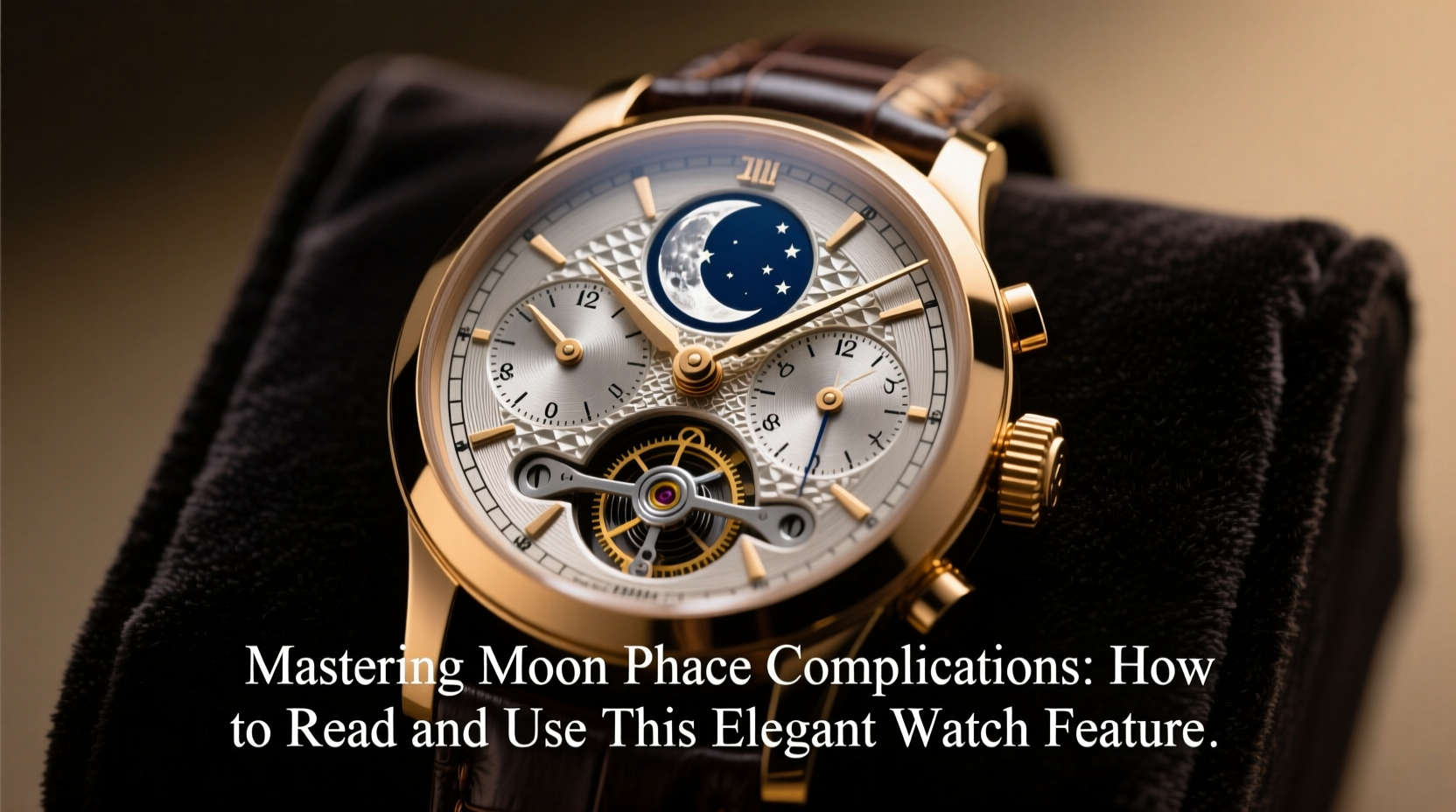
The moon completes one full cycle—known as a synodic month—approximately every 29.53 days. This means that from new moon to full moon and back again takes just under 30 days. Mechanical moon phase watches replicate this using a gear system connected to the movement, typically advancing the display once per day.
Inside the watch, a disc with two identical moons rotates beneath an aperture on the dial. As the gears turn, the visible portion of the moon changes, mimicking the waxing and waning phases. Most standard moon phase mechanisms use a 59-tooth gear, which advances the disc by one notch each day, completing a full rotation every 59 days—or two lunar cycles. This design results in an error of about one day every 2.5 years, though high-precision versions can reduce this discrepancy significantly.
“The moon phase is more than decoration—it’s a miniature astronomical instrument worn on the wrist.” — Dr. Hans Müller, Horological Historian
How to Read a Moon Phase Dial
Reading a moon phase complication is intuitive once you understand its layout. The display usually appears as a cutout window on the dial, revealing part of a rotating disc depicting two moons against a starry sky.
- New Moon: The moon is entirely hidden; only the dark half is visible.
- Waxing Crescent: A sliver of light appears on the right side (in Northern Hemisphere displays).
- First Quarter: Half of the moon is illuminated.
- Full Moon: The entire moon face is visible.
- Last Quarter and Waning: Illumination decreases, starting from the left side.
Some dials include small labels such as “Luna” or “Moon,” while others integrate the function subtly within subdials. Always note whether the display follows Northern or Southern Hemisphere conventions, as the direction of waxing and waning differs between them.
Setting and Calibrating Your Moon Phase Watch
To get accurate readings, your moon phase must be correctly synchronized with the current lunar cycle. This requires a simple setup process, ideally done during a known full or new moon.
Step-by-Step Guide to Setting the Moon Phase
- Determine today’s lunar phase. Use a trusted almanac, astronomy app, or website like timeanddate.com to confirm the current moon stage.
- Pull the crown to the time-setting position. On many watches, the moon phase is adjusted via a secondary function of the crown or a pusher near the case edge.
- Advance the date until the correct phase aligns. Since most moon phase discs jump forward incrementally with the date, scroll through several days until the visual matches reality.
- Verify alignment weekly. Check against a lunar calendar to ensure accuracy, especially in the first month after setting.
- Adjust annually if needed. High-beat movements may require correction every 2–3 years, but some boutique models offer instantaneous corrections via dedicated correctors.
Consult your watch manual—some brands lock moon phase adjustment during certain hours to protect the mechanism. Never force the setting if resistance occurs.
Practical Uses Beyond Aesthetics
While often seen as decorative, the moon phase has real-world applications across disciplines:
- Fishing and Hunting: Many anglers and hunters schedule outings around moon phases, believing activity peaks during full or new moons due to increased animal movement.
- Gardening: Biodynamic farming relies on lunar calendars, planting root crops during waning moons and leafy plants during waxing phases.
- Tidal Awareness: Coastal travelers and sailors use moon phases to anticipate stronger tides, particularly during spring tides (full and new moons).
- Cultural and Spiritual Observances: Religious festivals like Ramadan, Easter, and Chinese New Year are determined by lunar calendars.
In these contexts, having a reliable moon phase reference on your wrist offers convenience without needing digital tools.
Mini Case Study: A Sailor’s Trusted Companion
James R., a coastal charter captain in Maine, wears a vintage-inspired IWC moon phase chronograph while navigating tidal waters. “I don’t always have signal out on the bay,” he explains. “Knowing when we’re approaching a full moon helps me anticipate stronger currents near narrow passages. My grandfather used a paper almanac; now I just glance at my watch.” His model, set accurately twice a year, has become integral to trip planning—even when GPS is available.
Do’s and Don’ts of Moon Phase Watch Ownership
| Do’s | Don’ts |
|---|---|
| Set the moon phase during a clear night when you can observe the actual moon. | Never adjust the moon phase between 9 PM and 3 AM—this risks damaging the date mechanism. |
| Use official manufacturer tools or a plastic stylus for push-button adjustments. | Avoid using metal objects that could scratch the case or damage pushers. |
| Pair with a lunar calendar app for initial calibration. | Assume all moon phase watches are equally accurate—standard ones drift over time. |
| Service your watch every 5–7 years to maintain gear integrity. | Ignore persistent misalignment—it may indicate a deeper mechanical issue. |
FAQ
How often does a moon phase watch need adjustment?
A typical moon phase mechanism deviates by one day approximately every 2.5 years. Some high-precision variants, like those with a 135-tooth gear, remain accurate for over 120 years before requiring correction.
Can I set the moon phase independently of the time?
Yes, most modern moon phase watches allow independent adjustment via a recessed corrector button or through the crown in a specific position. Refer to your user manual for model-specific instructions.
Why do some moon phase watches show two moons instead of one?
The disc contains two identical moons so it can complete a full cycle every 59 days (covering two lunar months). This simplifies the gearing and ensures smooth progression across the aperture.
Expert Tips for Long-Term Accuracy
- ✅ Synchronize your watch with an authoritative lunar source upon purchase.
- ✅ Keep the watch wound consistently—stopping can disrupt both time and phase tracking.
- ✅ Store in a winder if not worn daily, especially for automatic movements.
- ✅ Record the last correction date in your watch journal for future reference.
- ✅ Choose models with quick-set functions for hassle-free updates.
Conclusion
Mastering the moon phase complication elevates your relationship with your timepiece. It bridges engineering and poetry, reminding us that even in an age of satellites and smart devices, there’s value in observing the sky through mechanical artistry. By learning to read, set, and apply this feature, you unlock both utility and wonder—one lunar cycle at a time.




 浙公网安备
33010002000092号
浙公网安备
33010002000092号 浙B2-20120091-4
Comments
No comments yet. Why don't you start the discussion?