
For decades, the ritual of draping strings of lights across eaves, winding them around banisters, and carefully securing each bulb to the porch rail defined the visual language of Christmas. Then came the projector: a sleek black box that, with the press of a button, blankets your home in shimmering snowflakes, animated reindeer, or cascading ribbons of color. Both promise joy, both aim for wonder—but they deliver it through fundamentally different sensory pathways. The question isn’t whether one is “better” than the other. It’s whether the magic they generate resonates in the same way—with your family, your neighbors, and the quiet, unspoken expectations we carry about what Christmas *feels* like.
The Physics of Light: How Each System Actually Works
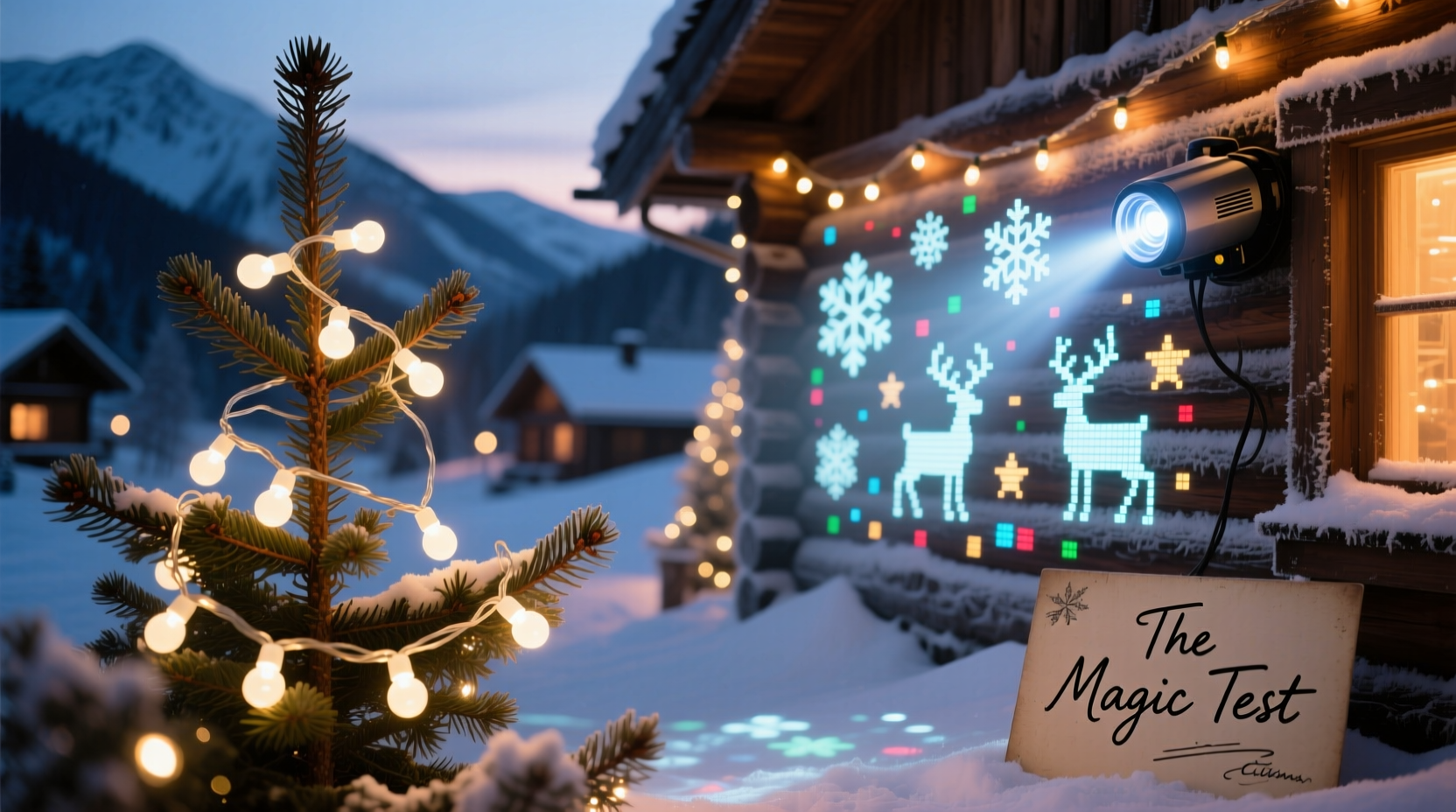
Real string lights operate on direct illumination: each bulb emits light from its own filament or LED chip. That light travels outward in all directions (or, in directional LEDs, with controlled beam angles), interacting physically with surfaces—branches, shingles, glass, snow-covered shrubs. The result is texture, depth, and variation: warm white bulbs cast soft halos; cool white ones highlight architectural edges; multicolor strings create rhythmic pulses when wired for chasing effects. Because every bulb is a discrete source, shadows fall naturally, highlights catch on wet pavement, and wind makes the whole display subtly breathe.
Projectors, by contrast, use optical projection—like miniature movie theaters mounted on tripods or brackets. They emit a focused beam of light through a lens system, often passing through rotating gobo wheels (metal or glass templates) or digital microdisplays. What you see isn’t light emanating *from* the house—it’s light *projected onto* it. This creates flat, high-contrast patterns with crisp edges and uniform brightness across large areas. A single projector can cover an entire façade where 300+ individual bulbs would be needed—but it cannot replicate the three-dimensional interplay of light and physical form that string lights achieve.
Installation & Practical Realities: Time, Tools, and Tolerance
String lights demand commitment. Installing 200 feet of C9 bulbs on a two-story Colonial involves ladders, extension cords rated for outdoor use, gutter clips, zip ties, weatherproof connectors, and at least two people if safety is non-negotiable. You’ll spend hours measuring, testing, troubleshooting flickering sections, and repositioning strands to avoid gaps. But once installed, they’re stable—wind may sway them, but they won’t drift out of alignment.
Projectors are faster to set up—often under 15 minutes. Mount the unit on a tripod or wall bracket, plug it in, adjust focus and angle, and you’re done. No climbing, no wiring multiple circuits, no bulb-by-bulb inspection. However, their performance hinges on environmental precision. A slight shift in mounting height changes pattern scale. A rainy night scatters light, washing out contrast. Snow accumulation on the lens kills visibility. And if your house has textured stucco or deep shadowed soffits, the projected image fractures unpredictably—what looks perfect on smooth brick may dissolve into abstraction on cedar siding.
| Factor | Real String Lights | Christmas Light Projectors |
|---|---|---|
| Setup Time (average 2,000 sq ft home) | 4–8 hours over 1–2 days | 20–45 minutes |
| Tools Required | Ladder, gloves, voltage tester, clips, surge protector | Level, measuring tape, optional mounting bracket |
| Weather Sensitivity | Moderate (wet connections risk shorts; wind may loosen clips) | High (rain, fog, frost, or heavy snow drastically reduce clarity) |
| Adjustability Post-Install | Low (repositioning requires full re-hanging) | High (tilt, pan, zoom, and pattern rotation possible) |
| Lifespan (with care) | 3–7 years (LED strings); bulbs replaceable | 2–5 years (LED lamp life degrades; lenses scratch; motors wear) |
The Emotional Architecture of Holiday Light
Magic isn’t just visual—it’s tactile, auditory, nostalgic, and communal. String lights engage multiple senses simultaneously. You feel the cool plastic of the cord in your hands. You hear the faint hum of transformers or the satisfying *click* of a bulb seating into its socket. You smell pine needles dusted with light-warmed resin when hanging lights on a fresh tree. And crucially, you participate: children help untangle strands, grandparents recount how they used to wrap lights around milk bottles in the 1950s, teenagers argue over which color scheme “feels more festive.” The labor becomes part of the tradition—the doing *is* the meaning.
Projectors streamline the doing—but at a cost to embodied engagement. There’s little for small hands to hold or older hands to manipulate. No shared problem-solving when a strand goes dark. The experience leans toward passive reception: you press play, and spectacle arrives. This suits families with mobility challenges, tight schedules, or homes with complex architecture—but it risks flattening the ritual into consumption rather than creation.
“The most enduring holiday traditions aren’t about perfection—they’re about presence. When a child spends ten minutes carefully placing one bulb on the lowest branch of the tree, that’s where memory lives—not in the pixel-perfect symmetry of a projected starfield.” — Dr. Lena Torres, Cultural Anthropologist, author of Festive Materiality: How Objects Shape Belonging
A Real-World Comparison: The Henderson Family’s Two-Year Experiment
In suburban Columbus, Ohio, the Henderson family tested both systems head-to-head across two consecutive seasons. In Year One, they installed 1,200 warm-white LED mini-lights on their Craftsman bungalow: 400 on the roofline, 300 wrapped around porch columns, 500 draped across the front-yard arbor. Setup took three evenings, including one rain delay. Their 7-year-old daughter helped clip lights to gutters; their 82-year-old grandfather tested each section with a multimeter. On Christmas Eve, neighbors commented on how “cozy” and “inviting” the house felt—the lights glowed warmly against frosted windowpanes, and the arbor looked like a tunnel of honeyed light.
In Year Two, they replaced everything with a dual-lens projector system: one lens for animated snowfall on the front wall, another for slow-pulsing gold-and-red patterns on the garage door. Setup was effortless. The visual impact was undeniably bold—especially after dark, when the projections popped against the black sky. But something felt off. Their daughter asked, “Where do the lights *live*?” She missed touching them. Their grandfather remarked, “It’s pretty, but it doesn’t *breathe*.” And when a December ice storm coated the projector lens overnight, the display vanished until they noticed and wiped it clean at noon the next day—leaving the house dark for 14 hours during peak viewing time.
By New Year’s, the Hendersons had returned to string lights—but kept the projector for their backyard patio, where quick setup and weather-resistant mounting made sense. Their conclusion? “Projectors are brilliant tools for specific jobs. But for the heart of the home—the front porch, the tree, the window frames—real lights still hold the soul.”
Your Decision Framework: Choosing Based on Purpose, Not Preference
Instead of asking “Which is better?”, ask: “What role does this light serve in *my* holiday ecosystem?” Use this step-by-step framework to decide:
- Define the location’s primary function: Is it high-visibility curb appeal (e.g., street-facing façade)? Intimate gathering space (e.g., covered porch)? Or decorative accent (e.g., mantle, staircase)?
- Assess physical constraints: Are there tall ladders required? Is the surface smooth (good for projection) or deeply textured (better for string lights)? Is there reliable outdoor GFCI outlet access within 25 feet?
- Evaluate household capacity: Do you have time and physical ability for multi-hour installation? Is someone available to assist safely? Does anyone in your household derive joy from the process itself—or is ease the priority?
- Consider longevity goals: Are you investing for one season or five? Will you store equipment year-round? Can you commit to cleaning projector lenses monthly and replacing LED modules every 3 years?
- Test the emotional weight: Walk past your own house at dusk. Does the idea of pressing a button satisfy your desire for control—or does it leave you feeling detached from the season’s warmth?
FAQ: Addressing Common Concerns Head-On
Do projectors use less electricity than string lights?
Generally, yes—but not as dramatically as marketing suggests. A high-output projector uses 25–45 watts. A 200-bulb LED string uses 12–20 watts. However, many households use *multiple* projectors (front, side, backyard) or pair one with supplemental strings—erasing the savings. Also, projectors run continuously; smart string-light controllers can dim, animate, or turn off sections during low-traffic hours, optimizing usage.
Can I mix projectors and string lights without clashing?
Absolutely—and it’s increasingly the professional standard. Use projectors for large-scale, kinetic backgrounds (e.g., swirling constellations on a garage wall) and strings for dimensional framing (e.g., outlining windows with warm white, or weaving red/green through holly garlands). Match color temperatures: choose 2700K warm-white strings to complement amber-toned projector animations, not cool 5000K projectors paired with icy-blue strings.
Are projectors safe around children and pets?
They pose different risks than strings. Projectors have no exposed wiring or hot bulbs, eliminating shock and burn hazards. However, their intense beams can cause temporary flash blindness if stared into directly—and curious toddlers may try to touch hot lenses or dislodge units from tripods. Mount projectors at least 7 feet high and out of reach, and use tamper-proof brackets. Strings, meanwhile, require secure anchoring to prevent tripping and GFCI protection to prevent ground faults.
Conclusion: Magic Isn’t Monolithic—It’s Multilayered
The magic of Christmas lights has never been a single, fixed phenomenon. It shifts with technology, adapts to ability, evolves with family needs, and deepens with intention. Projectors offer brilliance, speed, and scalability—making festive light accessible to those who might otherwise sit in darkness. Real string lights offer texture, participation, resilience, and a quiet, persistent humanity—the kind that shines through cracked ornaments and slightly uneven spacing. Neither replicates the other’s essence. And that’s precisely why the most meaningful displays often honor both: the projector casting wonder onto the wall, while real lights twinkle softly in the hands of a child placing the final bulb on the tree.
You don’t need to choose sides. You need to choose what serves your home, your people, and your heart—this year, and the next. Hang the strings with care. Aim the projector with purpose. And remember: the truest magic isn’t in the light itself, but in the shared pause it creates—a collective breath drawn in the dark, together.




 浙公网安备
33010002000092号
浙公网安备
33010002000092号 浙B2-20120091-4
Comments
No comments yet. Why don't you start the discussion?