
Decorating a Christmas tree is one of the most cherished holiday traditions. Yet, achieving the perfect glow—neither too dim nor blindingly bright—requires more than guesswork. Many people hang strings of lights without considering how much illumination their tree actually needs, resulting in uneven coverage or excessive energy use. Understanding the relationship between tree size, surface area, and lumen output allows you to create a balanced, visually appealing display. This guide breaks down how to calculate the ideal lumen output per square foot of your Christmas tree, offering practical tools, expert insights, and real-world examples to ensure your holiday centerpiece shines just right.
Why Lumen Output Matters for Christmas Trees
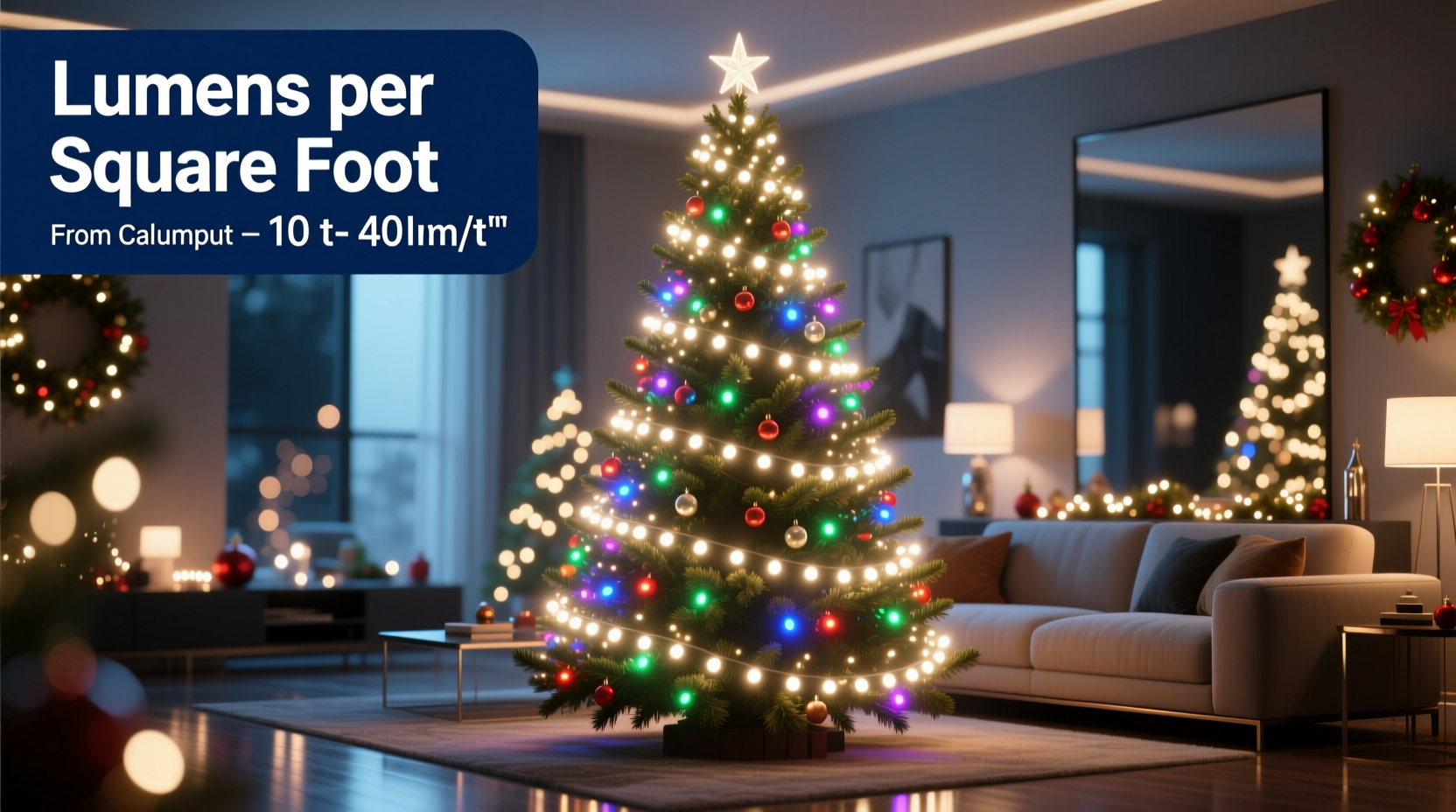
Lumens measure the total amount of visible light emitted by a source. Unlike watts, which indicate energy consumption, lumens tell you how bright a light appears to the human eye. When decorating a Christmas tree, selecting bulbs based on lumens—not wattage—gives you precise control over brightness. Too few lumens, and your tree may look underlit; too many, and it can overwhelm a room or increase electricity costs unnecessarily.
The goal is even, warm illumination that enhances the tree’s shape and ornaments without glare. A well-lit tree typically ranges from 50 to 150 lumens per square foot of surface area, depending on personal preference, ambient room lighting, and whether the tree is in a large hall or cozy living room.
Calculating Your Tree’s Surface Area
To determine how many lumens your tree needs, first calculate its surface area. While trees are conical, not flat, you can approximate the illuminated outer layer using the formula for the lateral surface area of a cone:
Surface Area = π × r × l
- π (pi) ≈ 3.1416
- r = radius of the base (half the tree’s width)
- l = slant height (distance from base edge to top of tree)
For example, a 7-foot-tall tree with a 4-foot diameter has a radius of 2 feet. If the slant height is approximately 7.3 feet (calculated via Pythagorean theorem: √(7² + 2²)), the surface area would be:
3.1416 × 2 × 7.3 ≈ 45.9 square feet
This number represents the total exterior “skin” of the tree where lights will be visible. Use this figure to estimate total lumen requirements.
Step-by-Step: Measuring Your Tree
- Measure the height of the tree from base to tip.
- Measure the widest diameter at the base and divide by two to get the radius.
- Calculate slant height: √(height² + radius²).
- Multiply π × radius × slant height to get surface area in square feet.
- Round up slightly to account for layered branches and depth.
Once you have the surface area, multiply it by your desired lumens per square foot to find total lumen output needed.
Recommended Lumen Ranges by Setting
Not every tree requires the same brightness. The ideal lumen density depends on room size, wall color, time of day visibility, and whether the tree is a focal point or background element.
| Setting | Lumens per Sq Ft | Description |
|---|---|---|
| Subtle Glow (Cozy Home) | 50–70 | Soft, ambient lighting ideal for intimate spaces. Best with warm white LEDs and dimmable strings. |
| Balanced Brightness | 80–100 | Standard recommendation for most living rooms. Ensures visibility without overpowering. |
| Vibrant Display (Large Room) | 110–130 | Suitable for high-ceiling areas or dark rooms. Enhances ornament detail and color reflection. |
| Festive Showcase (Event/Photo) | 140–150+ | Maximum sparkle for parties, photos, or commercial displays. Use sparingly in homes. |
A 45-square-foot tree aiming for balanced brightness (100 lumens/sq ft) would need about 4,500 total lumens. If each LED bulb produces 5 lumens, and a string has 100 bulbs (500 lumens per string), you’d need roughly 9 strings.
Real-World Example: Lighting a 6-Foot Pre-Lit Tree
Jamie wanted to supplement her pre-lit artificial tree for better coverage. The tree was 6 feet tall with a 3.5-foot diameter. Using the cone formula:
- Radius = 1.75 ft
- Slant height = √(6² + 1.75²) ≈ 6.25 ft
- Surface area = 3.1416 × 1.75 × 6.25 ≈ 34.3 sq ft
Aiming for vibrant but not overwhelming light (110 lumens/sq ft), Jamie calculated:
34.3 × 110 = 3,773 total lumens needed.
The tree already had 700 mini incandescent lights rated at 0.5 lumens each—just 350 total lumens. She added three strands of premium LED lights (each producing 1,200 lumens), bringing the total to 3,950 lumens—close to her target. After installation, the tree glowed evenly, enhancing silver and blue ornaments without washing out the room.
This case illustrates how understanding lumen output prevents under-lighting, especially with older pre-lit trees whose original bulbs may degrade over time.
Expert Insight: Lighting Design Principles
“People focus on bulb count, but lumens and distribution matter more. A tree lit from within appears fuller and warmer.” — Daniel Reeves, Holiday Lighting Designer & Author of *Festival Illuminations*
Reeves emphasizes internal lighting: weaving strings deep into branches rather than clustering them on the surface. This technique creates depth and reduces hotspots. He also recommends using multiple lower-lumen strings instead of a few high-output ones for smoother gradients.
“Warm white LEDs at 2700K mimic candlelight and pair beautifully with traditional decor. Avoid cool whites unless going for a modern icy theme.” — Maria Tran, Interior Stylist
Checklist: How to Achieve Perfect Tree Lighting
Follow this checklist to ensure optimal brightness and visual harmony:
- ✅ Measure your tree’s height and base diameter
- ✅ Calculate surface area using the cone formula
- ✅ Decide on desired ambiance (subtle, balanced, vibrant, or showcase)
- ✅ Multiply surface area by target lumens per square foot
- ✅ Check specifications of your light strings (lumens per bulb or per string)
- ✅ Calculate how many strings you need
- ✅ Test one string on the tree at night
- ✅ Install lights starting from the trunk outward, distributing evenly
- ✅ Step back and assess from multiple angles and distances
- ✅ Adjust or add strings if gaps or dark zones appear
Common Mistakes and How to Avoid Them
Even experienced decorators make errors when estimating brightness. Here are frequent pitfalls and solutions:
| Mistake | Consequence | Solution |
|---|---|---|
| Using only bulb count as a guide | Over- or under-lighting due to varying lumen output per bulb type | Always check lumen ratings, not just number of bulbs |
| Clustering lights on outer edges | Flat appearance with dark interior | Weave lights inward toward the trunk for depth |
| Ignoring room lighting conditions | Tree blends in or dominates the space | Test setup with typical evening lighting |
| Using mixed color temperatures | Inconsistent tone (e.g., warm and cool whites together) | Stick to one Kelvin rating across all strings |
| Overloading circuits | Tripped breakers or fire hazard | Follow manufacturer limits; use LED lights to reduce load |
FAQ
How many lumens does a standard Christmas light produce?
Mini incandescent bulbs typically emit 0.5 to 1 lumen each. LED equivalents range from 3 to 8 lumens per bulb, depending on quality and design. Always check packaging or product specs for exact values.
Can I mix different types of lights on one tree?
You can, but only if they match in color temperature and brightness level. Mixing dim incandescents with bright LEDs creates uneven patches. For best results, use one type or carefully balance output.
Do pre-lit trees provide enough lumens?
Many pre-lit trees fall short, especially older models. A typical 7.5-foot pre-lit tree might have 750 incandescent bulbs at 0.7 lumens each—just 525 total lumens. For a 50+ sq ft surface, that’s less than 10 lumens per square foot. Most benefit from supplemental lighting.
Conclusion: Shine Smart This Holiday Season
Creating a beautifully lit Christmas tree isn’t about covering every branch with lights—it’s about intelligent illumination. By calculating your tree’s surface area and matching it to the appropriate lumen output per square foot, you gain control over ambiance, efficiency, and visual impact. Whether you’re crafting a serene glow for quiet evenings or a dazzling centerpiece for holiday gatherings, the principles of brightness measurement transform decoration from guesswork into artistry. Take the time to measure, plan, and test. Your efforts will result in a tree that doesn’t just shine—but resonates with warmth, balance, and festive joy.




 浙公网安备
33010002000092号
浙公网安备
33010002000092号 浙B2-20120091-4
Comments
No comments yet. Why don't you start the discussion?