
There’s a quiet magic in a well-designed Christmas village: the soft glow of miniature lights, the gentle curve of snow-dusted rooftops, the sense of a story unfolding in miniature. Yet many homeowners abandon their villages after one season—not because they lack love for the tradition, but because the setup becomes overwhelming: tangled wires, mismatched scales, overcrowded shelves, and that nagging feeling that “it just looks busy.” Clutter doesn’t just strain the eyes—it dilutes the wonder. A truly magical village isn’t defined by quantity, but by intentionality: thoughtful placement, harmonious scale, curated lighting, and purposeful negative space. This guide distills over a decade of seasonal display expertise—from museum exhibit designers to award-winning holiday stylists—to help you build a village that breathes, delights, and endures.
Start with a Clear Vision—Not a Collection
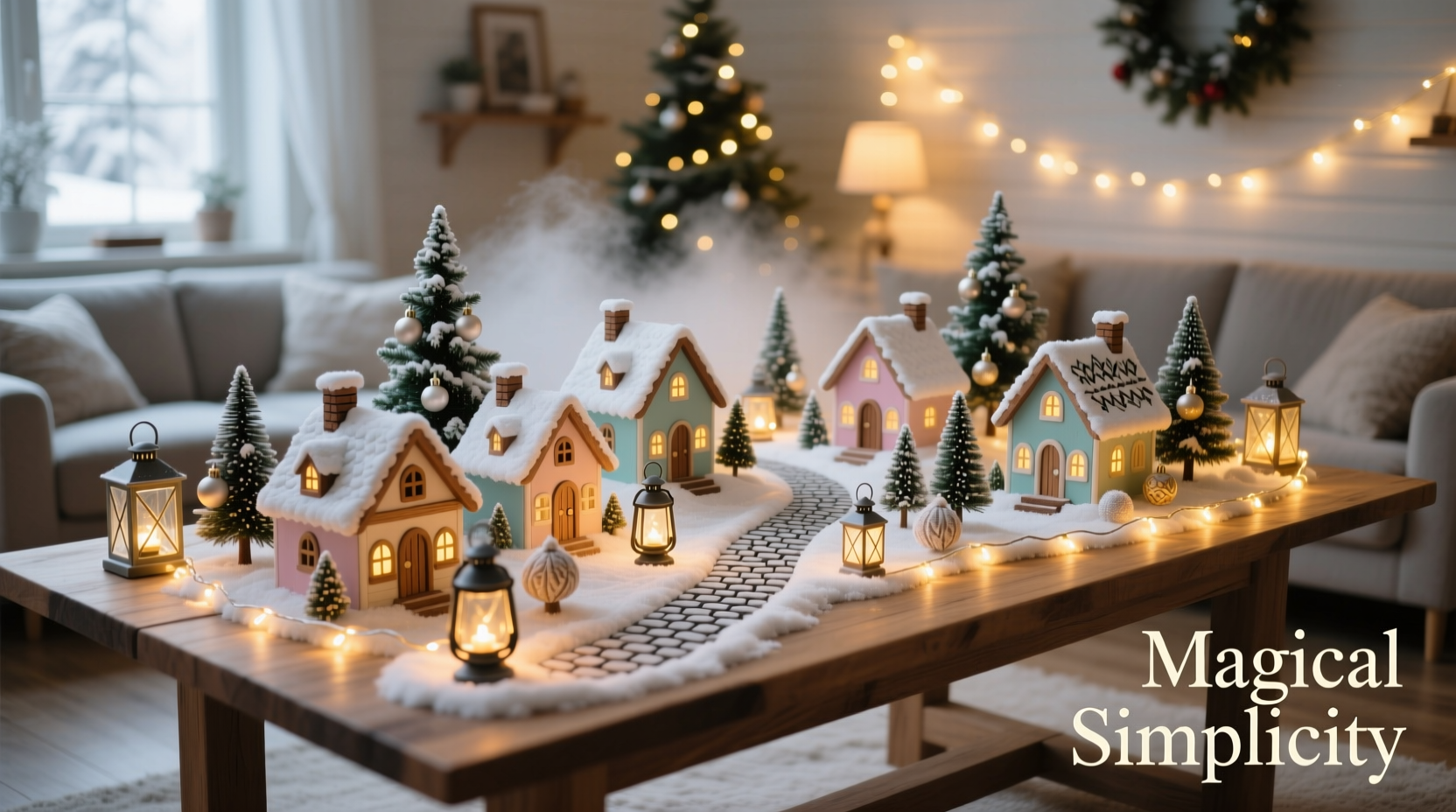
Most clutter begins long before the first house is unwrapped. It starts with accumulation: buying pieces across years without a unifying theme, scale, or color palette. Without a guiding vision, every new addition competes for attention—and loses meaning.
A cohesive village tells a single, quiet story. Is it a nostalgic New England hamlet? A snowy Alpine chalet cluster? A whimsical storybook lane with candy-cane lampposts and gingerbread chimneys? Choose one narrative thread—and let it govern every decision. That means resisting the “cute” figurine that doesn’t belong, even if it’s on sale.
Scale consistency is non-negotiable. Mixing 1:100 and 1:150 houses creates visual dissonance—even if the difference seems subtle. Stick to one manufacturer’s line, or verify scale markings before purchasing. If you own mixed-scale pieces, group them intentionally: place smaller buildings at the back (as distant hills) and larger ones toward the front—but only if they share proportional details (roof pitch, window size, door height). Otherwise, edit ruthlessly. A 12-piece village done well is more evocative than 30 pieces fighting for space.
The 3-Layer Spatial Framework
Clutter often stems from flat, two-dimensional arrangements—everything placed on the same surface plane, like postage stamps on a shelf. Professional display designers use depth deliberately. Apply this three-layer framework to any surface, from mantel to coffee table:
- Background Layer (Depth & Atmosphere): Use low-profile elements—snowy terrain mats, frosted birch branches, or subtle blue-gray felt—to suggest distance. Add a few tall, slender evergreen sprigs (real or high-quality faux) at the rear corners to frame the scene and lift the eye upward.
- Middle Layer (Narrative Core): This is where your primary buildings live—arranged in clusters of three or five, not rows. Leave at least 1.5 times a building’s width between structures. Vary roof heights slightly to create rhythm; avoid perfect symmetry unless you’re aiming for formal elegance.
- Foreground Layer (Human Scale & Detail): Introduce miniature figures (no more than 3–5), tiny sleds, or a single bench with a scarf-draped figure. These anchor the scene in relatable life—and signal to the viewer, “This is a place, not just a collection.”
This layering creates implied space, slows the viewer’s gaze, and eliminates the “wall of stuff” effect. It also makes wiring nearly invisible: run LED string lights along the background layer’s base, tuck battery packs beneath terrain mats, and route micro-USB cords behind evergreens.
Lighting as Sculpture—Not Just Illumination
Lighting transforms a static arrangement into a living vignette—but poorly executed lighting is the #1 cause of perceived clutter. Harsh, uneven, or overly bright lights flatten dimension and draw attention to dust, wires, and imperfections.
Think of light as a sculptural tool. Use three complementary sources:
- Base Glow: Warm-white micro-LED string lights (battery-operated, 20–30 bulbs) laid beneath terrain mats or under clear acrylic platforms. This creates a soft, diffused radiance—like snow reflecting ambient light.
- Architectural Accent: Tiny directional LEDs (3mm or 5mm) wired individually to highlight specific features: a glowing chimney, a lit shop window, or a lantern post. Use warm white (2700K–3000K) exclusively—cool white breaks the cozy spell.
- Ambient Halo: One small, dimmable LED puck light mounted above and slightly behind the display (not shining directly down). This casts gentle shadows that define form and add gravity.
| Lighting Type | Best For | Avoid |
|---|---|---|
| Warm-white micro-LED strings | Terrain base glow, path lighting | Visible wires, tangled coils, exposed batteries |
| Directional micro-LEDs | Windows, chimneys, signage | Cool-white bulbs, over-lighting more than 3–4 focal points |
| Dimmable puck lights | Soft overhead definition | Direct downward beams, multiple overhead sources |
Remember: less is more. A village with four precisely placed lights feels richer than one with 20 haphazardly scattered bulbs. Test lighting at dusk—not midday—with all room lights off. If you see glare, hotspots, or visible cords, adjust before finalizing.
Real-World Case Study: The Mantel That Breathes
Sarah, a graphic designer in Portland, Oregon, had collected village pieces for 12 years. Her mantel held 28 buildings, 14 trees, 7 lampposts, and dozens of figures—yet guests consistently said, “It’s so cute… but I can’t quite take it all in.” Frustrated, she consulted a local display artist who asked just two questions: “What’s the first word you want someone to say when they see it?” and “Where do you want their eye to land first?”
Sarah answered: “Calm.” And “the little bakery with the red awning.” With that, they edited—removing 19 pieces. They built a 2-inch-deep base from reclaimed pine, covered it in white-frosted burlap, and embedded warm micro-LEDs beneath. They grouped three buildings around the bakery (a church, a cottage, and a post office), all in matching 1:120 scale. They added two birch branches at the rear, angled outward to frame the scene, and placed one seated figure holding a paper bag outside the bakery door. No other figures. No extra trees. No additional lampposts.
The result? Guests now pause, smile softly, and say, “Oh—how peaceful.” The mantel no longer competes with the room; it invites quiet observation. Sarah stores the edited-down collection in labeled, stackable plastic bins with foam dividers—each bin dedicated to one “scene element” (buildings, terrain, lighting, figures). Setup now takes 45 minutes—not three evenings.
Step-by-Step: The 90-Minute Clutter-Free Setup
Follow this sequence—designed for efficiency, clarity, and joy—not frustration:
- Clear & Prep Surface (5 min): Wipe down shelf or mantel. Lay down a neutral base (linen runner, slate tile, or matte black acrylic sheet) to define boundaries and absorb visual noise.
- Sort & Select (10 min): Unpack all pieces. Remove anything damaged, mismatched in scale, or emotionally disconnected from your vision. Keep only what serves the story.
- Build Terrain Base (15 min): Arrange terrain mat, snow flocking, or crushed white eggshell. Embed lights *before* adding buildings. Tuck battery packs beneath.
- Place Core Buildings (20 min): Start with your focal point (e.g., the bakery). Place supporting buildings using the 1.5x-width rule. Step back every 3 placements. Adjust until spacing feels generous, not sparse.
- Add Vertical Elements (10 min): Insert birch branches, slender evergreens, or frosted twigs at rear corners—angled outward, not straight up.
- Insert Foreground Details (10 min): Add 1–3 figures, a single sled, or a tiny bench. Ensure they face inward—not out toward the viewer—to deepen the illusion of a lived-in world.
- Final Light Check (10 min): Turn off room lights. Observe glow distribution. Dim or reposition any light causing glare or distraction. Hide remaining cords with moss or bark chips.
This method prevents backtracking, reduces decision fatigue, and builds confidence through incremental wins. You’ll finish with a display that feels both intentional and effortless.
Expert Insight: The Psychology of Holiday Clarity
“Clutter doesn’t just occupy space—it occupies cognitive bandwidth. During the holidays, our brains are already processing heightened emotions, social demands, and sensory input. A visually overloaded village adds subconscious stress, not joy. But a thoughtfully edited scene? It acts as a micro-meditation—a 30-second pause where the mind can rest in harmony, symmetry, and quiet storytelling.” — Dr. Lena Torres, Environmental Psychologist & Author of Festive Spaces: Designing for Emotional Resonance
FAQ
How do I store my village to prevent clutter next year?
Use compartmentalized, stackable storage: one bin per category (buildings, terrain, lighting, figures), with foam inserts or cardboard dividers. Label each bin with contents *and* placement notes (“Bakery + Church + Cottage – middle layer”). Store in a cool, dry closet—not an attic or garage—where temperature swings won’t warp delicate materials.
Can I mix vintage and modern village pieces?
Yes—if you unify them through color and texture. Paint vintage pieces to match your modern set’s palette (use acrylic craft paint + matte sealant), or wrap bases in matching burlap or linen. Avoid mixing eras that clash tonally: 1950s pastel plastic with sleek 2020s matte ceramic rarely harmonizes. When in doubt, choose texture over era—e.g., all matte-finish pieces, regardless of age.
What’s the biggest mistake people make with lighting?
Overloading the scene with too many light sources—and using cool-white LEDs. Warm light (2700K–3000K) mimics candlelight and fireplaces, triggering feelings of safety and nostalgia. Cool light reads as clinical, even alienating, during the holidays. Stick to three light types max, and always test in full darkness.
Conclusion
A magical Christmas village isn’t measured in square inches of occupied space—or in the number of pieces displayed. It’s measured in the quality of attention it commands, the stillness it invites, and the quiet delight it sparks in those who pause to look. Clutter isn’t the enemy of abundance; it’s the symptom of unclear intention. When you choose fewer pieces, honor scale, sculpt with light, and design for depth—not density—you don’t sacrifice magic—you refine it. You transform decoration into meaning. You turn a seasonal task into a mindful ritual—one that gathers your family not just around the display, but around shared calm, shared focus, and shared presence.




 浙公网安备
33010002000092号
浙公网安备
33010002000092号 浙B2-20120091-4
Comments
No comments yet. Why don't you start the discussion?