
When it comes to holiday decorating, few elements capture the spirit quite like a beautifully lit Christmas tree. But behind that magical glow lies a decision many homeowners face each year: should you go with color changing smart bulbs or stick with traditional fixed color light sets? The choice isn’t just about aesthetics—it impacts convenience, cost, energy use, and long-term versatility. Understanding the strengths and limitations of each option helps ensure your tree becomes a centerpiece of joy rather than a seasonal headache.
The Evolution of Holiday Lighting
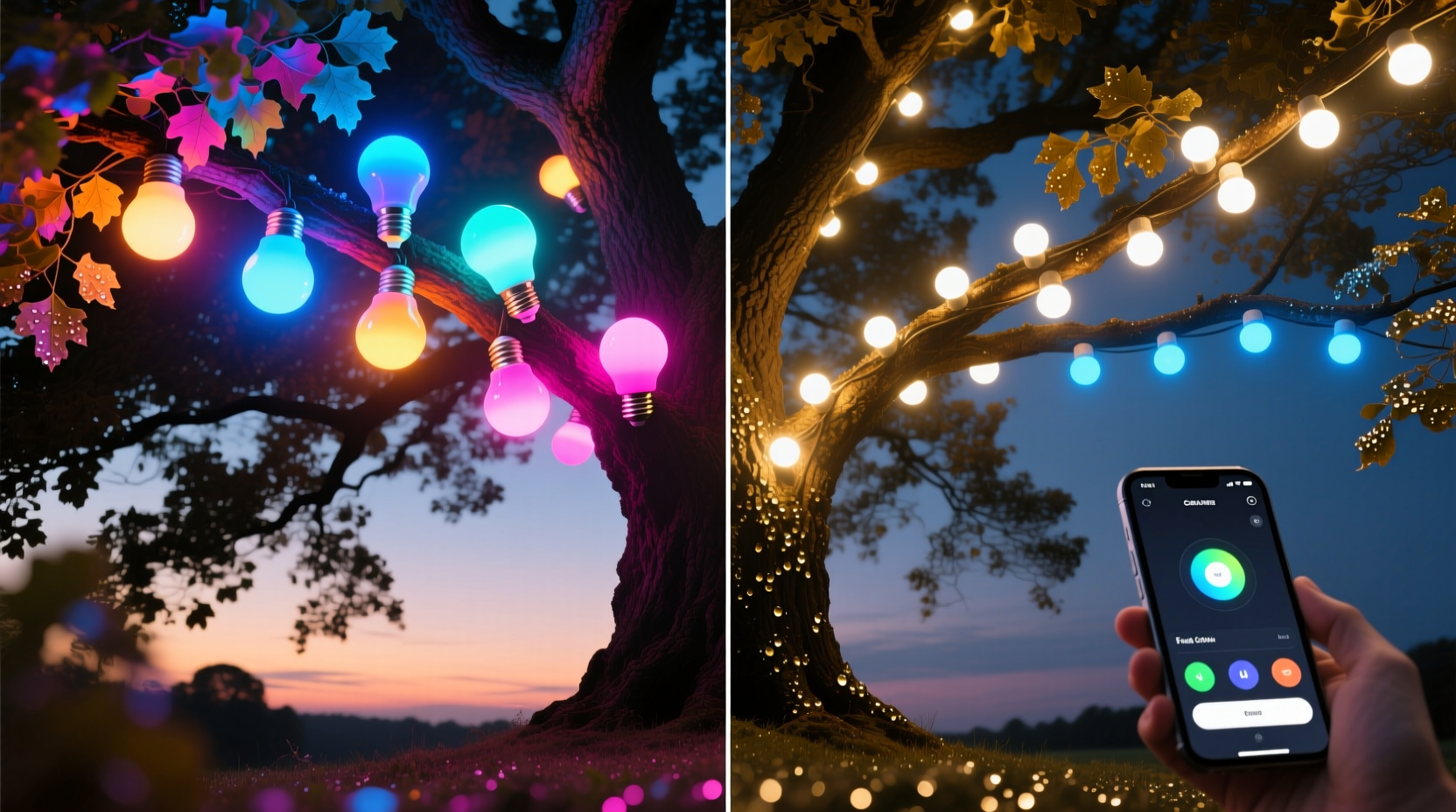
Christmas lights have come a long way since their first appearance on trees in the late 19th century. What began as dangerous candle-lit branches has evolved into sophisticated LED systems capable of shifting colors, syncing to music, and even responding to voice commands. Today’s market offers two dominant categories: fixed-color string lights and smart, color-changing alternatives. While both can deliver stunning visual results, they serve different needs and preferences.
Fixed color sets remain popular due to their simplicity and affordability. These are typically pre-wired with one hue—such as warm white, cool white, multicolor (red, green, blue, yellow), or specialty tones like purple or blue. They plug in and shine consistently, requiring no setup beyond hanging them properly.
On the other hand, color changing smart bulbs offer dynamic control. Using Wi-Fi, Bluetooth, or proprietary RF protocols, these bulbs connect to smartphone apps or home automation systems. With them, users can shift hues, adjust brightness, create lighting scenes, set schedules, and even synchronize effects with music—all from a phone or voice assistant.
Performance and Flexibility Compared
The most significant difference between the two options lies in flexibility. Fixed color sets provide reliability but lock you into one look per strand. If you want red and gold one year and icy blue the next, you’ll need multiple sets stored separately. Smart bulbs eliminate this limitation entirely. One installation can produce thousands of colors and countless combinations, adapting to any theme, holiday, or mood.
Consider a family that hosts gatherings throughout the winter season. On Christmas Eve, they might set their tree to pulse gently in classic red and green. For New Year’s, the same lights transition to shimmering silver and deep blue. Come Valentine’s Day, soft pink and rose gold take over—all without touching a single bulb.
Installation and Setup Complexity
Fixed color lights are plug-and-play. Unbox, drape, plug in, enjoy. There's minimal technical knowledge required. Most sets are designed for durability, often rated for indoor or outdoor use, and many include end-to-end connectors so you can link multiple strands safely within electrical limits.
Smart bulbs, while more powerful, demand more attention during setup. Many require a hub (like Philips Hue Bridge), stable Wi-Fi, and app configuration. Some operate via Bluetooth but limit range and multi-device control. Installation also varies by bulb type—E12 candelabra bases are common for tree lights, but compatibility with adapters or controllers must be verified.
Beyond initial setup, smart systems may experience connectivity issues, firmware updates, or app glitches. A power surge or router reboot could temporarily disconnect lights until manually restored. For tech-savvy users, this is manageable. For others, it introduces unnecessary complexity.
Cost Analysis Over Time
At first glance, fixed color sets win on price. A quality 100-light LED strand costs between $8 and $15. You can fully illuminate a medium tree for under $30. Replacement strands are inexpensive and widely available.
Smart bulb kits start higher—often $50–$100 for a starter pack of 25–50 bulbs, plus potential hub costs. Full tree coverage might require two or three packs, pushing total investment to $150 or more. However, this upfront cost buys long-term adaptability. Instead of buying new sets every time your décor changes, you reuse the same bulbs indefinitely.
“Smart lighting pays for itself in versatility. One system replaces ten seasonal purchases.” — Jordan Lee, Smart Home Lighting Designer
Visual Impact and Creative Control
When it comes to ambiance, smart bulbs offer unmatched creative freedom. Apps allow precise color selection using RGB sliders, preset themes, or inspiration from photos. Want your tree to match your living room’s accent pillows? No problem. Need lights that dim gradually for a calming effect before bed? Easily done.
Advanced features include:
- Scene presets (e.g., “Winter Forest,” “Festive Pulse”)
- Music synchronization (lights react to rhythm and volume)
- Geofencing (lights turn on when your phone approaches home)
- Voice integration (via Alexa, Google Assistant, Siri)
Fixed color sets, while limited, can still deliver strong visual appeal. Warm white creates an elegant, traditional feel; cool white feels modern and crisp. Multicolor strands evoke nostalgia and childlike wonder. Because the color output is consistent and predictable, designers often prefer them for cohesive holiday displays where uniformity matters.
Energy Efficiency and Longevity
Both types commonly use LED technology, meaning low power consumption and long lifespans—typically 25,000 to 50,000 hours. However, smart bulbs may draw slightly more standby power when connected to networks, especially if always-on hubs are involved. That said, the difference is marginal—usually less than 1 watt in idle mode.
Heat generation is negligible with LEDs, making both options safe for real and artificial trees. Still, proper spacing and avoiding knotting wires help prevent localized overheating and extend lifespan.
Comparison Table: Key Features at a Glance
| Feature | Color Changing Smart Bulbs | Fixed Color Sets |
|---|---|---|
| Initial Cost | High ($50–$150+) | Low ($8–$15 per strand) |
| Color Options | Thousands (RGB control) | One per strand |
| Setup Difficulty | Moderate to high (app/hub needed) | Low (plug-and-play) |
| Lifespan | 25,000–50,000 hours | 25,000–50,000 hours |
| Smart Features | Scheduling, voice control, music sync | None |
| Best For | Tech lovers, evolving décor, renters | Traditionalists, budget decorators |
Real-World Scenario: The Urban Apartment Dweller
Maria lives in a downtown loft with floor-to-ceiling windows and an open-concept living space. Every year, she rethinks her holiday aesthetic—sometimes minimalist white, sometimes bold rainbow. She hosts friends frequently and likes to impress with immersive experiences.
After years of storing multiple light sets, she invested in a smart bulb system. Now, she uses a single set of color-changing bulbs on her tree. With a tap on her phone, the entire mood shifts. During dinner parties, she activates a slow fade from amber to crimson. On quiet nights, she dims to warm white with a subtle twinkle.
The initial learning curve was steeper than expected—she had to update firmware and reset her bridge once—but now the system runs smoothly. She estimates she’s saved space and money by eliminating five separate light strands she used to rotate annually.
For Maria, the upgrade wasn’t just about convenience—it transformed her holiday experience into something interactive and personal.
Step-by-Step Guide: Choosing the Right Option for Your Needs
- Evaluate your decorating style. Do you change themes yearly or stick to a classic look? Frequent changers benefit more from smart bulbs.
- Assess your tech comfort level. Are you comfortable managing apps and troubleshooting connections? If not, fixed color may be safer.
- Calculate total tree coverage needed. Measure how many bulbs or strands you'll require. Compare total cost for both options.
- Check existing smart home setup. If you already use Alexa or Google Home, integrating smart bulbs is easier.
- Decide on primary use case. Is this for short-term holiday use only, or do you want year-round functionality (e.g., for parties)?
- Test one option first. Buy a single smart strand or a small smart bulb kit before committing to a full tree overhaul.
Frequently Asked Questions
Can I mix smart bulbs and fixed color lights on the same tree?
Yes, as long as they’re on separate circuits or power sources. Mixing allows you to keep a base layer of fixed warmth (like white tips) while adding dynamic color zones lower down. Just ensure voltage and connector types are compatible.
Do smart bulbs work during a power outage?
No—they require electricity. However, some systems resume previous settings once power returns, provided the hub and network are operational. Consider a surge protector with battery backup for critical components.
Are smart bulbs safe around children and pets?
Yes. Like fixed color LEDs, smart bulbs run cool and use low voltage. Ensure cords are secured and not within reach to prevent tripping or chewing hazards.
Action Plan Checklist
- ☐ Measure your tree height and circumference to estimate bulb count
- ☐ Decide on desired color palette(s) for current and future seasons
- ☐ Research compatible smart systems (Philips Hue, Govee, LIFX, etc.)
- ☐ Confirm Wi-Fi strength near your tree location
- ☐ Compare total cost: smart setup vs. multiple fixed color sets
- ☐ Purchase a sample strand to test brightness, color accuracy, and app function
- ☐ Label storage containers clearly if keeping both types
Final Thoughts: Matching Light to Lifestyle
The decision between color changing smart bulbs and fixed color sets ultimately reflects your lifestyle, priorities, and vision for the holidays. If consistency, ease, and tradition matter most, fixed color lights deliver charm without complication. They’re ideal for families who love the same cozy glow year after year.
But if you value creativity, customization, and long-term value, smart bulbs offer a future-proof solution. They grow with your tastes, reduce clutter, and bring a touch of modern magic to timeless traditions.
Technology doesn’t have to replace nostalgia—it can enhance it. Whether your tree glows in steady gold or dances through a spectrum of seasonal hues, what matters most is the warmth it brings to those gathered beneath it.




 浙公网安备
33010002000092号
浙公网安备
33010002000092号 浙B2-20120091-4
Comments
No comments yet. Why don't you start the discussion?