
Every morning, millions of people check their appearance before heading out—some reach for a compact mirror, others snap a quick selfie with their phone. But which method actually shows you more accurately how you look in real life? The answer isn’t as simple as it seems. While mirrors offer an immediate, unaltered view, smartphone cameras—especially when using flash—introduce variables like lens distortion, color temperature, and artificial lighting that can dramatically change your appearance. Understanding the science behind both tools helps clarify which one delivers a truer reflection and why context matters.
The Physics of Reflection: How Mirrors Work
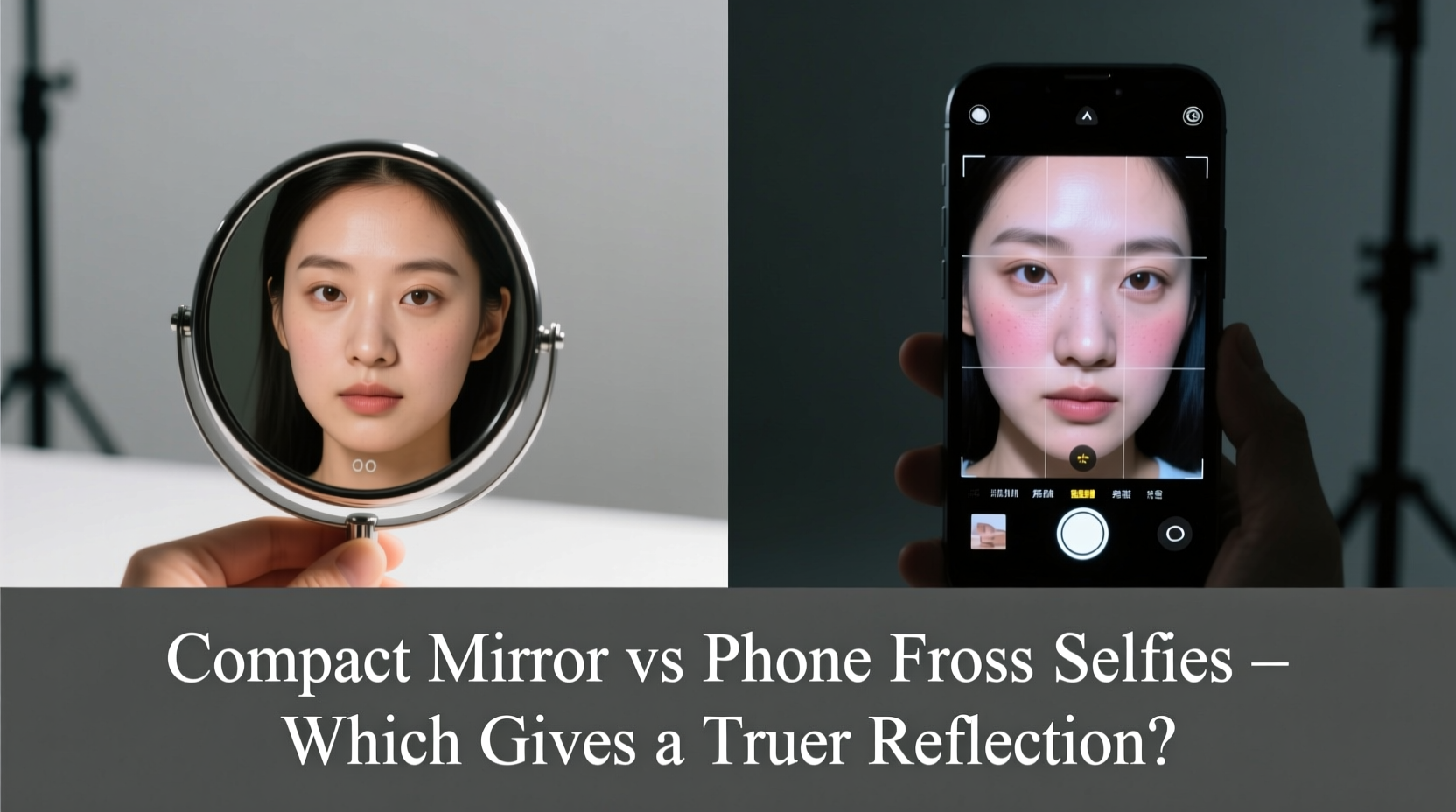
A flat mirror reflects light according to the law of reflection: the angle of incidence equals the angle of reflection. This means the image you see is a direct, laterally inverted representation of yourself in real time. There’s no digital processing, compression, or artificial enhancement involved. What you see is governed purely by optics and ambient lighting conditions.
Mirrors don't capture images; they reflect them instantly. Because there's no shutter speed, focus adjustment, or exposure setting, the visual feedback is continuous and consistent. In ideal lighting—such as natural daylight near a window—a mirror provides a balanced, real-time depiction of your face and grooming.
However, mirrors do have limitations. Most handheld compacts use small surfaces, often with magnification (e.g., 5x or 10x), which distorts proportions by enlarging certain features. Additionally, if the mirror is curved or poorly manufactured, it may warp edges or create optical illusions. But under standard conditions, a high-quality flat mirror remains the closest thing to seeing yourself as others do—within the limits of lateral reversal.
The Digital Distortion: How Phone Cameras Alter Reality
Smartphone cameras, despite their convenience, are far from neutral observers. They process every image through layers of software designed to enhance aesthetics—not accuracy. When you take a selfie, especially with flash enabled, multiple factors skew the result:
- Lens proximity: Holding the phone close creates wide-angle distortion, making noses appear larger and facial features uneven.
- Flash harshness: Onboard LED flashes emit intense, direct light from above, casting sharp shadows under eyes, nose, and chin—features rarely seen in normal social interactions.
- White balance errors: Flashlight often has a cooler (bluish) tone than ambient light, altering skin tones and making complexions look washed out or sallow.
- Digital sharpening and smoothing: Many phones automatically apply filters or beauty modes unless explicitly disabled.
According to imaging expert Dr. Lena Patel, “The human brain evolved to interpret faces under diffuse, directional lighting—like sunlight or indoor lamps. A frontal phone flash mimics a surgical spotlight, highlighting texture and asymmetry in ways that don’t occur naturally.”
“Selfie flash doesn’t show flaws—it reveals lighting flaws. What looks ‘bad’ in a flash photo is often just poor illumination.” — Dr. Lena Patel, Vision Science Researcher at MIT Media Lab
Side-by-Side Comparison: Mirror vs Flash Selfie
| Factor | Compact Mirror | Phone Flash Selfie |
|---|---|---|
| Image Type | Real-time reflection | Digitized photograph |
| Lighting Source | Ambient/environmental | Direct, front-facing LED flash |
| Focal Distance | Arm’s length or farther | Often very close (~12 inches) |
| Facial Proportions | Natural perspective | Nose enlargement due to proximity effect |
| Skin Texture Visibility | Soft, even rendering | Overemphasized pores, fine lines, blemishes |
| Color Accuracy | True to ambient conditions | Cool tint, potential oversaturation |
| Motion Feedback | Live movement tracking | Static snapshot only |
This comparison shows that while mirrors provide continuity and environmental realism, phone flash selfies prioritize capture over fidelity. The latter excels in documentation but fails in replicating everyday visual experience.
A Real-World Scenario: Morning Routine Misjudgment
Consider Sarah, a marketing professional who relies on her phone to check her makeup before video calls. One Tuesday, she applied foundation and concealer carefully, then snapped a flash selfie to verify. Horrified by what looked like dark circles and patchy skin, she reapplied product twice—only to receive compliments from colleagues during her meeting.
Later that day, she repeated the test using the same lighting but without flash. The difference was striking: her skin appeared smooth and even. She also stood in front of a bathroom mirror under identical conditions and saw a similar result. The original flash photo had exaggerated shadows due to the overhead angle of the phone’s light source, not her makeup application.
Sarah’s experience illustrates a common cognitive trap: mistaking photographic artifacts for personal flaws. Her reliance on flash created unnecessary stress and wasted time—all because the tool distorted reality rather than reflecting it.
Best Practices for Accurate Appearance Checks
To get the most truthful assessment of your appearance, consider combining tools strategically. Neither mirrors nor phone cameras are perfect, but each has strengths when used appropriately.
- Use mirrors for routine checks: A clean, full-face mirror in natural or warm-white lighting offers the best baseline for daily grooming.
- Avoid flash unless necessary: If using your phone, disable the flash and hold the device at eye level, about 18–24 inches away.
- Leverage window light: Position yourself facing a window during daytime for soft, diffused illumination that flatters and reveals true tones.
- Check movement and expression: Mirrors allow you to blink, smile, turn your head—critical for assessing how you appear in conversation.
- Use rear camera for accuracy: The back camera typically has better optics and less distortion than the front-facing one. Prop the phone up and use timer mode to avoid arm’s-length warping.
Checklist: Achieving a Truer Self-Reflection
- ☑ Use a non-magnifying, flat mirror for general checks
- ☑ Stand in front of natural light whenever possible
- ☑ Disable phone flash and beauty filters before taking selfies
- ☑ Hold the phone at least 18 inches from your face
- ☑ Compare mirror view with rear-camera photo taken in daylight
- ☑ Avoid judging skin texture under artificial or direct flash
- ☑ Reassess any concerns in different lighting before reacting
When Each Tool Excels: Context Matters
It’s important to recognize that \"truer reflection\" depends on purpose. For evaluating makeup symmetry, hair parting, or clothing fit, a mirror generally wins due to its real-time feedback. However, a well-lit, flash-free phone photo can serve as a valuable second opinion—particularly for noticing subtle details the eye might overlook in motion.
Photographers often say, “The camera doesn’t lie,” but this is misleading. Cameras record light and data—they don’t perceive context. A mirror shows you as you exist in space; a photo captures a single frozen moment shaped by technical constraints.
For social media or professional headshots, controlled photography is essential. But for assessing whether you’re ready to walk into a room confidently, nothing beats a calm glance in a properly lit mirror.
Frequently Asked Questions
Why does my skin look worse in phone flash photos?
Flash creates hard, direct lighting that emphasizes texture and casts deep shadows under facial contours. This amplifies the appearance of pores, fine lines, and uneven tone—even if these aren’t noticeable in person. Ambient light, by contrast, wraps around the face softly, minimizing such contrasts.
Is a mirror image more accurate than a selfie?
In terms of real-world resemblance, yes—provided the mirror is flat and lighting is natural. Mirrors show dynamic, three-dimensional movement and color balance as others see you. Selfies, especially front-camera ones, suffer from lens distortion and processing algorithms that alter proportions and tone.
Can I trust my phone camera to check my appearance?
You can—if you use it correctly. Disable flash, avoid extreme close-ups, turn off filters, and rely on daylight. Even better, use the rear camera on a tripod or stand. These adjustments make phone images significantly more reliable for honest evaluation.
Final Thoughts: Seeing Yourself Clearly
The debate between compact mirrors and phone flash selfies ultimately comes down to intention. If your goal is truth—a realistic sense of how you appear to others—the mirror, under good lighting, remains unmatched. It provides continuity, proportion, and environmental realism that no smartphone can fully replicate.
That said, technology can complement tradition. A thoughtfully taken phone photo—without flash, in natural light—can act as a useful double-check, revealing blind spots the mirror might miss. The key is awareness: understanding the distortions each tool introduces and adjusting accordingly.
Don’t let a poorly lit flash selfie undermine your confidence. You are not your worst photo. True self-perception comes not from flawless images, but from informed, compassionate observation. Choose tools that support clarity, not criticism.




 浙公网安备
33010002000092号
浙公网安备
33010002000092号 浙B2-20120091-4
Comments
No comments yet. Why don't you start the discussion?