
When it comes to functional timepieces, two of the most commonly confused types are countdown timer watches and chronographs. Both offer time-tracking capabilities beyond standard timekeeping, but they serve fundamentally different purposes. Choosing between them isn’t about which looks better on the wrist—it’s about which aligns with how you use time in your daily life, profession, or hobbies. Whether you're an athlete, pilot, diver, student, or busy professional, understanding the strengths and limitations of each can make a real difference in productivity, safety, and performance.
Understanding the Core Functions
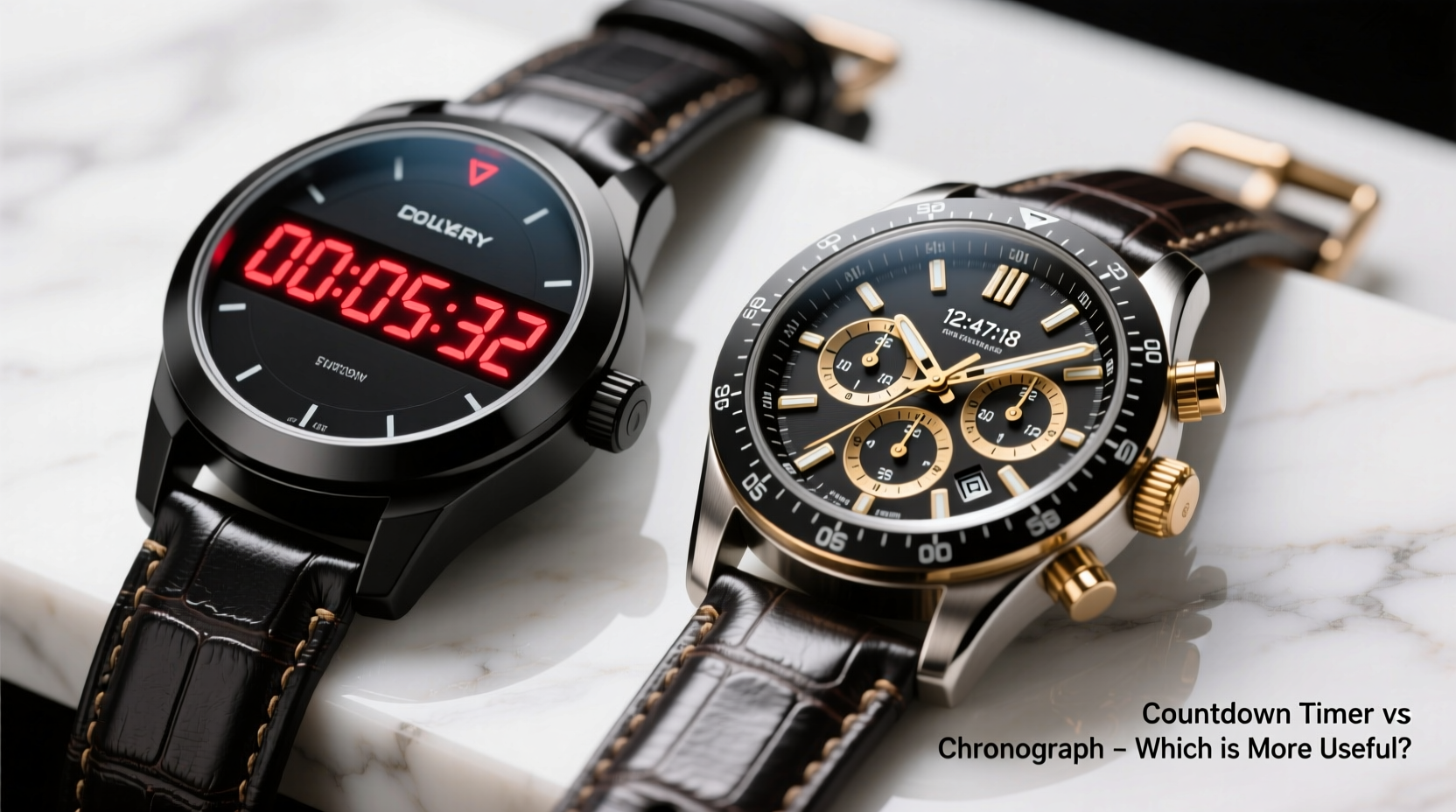
A **countdown timer watch** is designed to count backward from a set amount of time to zero. It alerts the user when time expires—ideal for managing intervals, workouts, cooking, or timed exams. The mechanism is simple: set a duration, start the countdown, and wait for the alarm.
In contrast, a **chronograph** is essentially a stopwatch built into a watch. It measures elapsed time from a starting point, typically with sub-dials to track seconds, minutes, and sometimes hours. Chronographs often feature tachymeter scales on the bezel to calculate speed or distance based on time traveled—a favorite among racing enthusiasts and engineers.
The key distinction lies in direction: countdown timers go backward, while chronographs go forward. This may seem minor, but in high-pressure scenarios, getting this wrong can cost precious seconds—or worse.
Real-World Use Cases Compared
To determine which watch is more useful, consider practical applications across common scenarios.
Sports & Fitness
For interval training, HIIT workouts, or Tabata sessions, a countdown timer excels. Athletes can pre-program 30-second work periods followed by 15-second rests, relying on audible or vibrating alerts to transition seamlessly. A chronograph, while capable of measuring how long a sprint took, doesn’t automate the next phase.
Aviation & Diving
Pilots and divers rely heavily on chronographs. In aviation, timing fuel burn or holding patterns requires precise measurement of elapsed time. Similarly, scuba divers use chronographs to monitor bottom time, ensuring they don’t exceed safe limits. A countdown timer could be preset for dive duration, but it lacks the flexibility to adapt mid-dive if conditions change.
Professional Workflows
Lawyers, consultants, and freelancers billing by the hour benefit from chronographs to track client time accurately. Conversely, project managers running stand-up meetings might prefer a countdown timer to keep discussions within a 15-minute window.
“Time management isn’t just about tracking hours—it’s about controlling attention. The right tool shapes behavior.” — Dr. Alan Pierce, Cognitive Ergonomics Researcher at MIT
Feature Comparison: Countdown Timer Watch vs Chronograph
| Feature | Countdown Timer Watch | Chronograph |
|---|---|---|
| Primary Function | Counts down from set time to zero | Measures elapsed time (stopwatch) |
| Best For | Intervals, alarms, deadlines | Racing, flight logs, billing |
| Alert System | Beep/vibration at end | No automatic alert (manual stop) |
| Complexity | Simple interface | Multiple pushers, sub-dials |
| Learning Curve | Low | Moderate to high |
| Battery Life Impact | Minimal | Higher (due to additional mechanisms) |
| Common Complications | Alarm, backlight | Tachymeter, telemeter, flyback |
Mini Case Study: The Marathon Coach’s Dilemma
Mark Teller, a certified running coach in Boulder, Colorado, used a high-end chronograph for years to time his athletes’ splits during training. But he found himself constantly distracted by resetting laps and checking sub-dials. When preparing a group for a half-marathon with strict pacing goals, he switched to a digital countdown timer watch programmed for 4:30/km intervals.
The result? Runners stayed on target without constant verbal cues. “The beep every 4 minutes and 30 seconds was like a metronome,” Mark said. “It reduced my cognitive load and improved their consistency.” He now uses both watches—one for coaching, one for personal time trials—but admits the countdown timer has become his go-to for structured training.
Step-by-Step Guide: Choosing the Right Watch for Your Needs
Follow this decision framework to identify which watch serves you best:
- Define your primary use case: Are you measuring duration (use chronograph) or managing deadlines (use countdown)?
- Assess frequency: Will you use it daily or occasionally? Frequent users benefit from intuitive interfaces.
- Evaluate environment: In loud or underwater settings, vibration alerts (common in countdown timers) outperform visual readouts.
- Consider skill level: Chronographs require practice to operate efficiently under pressure. Beginners may prefer simplicity.
- Check integration needs: Some smartwatches simulate both functions. If you already own one, dedicated hardware may be redundant.
- Test before buying: Visit a retailer to simulate real-world use—start, pause, and reset both types to feel the difference.
Hybrid Solutions and Modern Innovations
Today’s market blurs the line between these two categories. Many digital watches, such as those from Casio G-Shock or Garmin, combine both functions in a single device. The G-Shock GW-6900, for example, includes a countdown timer, stopwatch, tide graph, and world time—all accessible via menu navigation.
Smartwatches take this further. An Apple Watch or Samsung Galaxy Watch lets users toggle between countdown and chronograph modes instantly, with customizable haptic feedback and voice control. However, battery life and complexity remain trade-offs compared to analog-only models.
FAQ: Common Questions Answered
Can a chronograph function as a countdown timer?
Not natively. While you can manually calculate backward time using a chronograph (e.g., start it at 5:00 and stop when it hits 3:00 to mark 2 minutes elapsed), it won’t alert you when time is up. True countdown functionality requires a dedicated mode with alarm support.
Are analog chronographs more accurate than digital ones?
Modern digital chronographs generally offer greater precision (to 1/100th of a second) compared to mechanical analog versions, which may drift slightly due to movement tolerances. However, for most real-world uses—like timing a 5K run—the difference is negligible.
Do countdown timer watches work underwater?
Many do, especially models designed for diving or sports. Look for water resistance ratings of at least 100 meters and buttons that function under pressure. Seiko and Citizen offer reliable options in this category.
Final Verdict: Which Is More Useful?
The answer depends entirely on context. For **precision measurement of events**, the chronograph remains unmatched. Its legacy in motorsports, aviation, and science underscores its utility in capturing exact durations. However, for **time management, task execution, and behavioral pacing**, the countdown timer proves more immediately practical.
In modern life—where focus, deadlines, and micro-scheduling dominate—the countdown timer supports mindfulness and structure. It turns abstract time into tangible action. Meanwhile, the chronograph serves specialized roles where historical data matters more than future planning.
If forced to choose only one, the countdown timer wins for broader everyday usefulness. But the smartest choice is recognizing that both have value—and selecting based on purpose, not popularity.




 浙公网安备
33010002000092号
浙公网安备
33010002000092号 浙B2-20120091-4
Comments
No comments yet. Why don't you start the discussion?