
In an age where digital distractions dominate our attention, the practice of journaling has re-emerged as a powerful tool for cultivating mindfulness. Whether scribbling thoughts in a leather-bound notebook or typing reflections into a sleek app, people are turning to journaling to slow down, process emotions, and reconnect with the present moment. But does one method—digital or analog—offer a clearer path to mindfulness than the other?
Mindfulness is not just about awareness; it's about intentional presence. The medium through which we journal can either deepen that presence or subtly pull us away from it. While both digital and paper journaling have their advocates, understanding how each affects cognitive processing, emotional regulation, and sensory engagement reveals important distinctions. This article examines the neurological, psychological, and practical dimensions of both methods, offering insights grounded in research and real-world experience.
The Cognitive Impact of Writing by Hand
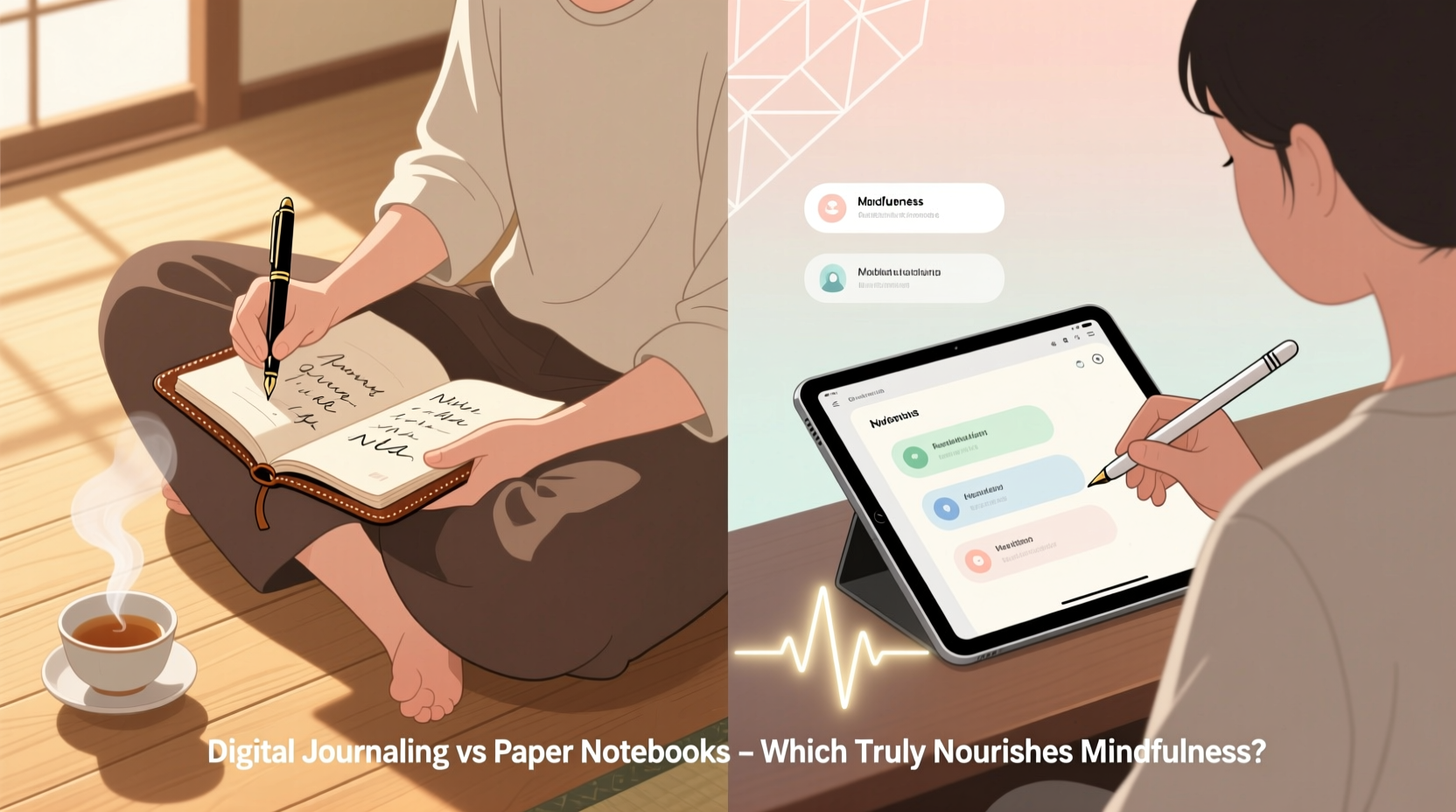
When you write with pen and paper, your brain engages in a fundamentally different way than when you type. Neurological studies show that handwriting activates regions associated with memory encoding, language processing, and emotional expression more intensely than keyboard input. A 2014 study published in Psychological Science found that students who took notes by hand demonstrated better conceptual understanding and retention than those who typed their notes on laptops.
This isn’t just about memory—it’s about mindfulness. The slower pace of handwriting forces a kind of mental filtering. You can’t transcribe every word verbatim, so you must summarize, reflect, and prioritize what matters. This selective processing mirrors the core principles of mindfulness: observation without judgment, staying present, and making conscious choices.
Additionally, the physical sensation of writing—the pressure of the pen, the texture of the paper, the rhythm of forming letters—anchors attention in the body. These tactile cues create a feedback loop that keeps the mind from drifting into autopilot mode, a common trap in digital environments.
Digital Journaling: Efficiency vs. Distraction
Digital journaling offers undeniable advantages: searchability, portability, encryption, voice-to-text options, and seamless integration with calendars and habit trackers. Apps like Day One, Journey, or Notion allow users to tag entries, embed photos, and even analyze mood trends over time. For individuals managing anxiety, depression, or ADHD, these features can make journaling more accessible and consistent.
However, convenience comes at a cost. Every time you open a device to journal, you're exposed to potential interruptions—notifications, emails, social media pings—that fracture focus. Even the absence of alerts doesn't eliminate the subconscious pull toward multitasking. Researchers at Stanford University have shown that heavy media multitaskers perform worse on cognitive control tasks, including sustained attention and task-switching efficiency.
Moreover, typing promotes a linear, fast-paced flow of thought that can encourage surface-level reflection rather than deep introspection. Without the natural pauses imposed by handwriting, digital journaling risks becoming transactional—another box to check off in a productivity routine, rather than a mindful ritual.
“Mindfulness requires disengagement from speed and stimulation. When journaling becomes just another digital task, its contemplative power diminishes.” — Dr. Lena Torres, Cognitive Psychologist and Mindfulness Researcher
Comparing Mindfulness Outcomes: A Practical Table
| Factor | Paper Notebooks | Digital Journaling |
|---|---|---|
| Sensory Engagement | High (touch, sound, visual texture) | Low (uniform screen interface) |
| Cognitive Processing Depth | Deep (slower, reflective writing) | Moderate to shallow (fast typing, copy-paste habits) |
| Distraction Risk | Very low | High (notifications, app switching) |
| Emotional Expression Accuracy | Higher (linked to motor memory) | Variable (can feel detached) |
| Accessibility & Searchability | Low (manual indexing required) | High (instant search, tagging) |
| Ritual Quality | Strong (physical act enhances intentionality) | Weak unless deliberately cultivated |
This comparison doesn’t declare a definitive winner but highlights trade-offs. If your goal is pure mindfulness—being fully present with your inner world—paper holds a distinct advantage. If your aim includes tracking patterns, integrating with therapy tools, or maintaining consistency despite mobility challenges, digital may be more sustainable.
A Real-Life Example: Sarah’s Transition to Analog Journaling
Sarah, a 34-year-old project manager in Seattle, had been journaling digitally for years using a popular app. She appreciated the ability to search past entries and attach location data. But she noticed something troubling: her entries felt robotic, often written in bullet points between meetings. She wasn’t reflecting—she was logging.
After reading about the cognitive benefits of handwriting, she decided to try a minimalist paper journal for 30 days. She chose a small Moleskine, committed to writing each morning with her coffee, and left her phone in another room. Within a week, she reported feeling “more connected” to her emotions. By day 20, she began noticing recurring thought patterns related to work stress—insights she hadn’t uncovered in months of digital entries.
“It wasn’t just what I wrote,” she said. “It was how it felt. The scratch of the pen, the time it took—I couldn’t rush it. That slowness made space for honesty.”
Sarah didn’t abandon digital tools entirely. She now uses them for weekly summaries and goal tracking, while reserving her paper journal for deep reflection. Her hybrid approach illustrates a growing trend: leveraging both mediums strategically, based on purpose.
Building a Mindful Journaling Practice: A Step-by-Step Guide
Whether you choose paper, digital, or a blend, mindfulness depends less on the tool and more on the intention behind its use. Follow this five-step process to cultivate a truly mindful journaling habit:
- Define Your Purpose: Are you journaling to reduce anxiety? Gain clarity? Track moods? Write down your primary intention before choosing a format.
- Select Your Medium Based on Context: Use paper for emotional processing and self-inquiry. Use digital for structured logging (e.g., gratitude lists, sleep tracking).
- Create a Ritual: Light a candle, brew tea, sit in the same spot. Rituals signal to the brain that it’s time to shift into reflective mode.
- Limit Time and Scope: Set a timer for 10–15 minutes. Focus on one question: “What am I feeling right now?” Avoid trying to capture everything.
- Review Without Judgment: Re-reading entries should be an act of curiosity, not criticism. Ask: “What can I learn from this version of myself?”
Expert Recommendations for Digital Users
If you prefer digital journaling, you can still foster mindfulness—but it requires deliberate design. Experts recommend the following strategies:
- Use distraction-free writing apps like iA Writer or FocusWriter that hide menus and toolbars.
- Enable “Do Not Disturb” mode or use a dedicated device (e.g., an old tablet) solely for journaling.
- Write longhand first on paper, then transcribe select entries digitally for archiving.
- Avoid editing entries after writing. Preserve the raw, unfiltered moment.
“The key isn’t the tool—it’s whether the tool serves your attention, or steals it.” — Dr. Rajiv Mehta, Digital Wellbeing Researcher at MIT
Checklist: Is Your Journaling Mindful?
Use this checklist to evaluate your current practice:
- ☑ I write without distractions (no notifications, no multitasking)
- ☑ My entries reflect feelings, not just events
- ☑ I pause before writing to center myself
- ☑ I don’t obsess over grammar or structure
- ☑ I revisit past entries with compassion, not judgment
- ☑ I feel calmer or clearer after journaling
If fewer than four boxes are checked, consider adjusting your environment, timing, or medium to deepen mindfulness.
Frequently Asked Questions
Can digital journaling ever be truly mindful?
Yes—but only if safeguards are in place. Using a distraction-free app on a locked device, setting a clear intention before writing, and limiting session length can make digital journaling a mindful practice. However, it requires more discipline than paper journaling, where the medium itself discourages multitasking.
Is there scientific evidence that paper journals improve mental health?
Multiple studies support the benefits of expressive writing on mental health. A seminal study by Dr. James Pennebaker showed that writing about traumatic experiences for 15–20 minutes over three to four days led to improved immune function, reduced anxiety, and better mood. While the study didn’t compare formats, follow-up research suggests handwriting amplifies these effects due to increased neural engagement.
Should I switch from digital to paper completely?
Not necessarily. The best system is the one you’ll use consistently. Some people thrive on digital organization, especially when journaling supports therapy or habit tracking. Others find paper indispensable for emotional depth. Consider a dual approach: use paper for introspective sessions and digital for quick logs or backups.
Conclusion: Choose Intention Over Convenience
The debate between digital journaling and paper notebooks isn’t about technology versus tradition—it’s about attention versus distraction. Mindfulness flourishes in conditions of slowness, sensory richness, and uninterrupted focus. Paper naturally fosters these conditions. Digital tools, while efficient, often operate in ecosystems designed to fragment attention.
That doesn’t mean digital journaling is inherently inferior. With careful design and disciplined use, it can support mindfulness. But for most people seeking deeper self-awareness, emotional release, and present-moment awareness, the tactile, deliberate act of writing by hand remains unmatched.
Ultimately, the most effective journaling method is the one that helps you show up honestly for yourself. Whether your pages are physical or virtual, ask this: Does this practice help me feel more grounded, or more scattered? The answer will guide you to the right choice—not just for productivity, but for presence.




 浙公网安备
33010002000092号
浙公网安备
33010002000092号 浙B2-20120091-4
Comments
No comments yet. Why don't you start the discussion?