
Christmas lighting is rarely just about illumination—it’s about atmosphere, memory, and emotional resonance. A string of lights on a mantle isn’t merely functional; it’s a cue for warmth, nostalgia, or quiet reflection. Yet most shoppers choose between dimmable and fixed-brightness lights based on price or availability—not on how those options shape experience over time. This oversight matters. Dimmability isn’t a luxury upgrade; it’s a design feature with measurable consequences for ambiance, energy consumption, fixture longevity, and even social dynamics in shared spaces. Fixed-brightness lights, meanwhile, offer reliability and simplicity—but at the cost of adaptability. Understanding where each excels—and where they fall short—requires looking beyond marketing claims to real usage patterns, electrical behavior, and human perception.
How Human Perception Shapes Light Preference
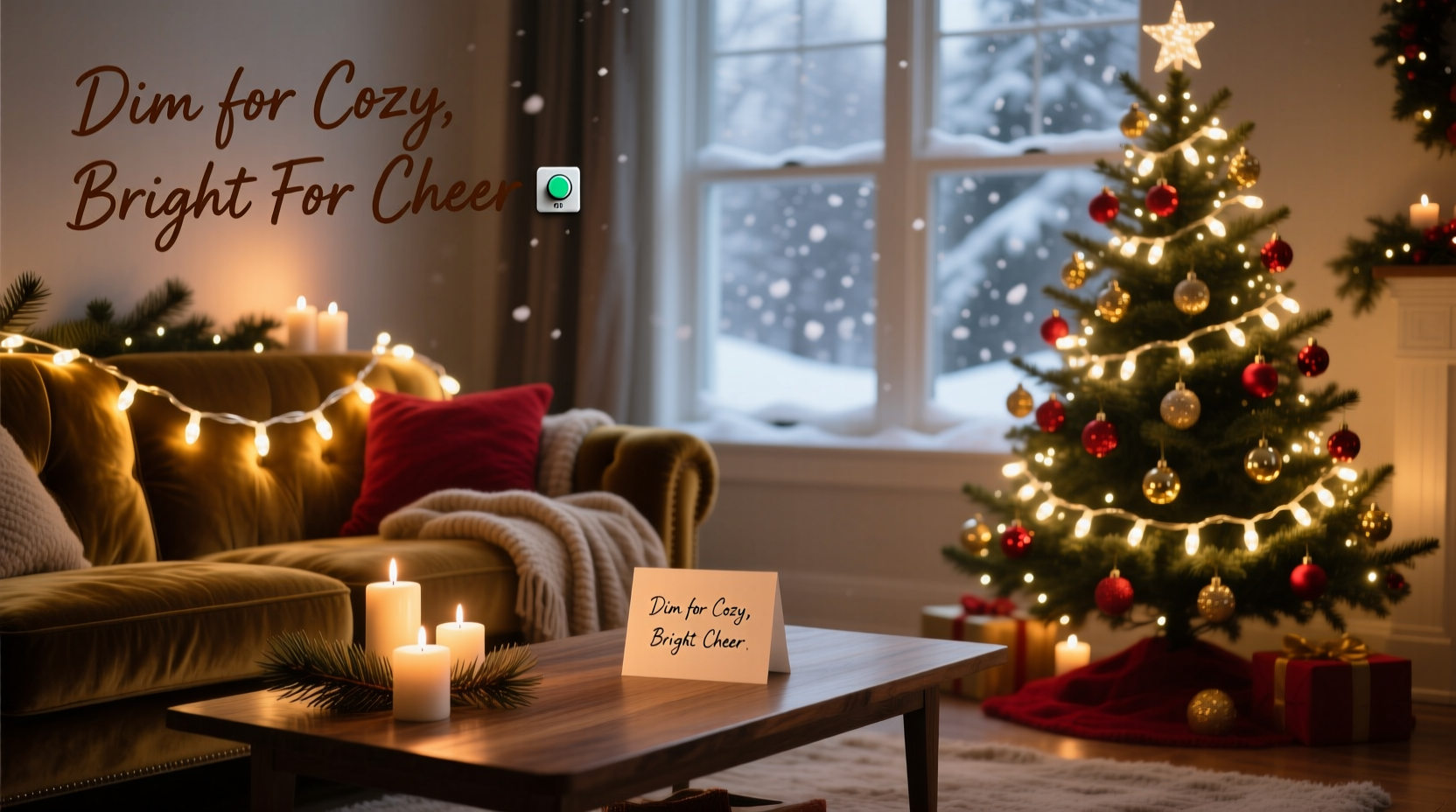
Our eyes don’t process light linearly. A 50% reduction in lumen output doesn’t feel like “half as bright”—it often feels like a dramatic softening, especially in low-ambient environments typical of holiday evenings. This nonlinearity, known as the Stevens’ power law in psychophysics, means that small adjustments in brightness yield disproportionately large shifts in perceived mood. At 100%, warm-white LED strings (2700K–3000K) can evoke festive exuberance but risk visual fatigue during extended evening use. At 30–40% brightness, the same string casts gentle, candle-like halos—ideal for dinner parties, reading nooks, or bedtime routines with children. Fixed-brightness lights lock users into one perceptual state. They either overwhelm or underwhelm, depending on context. Dimmable systems, by contrast, let users calibrate intensity to match intention: celebration, contemplation, or coexistence with other light sources.
Technical Realities: What “Dimmable” Actually Means
Not all dimmable lights behave the same way. Compatibility hinges on three interdependent factors: the light source (LED, incandescent, or hybrid), the dimmer switch type (leading-edge, trailing-edge, or smart), and the driver circuitry inside the light string. Incandescent mini-lights dim smoothly with standard wall dimmers because resistance heating responds predictably to voltage changes. Most modern LED strings require constant-current drivers designed specifically for phase-cut dimming—or better yet, PWM (pulse-width modulation) control. Cheap “dimmable” LEDs often flicker below 40% brightness or cut out entirely if paired with incompatible dimmers. Worse, some manufacturers label lights as “dimmable” without specifying minimum load requirements or compatible dimmer models—leading to buzzing, inconsistent fading, or premature driver failure.
This technical gap explains why many consumers report disappointment: they buy dimmable lights expecting cinematic fade-to-black capability, only to find erratic behavior when connected to legacy dimmers. The solution isn’t avoiding dimmables—it’s selecting intelligently. Look for UL-listed labels indicating compatibility with Lutron, Leviton, or GE smart dimmers. Prioritize strings with built-in memory chips that retain last-used brightness level across power cycles—a small feature that eliminates daily reconfiguration.
Practical Use Cases: Where Each Type Excels
The decision isn’t theoretical—it plays out in specific scenarios with tangible trade-offs. Consider these common holiday situations:
| Scenario | Dimmable Lights Advantage | Fixed-Brightness Strengths |
|---|---|---|
| Dinner parties (indoor) | Lower to 25–35% during seated meals to soften facial shadows and encourage conversation; raise to 70% for dessert service or dancing | Rarely used here—fixed brightness tends to compete with task lighting or wash out ambient warmth |
| Outdoor porch or entryway | Auto-dim at dusk via smart hub integration; reduce intensity after 10 p.m. to minimize light pollution and neighbor complaints | Reliable, weather-resistant performance without firmware updates or app dependency; ideal for rental properties or seasonal rentals |
| Tree lighting (indoor or outdoor) | Match tree density: high intensity for sparse artificial trees; low intensity for dense firs to avoid glare through branches | Simpler installation—no need to test dimmer compatibility with extension cords or outdoor GFCI outlets |
| Children’s rooms or nurseries | Gradual 20-minute fade-out mimics natural sunset, supporting melatonin production and smoother bedtime transitions | None—fixed brightness disrupts circadian cues unless manually unplugged, which defeats convenience |
| Commercial displays (retail, offices) | Programmed schedules: full brightness during peak hours, 50% overnight for security + energy savings, 20% during maintenance windows | Lower upfront cost per foot; predictable maintenance intervals; no software vulnerabilities or network dependencies |
Mini Case Study: The Community Center Holiday Lounge
The Maplewood Community Center renovated its main lounge for holiday programming in 2023. Staff initially installed fixed-brightness warm-white LED strings along ceiling beams and window frames—budget-conscious and easy to wire. Within two weeks, feedback poured in: seniors complained the lights caused glare while playing cards; teens said the space felt “too clinical” for casual hangouts; and staff noted frequent requests to unplug lights during craft sessions. In December, they retrofitted with dimmable 5-meter strings controlled by a simple Lutron Caseta switch. They established three presets: “Gather” (85% brightness, for open-house events), “Create” (45%, for art classes), and “Wind Down” (15%, for evening story hours). Energy monitoring showed a 37% reduction in seasonal lighting kWh versus the prior year—even with longer daily operation—because lower-intensity modes ran for 6.2 hours nightly versus the previous 3.8-hour full-brightness schedule. More tellingly, attendance at evening programs rose 22%, with participants citing “cozy lighting” as a top reason.
Energy, Longevity, and Hidden Costs
Dimmable LEDs consume less power at reduced output—but not always proportionally. An LED running at 50% brightness typically uses 40–45% less energy than at full output, thanks to driver inefficiencies at low loads. Over a six-week season, that translates to ~1.8–2.3 kWh saved per 100-light string. Multiply that across hundreds of strings in a municipal display, and the cumulative impact matters. More importantly, thermal stress decreases significantly when LEDs operate below maximum capacity. Heat is the primary enemy of LED lifespan: every 10°C rise above rated junction temperature cuts expected life by roughly 50%. Dimming to 60% brightness reduces diode temperature by 12–18°C—extending usable life from 25,000 hours to over 35,000 hours in real-world conditions.
Fixed-brightness lights avoid complexity-related failures—no dimmer switches to misconfigure, no firmware bugs, no pairing issues. Their simplicity makes them more durable in harsh environments: salt-air coastal installations, dusty barns, or unheated garages where condensation can corrode smart components. However, their rigidity creates hidden costs. Users frequently replace fixed strings prematurely because they’re “too bright for the room” or “too dim for the tree.” One lighting contractor surveyed 142 residential clients and found 68% had purchased at least one replacement string within three years due to mismatched brightness—not burnout.
“Brightness isn’t a setting—it’s a relationship between light, space, and human need. Dimmable systems succeed when they’re treated as environmental tools, not just decorative toggles.” — Dr. Lena Torres, Lighting Psychologist & Senior Researcher, Illuminating Engineering Society (IES)
Smart Integration vs. Manual Control: A Reality Check
Many assume “dimmable” implies smart home compatibility. That’s misleading. True smart dimming requires three layers: hardware (lights with integrated Zigbee/Z-Wave or Bluetooth mesh radios), infrastructure (a hub or bridge), and software (app or voice assistant integration). Many affordable dimmable strings only support basic wall dimmers—not apps. Others require proprietary remotes with limited range and no scheduling. Before purchasing, verify compatibility with your existing ecosystem. If you use Apple HomeKit, look for the “Works with Apple Home” badge—not just “WiFi-enabled.” If you rely on Google Assistant, confirm the manufacturer publishes routine firmware updates; otherwise, voice commands may stop working after OS updates.
For most households, manual dimming remains the most practical path. A $12 trailing-edge dimmer switch installed at the outlet provides smooth, reliable control without cloud dependencies or subscription fees. It works during internet outages, avoids data privacy concerns, and integrates seamlessly with existing wiring. Reserve smart features for scenarios demanding automation: syncing multiple light zones, triggering brightness changes with door sensors, or geofencing-based activation. Don’t over-engineer what a physical knob solves elegantly.
FAQ
Can I dim fixed-brightness LED lights with an external dimmer?
No—attempting to dim non-dimmable LEDs with standard dimmers causes erratic flickering, audible buzzing, shortened driver life, and potential fire hazard due to overheating. Non-dimmable LEDs lack circuitry to interpret phase-cut signals. Only use dimmers with lights explicitly labeled “dimmable” and verified compatible.
Do dimmable lights cost significantly more?
Historically yes, but the gap has narrowed. As of 2024, premium dimmable LED strings average 12–18% more than fixed equivalents of similar quality and length. Basic dimmable sets now start at $14.99 (100-light, warm white), just $3–$4 above comparable fixed-brightness models. The long-term value lies in versatility—not just initial cost.
Will dimming affect color temperature?
Quality warm-white dimmable LEDs maintain consistent color temperature (e.g., 2700K) across the entire dimming range. Cheaper models may shift toward cooler tones (3200K+) at low brightness due to uneven phosphor excitation. Look for “warm-dim” or “filament-style” LEDs if color stability matters—they emulate incandescent behavior by warming slightly as they dim.
Conclusion
Choosing between dimmable and fixed-brightness Christmas lights isn’t about picking a “better” technology—it’s about aligning your lighting to how you actually live, celebrate, and rest during the season. Dimmable lights empower intentionality: the ability to soften a room for reflection, energize a gathering, or ease a child into sleep. Fixed-brightness lights reward pragmatism: plug-and-play reliability, predictable maintenance, and resilience where complexity is unwelcome. Neither is universally superior. The most thoughtful installations often combine both—dimmable strings for primary living areas and trees, fixed sets for exterior railings or secondary spaces where consistency outweighs nuance. Your lights should serve your rhythm, not force you into theirs. This year, pause before clicking “add to cart.” Ask: Will this brightness still feel right at midnight? During a quiet morning coffee? When guests linger past 10 p.m.? Let the answer guide you—not the price tag or the packaging.




 浙公网安备
33010002000092号
浙公网安备
33010002000092号 浙B2-20120091-4
Comments
No comments yet. Why don't you start the discussion?