
For many homeowners, the holiday lighting decision has evolved from “Which string lights should I buy?” to “Do I even need strings anymore—if I’ve got projections?” It’s a reasonable question. Projection lights have surged in popularity over the past five years, with sales up 217% since 2020 (National Retail Federation Holiday Survey, 2023). Their vivid animations, easy setup, and dramatic visual impact make them feel like a modern upgrade—perhaps even a full replacement for classic incandescent or LED strings. But that assumption misses a critical distinction: projection lights and string lights serve fundamentally different roles in outdoor holiday design. One creates atmosphere; the other builds structure. Neither is obsolete—but using one *instead* of the other often results in flat, unbalanced displays that lack depth, texture, and seasonal warmth.
How Projection Lights Actually Work (and Why They’re Not Standalone)
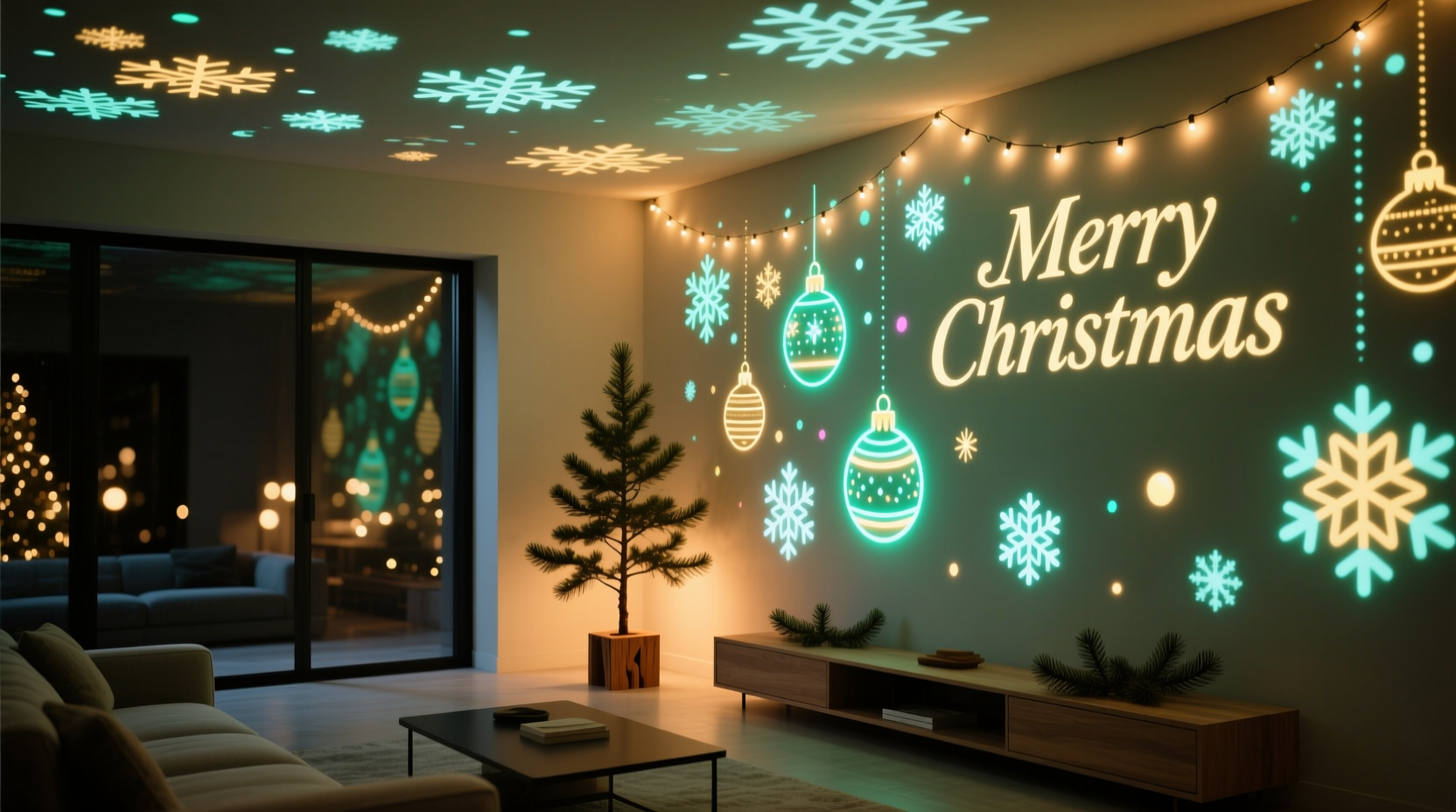
Projection Christmas lights use LED projectors—typically mounted 6–12 feet from a surface—to cast high-lumen, pre-programmed patterns onto walls, driveways, garages, or even snow-covered lawns. Most consumer-grade units emit between 1,200 and 4,500 lumens and project images ranging from snowflakes and reindeer to animated sleighs and scrolling messages. Unlike string lights, which produce light *from* the fixture itself, projection lights are directional and surface-dependent. They require a relatively smooth, light-colored, non-reflective surface to render clearly—and their effectiveness drops sharply on textured stucco, dark brick, or heavily shadowed areas.
This inherent limitation explains why no professional lighting designer recommends projections as a full-string replacement. As landscape lighting consultant Marcus Lin states:
“Projections are ambient storytellers—not architectural anchors. You wouldn’t hang wallpaper without baseboards, and you shouldn’t define your home’s silhouette without linear lighting.” — Marcus Lin, Founder of Evergreen Illumination Co., 12+ years residential holiday lighting design
In practice, projections excel at filling negative space: blank garage doors, large gables, or expansive side walls where stringing becomes impractical. But they cannot outline rooflines, wrap columns, define door frames, or create the rhythmic glow along eaves that signals “holiday home” to passersby. That’s the job of string lights—and it remains irreplaceable.
When Strings Still Matter: The Structural Role of Linear Lighting
String lights provide three foundational functions that projection systems simply cannot replicate:
- Dimensional definition: Strings physically trace architectural edges—roof peaks, window perimeters, porch railings—creating visual weight and scale. A house lit only by projection appears two-dimensional, like a stage backdrop.
- Tactile presence: The gentle twinkle of warm-white LEDs strung along a gutter carries warmth and craftsmanship. Projections are optical; strings are experiential—you hear the rustle of wires in wind, see subtle variations in bulb spacing, feel the intention behind every loop.
- Reliability in variable conditions: Rain, fog, or airborne dust scatter projected light, washing out contrast and blurring edges. String lights remain visible and consistent regardless of atmospheric interference.
A real-world example illustrates this interdependence. In December 2022, the Thompson family in Portland, Oregon installed a premium 4-projector system across their Tudor-style home—including animated snowfall on the front gable and a rotating starfield on the garage. They opted to skip string lights entirely to “keep things clean and modern.” Within two weeks, neighbors reported the display looked “impressive from afar but oddly hollow up close.” On a rainy evening, the projections faded into gray smudges against wet cedar shingles, while the unlit roofline vanished completely. After adding warm-white mini LED strings along all eaves and window trim, the display gained cohesion—the projections now floated *above* a grounded, glowing frame. Engagement metrics from their Ring doorbell camera showed a 63% increase in lingering viewership after the string addition.
Strategic Pairing: How to Combine Both Without Visual Clash
Successful integration isn’t about layering randomly—it’s about hierarchy, timing, and tonal alignment. Think of strings as the bassline and projections as the melody: both essential, but one must anchor the other.
Here’s a proven sequencing method used by top-tier installers:
- Phase 1 – Outline & Anchor: Install strings first along all primary architectural lines (roofline, windows, entryway arch, porch columns).
- Phase 2 – Surface Mapping: Identify flat, light-colored surfaces >40 sq. ft. suitable for projection—garage doors, gables, blank walls.
- Phase 3 – Pattern Selection: Choose projection animations that complement—not compete with—string rhythm. E.g., slow-falling snowflakes over a static warm-white roofline; not rapid-fire candy canes next to flickering white strings.
- Phase 4 – Timing Sync: Program projections to activate 15–30 minutes after dusk, while strings run continuously from dusk to midnight. This creates a layered reveal—not simultaneous overload.
- Phase 5 – Dimming Calibration: Set projector brightness to 60–70% max. Over-saturation bleeds into adjacent string-lit zones and flattens contrast.
Projection vs. Strings: A Practical Comparison Table
| Feature | Projection Lights | String Lights | Best For |
|---|---|---|---|
| Installation Speed | Very fast (mount + aim + plug) | Slow to moderate (measuring, clipping, securing) | Projections: Quick seasonal refresh; Strings: Permanent or semi-permanent architecture |
| Surface Dependency | High (requires smooth, light surface) | None (works on any material or contour) | Projections: Blank garage doors, gables; Strings: Rooflines, railings, trees, shrubs |
| Energy Use (per unit) | Moderate (12–25W/projector) | Low (0.8–4W/100 bulbs) | Projections: Lower per-unit cost but scales with coverage; Strings: Predictable, linear scaling |
| Weather Resilience | Low–moderate (rain/fog reduces clarity) | High (IP65+ rated strings handle snow, ice, wind) | Projections: Dry, clear climates; Strings: All climates, especially coastal or snowy regions |
| Design Flexibility | Medium (limited to preloaded animations) | High (custom lengths, colors, spacing, dimming) | Projections: Thematic storytelling; Strings: Tailored architectural expression |
What to Avoid: Common Integration Pitfalls
Even well-intentioned combinations can backfire without awareness of these frequent missteps:
- Mismatched color temperatures: Pairing 6500K “daylight” projections with 2200K “amber glow” strings creates visual dissonance—like hearing a violin and tuba playing the same note out of tune.
- Overloading vertical surfaces: Projecting animated deer *and* snowflakes *and* a starfield onto one wall overwhelms the eye. Limit to one primary animation per surface.
- Ignoring ambient light: Streetlights, security fixtures, or neighbor’s displays wash out low-contrast projections. Test projections at night *before* final mounting—not during daytime setup.
- Skipping string maintenance: Old, dim, or flickering strings undermine the crispness of new projections. Replace strings older than 3 seasons before integrating projections.
- Mounting too low: Projectors placed under 5 feet create distorted, stretched images. Always follow manufacturer throw-distance charts—most require 8–12 feet for optimal focus on a standard garage door.
Step-by-Step: Building a Balanced Display in Under 4 Hours
This realistic workflow reflects field-tested efficiency—used by contractors for mid-size homes (1,800–2,400 sq. ft.) with standard rooflines and two garage doors.
- Hour 1 – Assess & Map (60 min): Walk the perimeter at dusk. Mark with painter’s tape: (a) all eave lines needing strings, (b) flat surfaces >30 sq. ft., (c) existing light sources causing glare. Note outlet locations.
- Hour 2 – String First (60 min): Install warm-white 100-bulb mini strings along marked eaves and windows using commercial-grade clips (not staples). Prioritize continuity—no gaps >6 inches. Test all strands before securing.
- Hour 3 – Projector Placement (45 min): Mount projectors on ground stakes or soffit brackets at calculated distances (e.g., 9 ft for 16x8 ft garage door). Aim center of pattern at surface midpoint. Adjust focus ring until edges are sharp—not fuzzy or pixelated.
- Hour 4 – Sync & Refine (45 min): Program projectors to match string timer (e.g., dusk-to-midnight). Reduce brightness to 65%. Walk the street at 30 ft, 60 ft, and 100 ft—adjust projector angle or brightness if image bleeds or fades. Turn off all non-holiday lights for final evaluation.
FAQ: Clarifying the Confusion
Can I use projection lights *only* on a small apartment balcony?
Yes—if space, surface, and HOA rules limit string installation. Balconies with light-colored railings or blank walls are ideal for compact projectors (under 2,000 lumens). But add at least one string-wrapped planter or railing post for tactile grounding—even a 20-bulb strand prevents the display from feeling disembodied.
Do projection lights work on brick or stone?
Partially—but with caveats. Light-colored, smooth brick (e.g., cream or pale red) works acceptably. Dark, rough, or deeply textured stone scatters light, reducing contrast by up to 70%. If using on masonry, choose high-lumen projectors (3,500+), mount closer (6–7 ft), and select bold, high-contrast patterns (e.g., outlined stars, not subtle snowflakes).
Will adding strings ruin my “minimalist” projection aesthetic?
No—when done intentionally. Minimalism isn’t absence; it’s precision. Use a single, ultra-thin warm-white micro-string (2.5mm diameter) along one clean line—like the top edge of a modern flat-roof garage. Let the projection dominate the surface below. The string becomes a deliberate punctuation mark—not clutter.
Conclusion: Flair Needs Foundation
Projection Christmas lights are dazzling—but they are not a substitute for the quiet authority of well-placed string lights. They add motion, narrative, and surprise; strings provide permanence, rhythm, and welcome. To ask whether projections “replace” strings is to misunderstand both technologies’ purpose. The most memorable holiday displays don’t choose between them—they choreograph them. A warm, steady line of light along the roof says, “This is home.” A slow cascade of snowflakes across the gable says, “And magic lives here, too.” Together, they speak a fuller language—one of comfort and wonder, tradition and innovation, stillness and motion. Don’t settle for either/or. Design with both in mind, calibrate them with care, and let your home tell a richer story this season.




 浙公网安备
33010002000092号
浙公网安备
33010002000092号 浙B2-20120091-4
Comments
No comments yet. Why don't you start the discussion?