
Every holiday season, U.S. fire departments respond to an average of 800 home structure fires involving Christmas decorations—nearly half linked to electrical distribution or lighting failures, according to the National Fire Protection Association (NFPA). Among those incidents, a significant share involve lights left burning unattended for extended periods: overnight, while families are away, or through multiple days without oversight. At the same time, households with outdoor lighting displays report seasonal electricity spikes of 15–25%, sometimes adding $30–$60 to December and January bills. Timer outlets sit at the quiet intersection of safety and savings—simple plug-in devices that automate on/off cycles—but their real-world impact is often misunderstood, oversold, or overlooked entirely. This article cuts through marketing claims with verified fire data, utility-grade energy calculations, and field-tested installation practices. It answers not just whether timers help—but how much, under what conditions, and where they fall short without complementary safeguards.
How Timer Outlets Actually Reduce Fire Risk
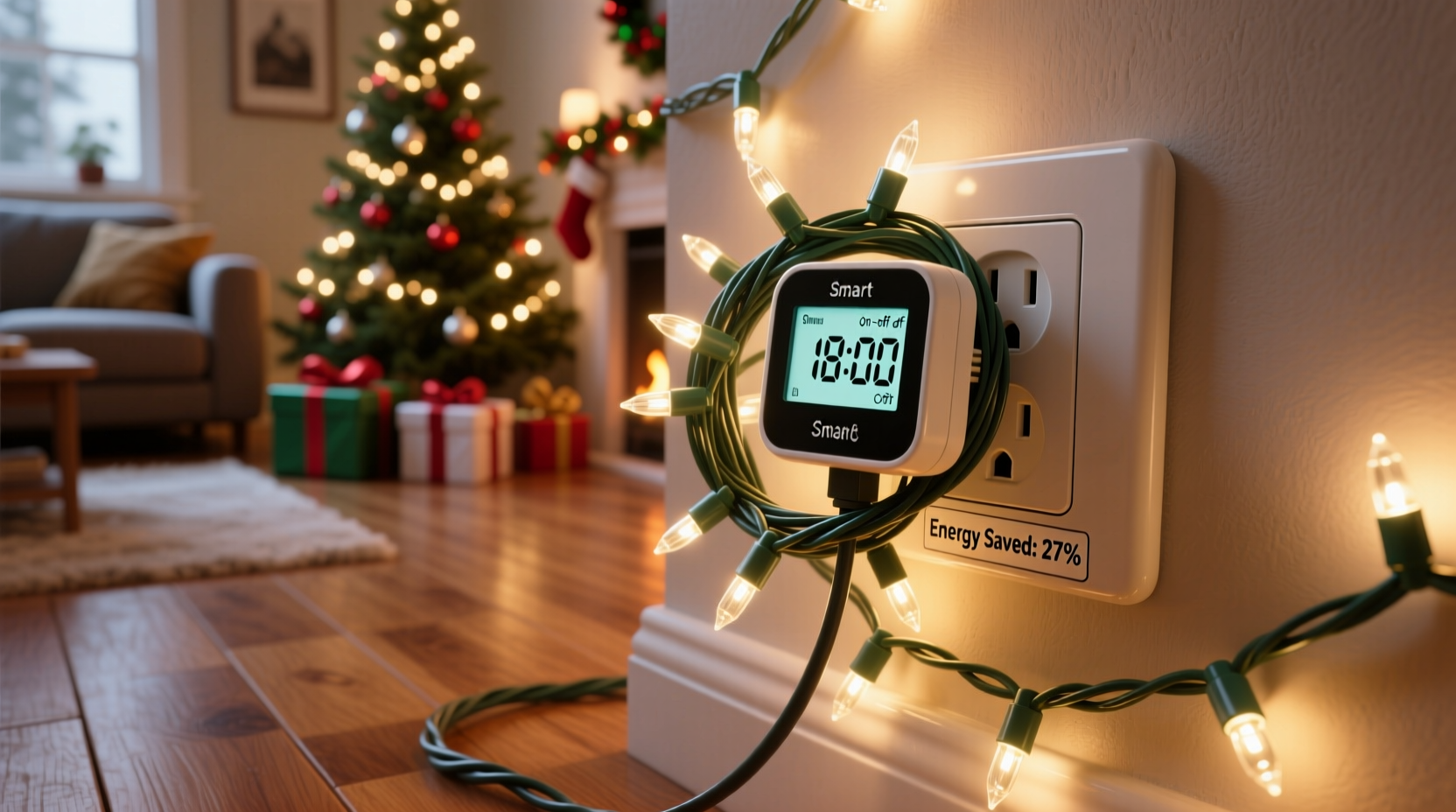
Timer outlets don’t eliminate electrical faults—they mitigate human error and environmental exposure, two leading contributors to decoration-related fires. According to NFPA’s 2023 Holiday Fire Safety Report, 42% of Christmas light fires occur between 11 p.m. and 7 a.m., when homes are dark and occupants are asleep. Another 28% happen while residents are away from home for six or more hours. In both cases, the hazard isn’t faulty wiring alone—it’s sustained operation under unmonitored conditions: heat buildup in insulation, contact with dry pine needles or curtains, or unnoticed damage from wind, rain, or animal activity.
A mechanical or digital timer outlet interrupts that exposure window. By defaulting lights to operate only during safe, predictable hours—say, 4:30 p.m. to 11:00 p.m.—it reduces active runtime by up to 65% compared to manual “leave-on-all-night” habits. That directly lowers thermal stress on sockets, wires, and transformers. More critically, it removes the opportunity for undetected failure escalation: a frayed wire may spark at 2:17 a.m., but if power is cut at 11:00 p.m., that spark never occurs.
Energy Savings: Quantifying the Real Dollar Impact
Savings depend less on the timer itself and more on disciplined runtime reduction. Consider a typical residential display: 300 LED mini lights (5W total), 200 warm-white net lights (8W), and four 12V LED icicle strings (3W each = 12W). Total draw: 25 watts. Left on 24/7 for 45 days (Dec 1–Jan 15), that consumes 25 W × 24 h × 45 d = 27,000 watt-hours, or 27 kWh. At the U.S. national average residential rate of $0.16/kWh, that’s $4.32—modest, but illustrative.
Now apply a realistic timer schedule: 5:00 p.m. to 11:00 p.m. daily (6 hours). Consumption drops to 25 W × 6 h × 45 d = 6,750 Wh (6.75 kWh), costing just $1.08. That’s a 75% reduction in energy use and cost—$3.24 saved. Scale that to larger displays: a midsize setup using 120W (e.g., mixed LED and incandescent accents) saves over $15.40 on the same schedule. Crucially, this math assumes LED lighting. Incandescent strings—still used by ~18% of households per the 2023 NEMA Holiday Lighting Survey—draw 5–10× more power. A single 100-bulb incandescent set consumes 40W; running it 6 hours/day saves $11.50 over 45 days versus 24/7 operation.
| Light Type | Typical Wattage (per 100 bulbs) | Daily Use (24h) | Daily Use (6h w/ Timer) | 45-Day Cost Savings* |
|---|---|---|---|---|
| LED Mini Lights | 4–5 W | $0.08 | $0.02 | $2.70 |
| LED Icicles (12 ft) | 6–8 W | $0.11 | $0.03 | $3.60 |
| Incandescent Mini (C7/C9) | 40–60 W | $0.96 | $0.24 | $32.40 |
| Mixed Residential Display (avg.) | 75–120 W | $2.16 | $0.54 | $72.00 |
*Based on $0.16/kWh, 45-day season. Savings reflect difference between 24h and 6h daily runtime.
Where Timers Fall Short—and What You Must Add
A timer is a behavioral tool—not a fault-tolerance device. It does nothing to prevent fires caused by overloaded circuits, damaged cords, improper outdoor-rated equipment, or incompatible dimmers and controllers. The U.S. Consumer Product Safety Commission (CPSC) emphasizes that 63% of decoration-related fires involve “improper installation or use,” not equipment failure alone. That includes plugging three or more light strings into a single outlet strip, using indoor lights outdoors, or daisy-chaining beyond manufacturer limits.
Timers also cannot compensate for aging infrastructure. Homes built before 1990 often have ungrounded two-prong outlets, undersized 15-amp circuits, or aluminum wiring—all of which increase resistance, heat, and arcing risk regardless of runtime. And critically: timers do not sense temperature, smoke, or current surges. If a transformer shorts or a junction box overheats, the timer keeps delivering power until the breaker trips—or until ignition occurs.
“Timers are highly effective at reducing *opportunity* for fire—but they’re one layer in a system. We consistently see incidents where timers were used correctly, yet fires occurred because lights were draped over combustible decking or wired into corroded outdoor receptacles.” — Capt. Daniel Reyes, NFPA Fire Prevention Division
Step-by-Step: Installing a Timer Outlet Safely & Effectively
Follow this sequence—not as optional advice, but as minimum due diligence for any display drawing more than 5A (600W at 120V).
- Evaluate your circuit load: Identify the breaker serving your outdoor outlet(s). Add up wattage of all devices on that circuit—including garage door openers, refrigerators, or landscape lighting. Do not exceed 80% of the breaker’s rating (e.g., max 1,440W on a 15A/120V circuit).
- Choose the right timer: Select a heavy-duty, outdoor-rated timer with a minimum 15A capacity and UL listing for wet locations. Avoid “dial-style” mechanical timers if you need precision (±1 minute); opt for digital models with battery backup for power outages.
- Install upstream—not downstream: Plug the timer into the GFCI-protected outdoor outlet first. Then plug your light controller or main extension cord into the timer. Never plug a timer into a power strip or surge protector unless explicitly rated for that configuration.
- Set conservative runtime: Start with 4:30 p.m. to 10:30 p.m. Adjust only after verifying no heat buildup at plugs, transformers, or splices after 3+ hours of operation. Use an infrared thermometer if possible—anything above 110°F (43°C) warrants inspection.
- Test weekly: Manually override the timer once per week to verify lights turn on/off as scheduled. Check for discoloration, brittleness, or melted plastic near connections. Replace any cord showing cracked insulation—even if it “still works.”
Real-World Validation: A Midwest Suburban Case Study
In December 2022, the Thompson family in Des Moines, Iowa, installed a moderate outdoor display: 400 LED lights across eaves, 30-ft garland with integrated LEDs, and two animated reindeer figures (total draw: 88W). They’d previously run lights manually from dusk until midnight—often forgetting to turn them off, resulting in 14+ hour nights. Their 2021 electric bill spiked $47.20 in December alone, and their neighbor reported smelling “hot plastic” near their shared fence line one January morning.
In 2022, they installed two UL-listed digital timers—one for front-yard lights, one for backyard—and programmed them for 4:45 p.m. to 10:15 p.m. They also replaced all extension cords with 12-gauge, outdoor-rated versions and added a dedicated 20A circuit for future expansion. Over 48 days, their December electricity usage increased only $12.80—$34.40 less than 2021. More importantly, Des Moines Fire Department confirmed zero reports of heat-related issues on their block that season, and their insurance carrier offered a 5% holiday safety discount after reviewing their documented upgrades.
FAQ: Critical Questions Answered
Can I use a smart plug timer instead of a dedicated outlet timer?
Yes—if it’s UL 943-certified for outdoor use and rated for your load. Many Wi-Fi plugs are designed for indoor lamps (max 10A) and lack weather sealing. Verify IP64 or higher rating and confirm compatibility with LED drivers (some smart plugs cause flickering due to low-load detection). For reliability, hardwired or heavy-duty plug-in timers remain the gold standard for seasonal lighting.
Do timers work with solar-powered lights?
No—and they’re unnecessary. Solar lights have built-in photoreceptors and charge controllers that automatically regulate on/off cycles and battery charging. Adding an external timer can interfere with charging logic or drain batteries prematurely. Reserve timers for AC-powered systems only.
What’s the biggest mistake people make with timer outlets?
Assuming “set and forget” means “safe forever.” Timers degrade: mechanical gears wear, digital memory fails, and weather seals crack. NFPA data shows 22% of timer-related incidents involved units older than five years. Replace timers every 3–4 seasons—or immediately after exposure to flooding, lightning surges, or physical impact.
Conclusion: Safety and Savings Start With Intentional Control
Timer outlets don’t magically prevent fires or slash bills. They enforce discipline where human attention lapses—cutting exposure time, capping energy waste, and creating predictable operational boundaries. But their value multiplies only when paired with foundational electrical hygiene: proper circuit management, outdoor-rated gear, routine visual inspections, and prompt replacement of compromised components. This isn’t about buying a gadget—it’s about adopting a safety-first mindset for seasonal electricity use. Every household that switches from “on until I remember” to “on only when needed” gains measurable protection: fewer thermal stress cycles on wiring, lower peak demand on aging grids, and peace of mind knowing lights won’t blaze unattended at 3 a.m. Start this season by auditing one outlet, installing one certified timer, and committing to a 6-hour nightly runtime. That small act—repeated across millions of homes—reduces collective fire risk, eases strain on utilities, and puts real dollars back in your pocket. Your lights will shine just as brightly. Your home—and your wallet—will thank you.




 浙公网安备
33010002000092号
浙公网安备
33010002000092号 浙B2-20120091-4
Comments
No comments yet. Why don't you start the discussion?