
Christmas lights bring warmth, cheer, and seasonal magic to homes every year. But behind the sparkle lies a hidden cost: wear and tear on the bulbs, wires, and electrical components from prolonged use. Many homeowners leave their lights on for hours longer than necessary—sometimes all night or even throughout the day—unaware that this constant operation shortens the lifespan of their decorations. A simple solution? Timer plugs. These unassuming devices do more than automate lighting schedules—they actively protect your investment by limiting exposure to heat, power surges, and unnecessary electrical stress.
Understanding how timer plugs influence the longevity of Christmas lights requires examining both the technical behavior of light strings and the real-world habits of users. When used strategically, timer plugs don’t just save electricity; they reduce thermal degradation, prevent overuse, and minimize risks associated with human error. This article explores the science behind bulb degradation, evaluates the protective role of timers, and provides actionable strategies for maximizing the life of your holiday lighting display.
How Christmas Lights Degrade Over Time
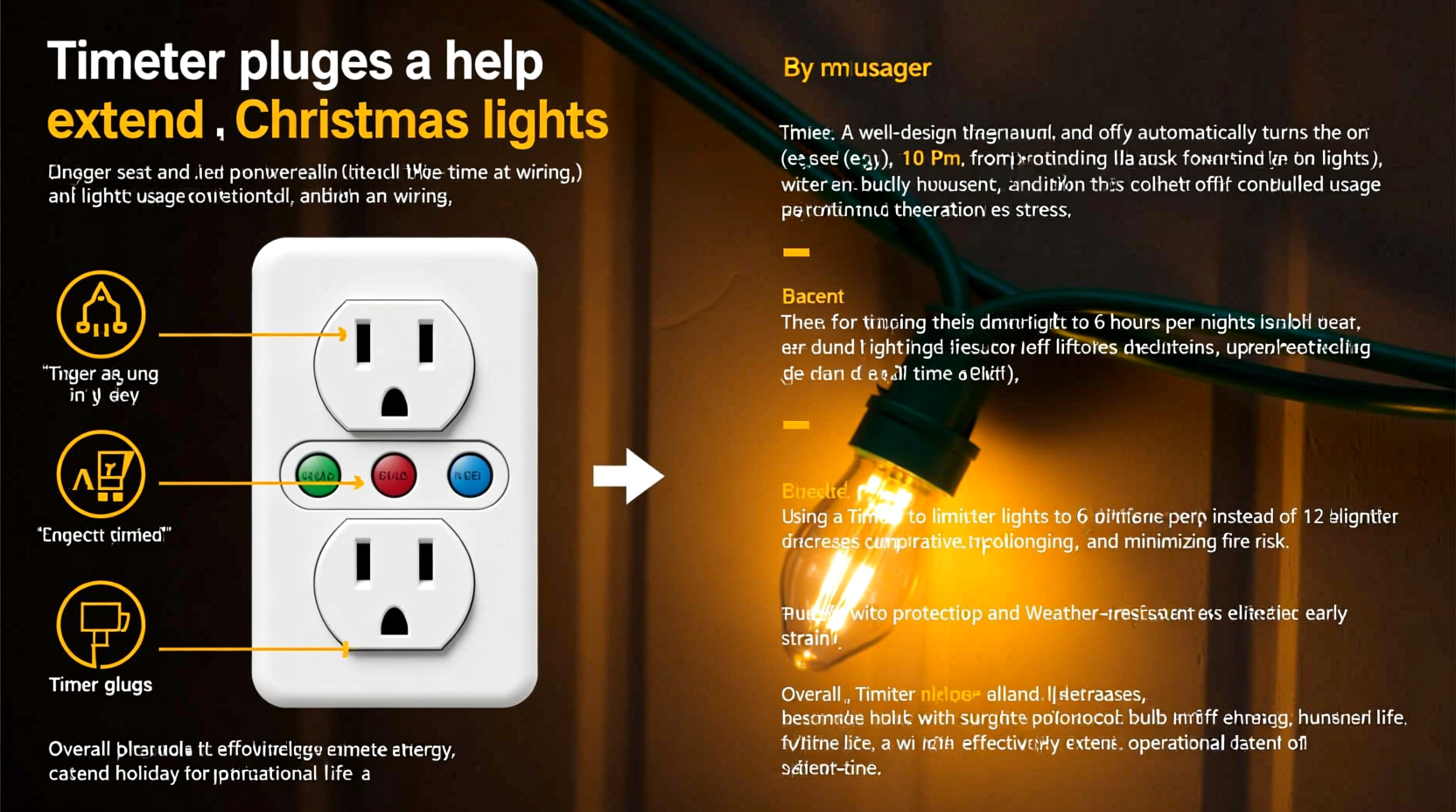
The lifespan of Christmas lights is not solely determined by manufacturing quality. Environmental and operational factors play a critical role in how quickly bulbs dim, flicker, or fail. Most traditional incandescent mini-lights have an average rated life of 3,000 hours. LED versions, while significantly more durable, typically last between 25,000 and 50,000 hours under ideal conditions. However, these figures assume optimal operating environments—something rarely achieved during holiday displays.
Several key mechanisms contribute to premature failure:
- Thermal Stress: Incandescent bulbs generate substantial heat. Continuous operation causes repeated expansion and contraction of filaments and solder joints, leading to microfractures.
- Moisture Infiltration: Outdoor lights exposed to rain, snow, or condensation may suffer internal corrosion, especially if seals degrade due to heat cycles.
- Voltage Fluctuations: Power surges, common during winter storms or grid fluctuations, can damage sensitive LED drivers or burn out filaments.
- Overuse: Leaving lights on 24/7 drastically increases cumulative exposure to all these stressors.
Even high-quality lights are vulnerable when operated beyond reasonable daily limits. For example, running incandescent strands for 12 hours a day will exhaust their rated lifespan in about ten months—well within a single holiday season’s extended use if left unchecked.
The Role of Timer Plugs in Managing Light Usage
Timer plugs act as automated switches that turn connected devices on and off according to a preset schedule. When applied to Christmas lights, they eliminate reliance on manual control, ensuring consistent operation windows regardless of homeowner availability or memory.
Modern timer plugs come in several formats:
- Mechanical Dial Timers: Affordable and reliable, these allow users to set multiple on/off intervals across a 24-hour cycle using physical tabs.
- Digital Timers: Offer greater precision, programmable weekly schedules, and sometimes backlighting for nighttime adjustments.
- Smart Plugs: Wi-Fi-enabled models integrate with apps and voice assistants, enabling remote control, geofencing, and integration into home automation routines.
All types serve the same fundamental purpose: reducing total runtime. By restricting operation to specific evening hours—say, 5 PM to 11 PM—you cut daily usage by up to 75% compared to leaving lights on all night. This directly translates into fewer cumulative operating hours over the season, slowing the progression of thermal fatigue and electronic wear.
“Consistent cycling through controlled durations extends light life far more effectively than any coating or housing improvement.” — Dr. Alan Reyes, Electrical Systems Engineer at Northeast Lighting Research Institute
Step-by-Step Guide to Optimizing Light Longevity with Timers
Maximizing the benefits of timer plugs involves more than just plugging in and setting a random schedule. A strategic approach ensures safety, efficiency, and long-term durability.
- Assess Your Display Needs: Determine which lights are purely decorative versus functional (e.g., pathway markers). Prioritize timers for non-essential strings.
- Select the Right Timer Type: Use outdoor-rated, weatherproof timers for exterior installations. For complex multi-zone setups, consider smart plugs with individual scheduling.
- Set Realistic On/Off Windows: Choose times that align with when people are likely to view the display—typically early evening. Avoid dawn-to-dusk settings unless using photocell-controlled systems.
- Avoid Peak Surge Hours: If possible, program lights to turn on after 6 PM, avoiding late-night voltage spikes caused by heating system cycling.
- Test Before Final Installation: Run a 24-hour test to confirm timing accuracy and ensure no conflicts with other appliances on shared circuits.
- Label and Document Settings: Keep a log of timer configurations for next year’s setup, reducing reconfiguration time and errors.
Comparative Benefits: Timers vs. Manual Control
| Factor | With Timer Plug | Without Timer (Manual) |
|---|---|---|
| Average Daily Runtime | 6–8 hours | 10–16+ hours |
| Bulb Lifespan Utilization | ~25% slower degradation | Accelerated wear |
| Energy Consumption | Reduced by 30–50% | Higher, inconsistent usage |
| Risk of Forgotten Shutdown | Nearly eliminated | Common (especially during holidays)|
| Seasonal Maintenance Burden | Lower (consistent patterns) | Higher (ad hoc management) |
| Safety from Overheating | Improved (limited exposure) | Dependent on user vigilance |
This comparison highlights how automation enhances both performance and preservation. The reduction in runtime alone can add several seasons to a string of lights, particularly for incandescent varieties where heat is the primary enemy.
Real-World Example: The Johnson Family's Holiday Lighting Upgrade
The Johnsons in Portland, Oregon, had been replacing their front-yard light display every two years due to widespread burnouts and broken sections. Their tradition involved turning lights on around December 1st and often forgetting to shut them off until well past midnight—or sometimes leaving them on all night.
In 2021, they invested in three outdoor-rated digital timer plugs, programming each zone (roofline, tree, railing) to activate at 5:30 PM and deactivate at 11:00 PM. They also upgraded one section to commercial-grade LED strings known for better heat dissipation.
The results were immediate. Energy bills dropped by $18 over the six-week season. More importantly, post-holiday inspection revealed zero failed bulbs—a first in over a decade. Two years later, the same lights remain fully functional with only minor connector wear. The family attributes the improvement primarily to reduced runtime enabled by the timers.
“We didn’t realize how much we were overusing them,” said Mark Johnson. “Now that they’re only on when people actually see them, they look brighter, last longer, and feel safer.”
Additional Tips for Maximizing Light Longevity
While timer plugs are a powerful tool, they work best as part of a broader care strategy. Combine timed operation with these best practices:
- Inspect Before Hanging: Check for cracked sockets, frayed wires, or loose connections before installation.
- Use Surge Protectors: Plug timer-controlled lights into surge-protected outlets, especially outdoors.
- Store Properly Off-Season: Coil lights carefully on reels or cardboard spools, store in dry containers away from rodents and temperature extremes.
- Limit String Lengths: Avoid daisy-chaining too many sets together, which increases load and heat buildup.
- Clean Gently: Wipe down housings with a damp cloth before storage to remove salt, dirt, or bird droppings that accelerate corrosion.
Frequently Asked Questions
Can timer plugs damage LED Christmas lights?
No, timer plugs do not harm LED lights. In fact, they help preserve them by reducing thermal cycling and electrical load duration. Just ensure the timer is rated for the total wattage of your display and is designed for outdoor use if needed.
Do I need a separate timer for each strand?
Not necessarily. You can group compatible lights on the same circuit using a single timer, provided the total load does not exceed the timer’s maximum capacity (usually 1,800–2,000 watts). For complex displays with different schedules, multiple timers or smart plugs offer greater flexibility.
Are smart plugs worth it for Christmas lights?
For users who value convenience and remote access, yes. Smart plugs allow you to adjust schedules via smartphone, receive outage alerts, and integrate with holiday scenes (e.g., “Movie Night” mode that dims indoor lights). While more expensive upfront, they pay off in usability and fine-tuned control.
Checklist: Extending Christmas Light Life with Timer Plugs
- ✔️ Choose a timer rated for outdoor use if placing outside
- ✔️ Verify total wattage of connected lights is below timer limit
- ✔️ Set on/off times aligned with viewing hours (e.g., 5 PM – 11 PM)
- ✔️ Test operation for at least one full cycle before finalizing
- ✔️ Pair with surge protector for added electrical safety
- ✔️ Label timer settings for easy reuse next season
- ✔️ Perform end-of-season inspection and clean before storage
Conclusion: A Small Change with Lasting Impact
Timer plugs represent a low-cost, high-impact upgrade for anyone who decorates with Christmas lights. Far from being mere conveniences, they function as essential guardians of your lighting investment. By curbing excessive usage, mitigating heat exposure, and enforcing disciplined operation, timers significantly extend the functional life of both incandescent and LED strings.
The evidence is clear: reducing runtime slows degradation, improves safety, and delivers tangible savings over time. Whether you opt for a basic mechanical model or a full smart-home-integrated system, the core benefit remains the same—your lights stay brighter, safer, and more reliable year after year.




 浙公网安备
33010002000092号
浙公网安备
33010002000092号 浙B2-20120091-4
Comments
No comments yet. Why don't you start the discussion?