
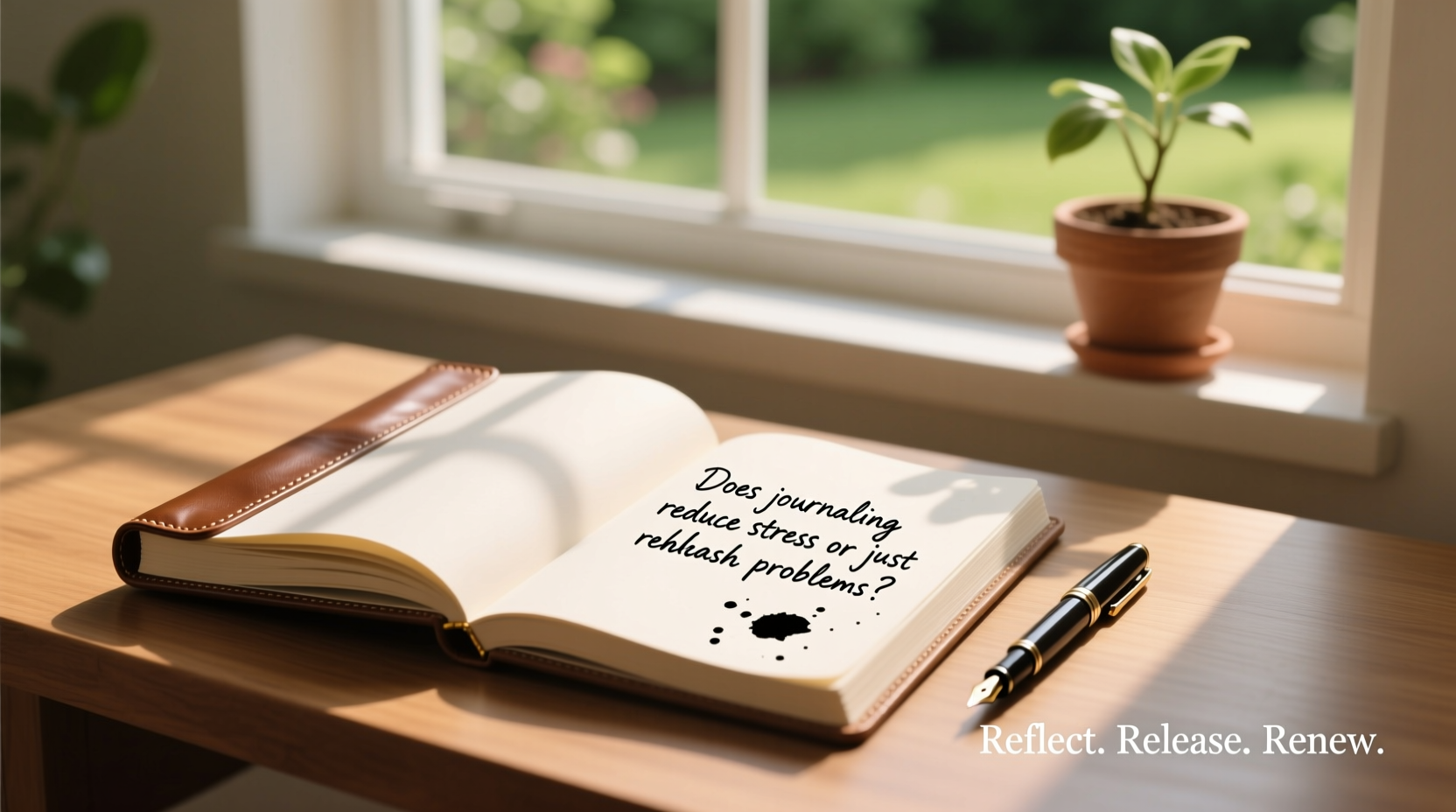
Journaling has long been promoted as a low-cost, accessible way to manage stress, process emotions, and improve mental clarity. From therapists to life coaches, many recommend writing down thoughts as a form of emotional release. But for some, the act of journaling can feel like reliving painful experiences—rehashing problems without resolution. So, does journaling truly reduce stress, or does it risk deepening rumination? The answer lies not in the act itself, but in how it's practiced.
When done with intention and structure, journaling can be a powerful psychological tool. When approached passively or repetitively, it may reinforce negative thought loops. Understanding the difference is key to turning your journal into a sanctuary of healing rather than a hall of echoes.
The Science Behind Journaling and Stress Reduction
Numerous studies support the idea that expressive writing can significantly reduce stress and improve emotional well-being. A landmark study by Dr. James Pennebaker in the 1980s found that individuals who wrote about traumatic or emotionally charged experiences for 15–20 minutes over several days showed improved immune function, reduced blood pressure, and lower levels of anxiety and depression.
The mechanism behind this benefit is cognitive processing. Writing forces the brain to organize fragmented thoughts, assign narrative structure to chaotic emotions, and create distance from overwhelming feelings. This process, known as “affect labeling,” helps regulate the amygdala—the brain’s emotional alarm system—by engaging the prefrontal cortex, which governs logic and self-control.
“Writing about emotional upheavals allows people to gain control over them. It doesn’t erase pain, but it makes it manageable.” — Dr. James Pennebaker, Psychology Researcher, University of Texas
However, the same study also noted that not all writing leads to improvement. Participants who simply vented without reflection or insight saw little benefit. In some cases, they reported feeling worse—evidence that unstructured rumination through journaling can backfire.
When Journaling Helps—and When It Hurts
The critical factor in determining whether journaling reduces stress or amplifies it is the quality of engagement. Consider these two contrasting scenarios:
- Constructive Journaling: You write about a conflict at work, exploring your feelings, identifying triggers, and brainstorming solutions. You end with a note of self-compassion and a plan to address the issue calmly.
- Destructive Rumination: You repeatedly describe the same argument, focusing on blame, injustice, and helplessness. There’s no forward movement, only repetition of distress.
The first example promotes emotional regulation and problem-solving. The second reinforces neural pathways associated with stress and victimhood. The difference isn't the topic—it's the approach.
Signs Your Journaling Is Reducing Stress
- You feel lighter or calmer after writing
- You gain new perspectives on old issues
- You identify patterns in your behavior or triggers
- You begin setting intentions or goals
Signs Your Journaling Is Rehashing Problems
- You feel more agitated or sad afterward
- Entries repeat the same story with no variation
- You focus heavily on others’ actions without self-reflection
- There’s no sense of closure or next steps
Best Practices for Stress-Reducing Journaling
To ensure your journal serves as a tool for relief rather than rumination, adopt evidence-based techniques that promote constructive reflection.
1. Use Structured Prompts
Open-ended prompts like “What’s bothering me?” can lead to unfocused venting. Instead, use targeted questions that guide insight:
- What emotion am I feeling most right now, and where do I feel it in my body?
- What part of this situation is within my control?
- How would I advise a friend in this situation?
- What’s one small action I can take today to feel more grounded?
2. Limit Time and Frequency
Set a timer for 10–15 minutes. This prevents over-immersion and creates a boundary around emotional processing. Daily journaling isn’t necessary; 2–3 times per week is often enough to gain benefits without tipping into obsession.
3. Incorporate Gratitude and Reflection
Balancing difficult topics with positive reflection reduces negativity bias. Try ending each session with one thing you’re grateful for or one strength you used that day.
| Journaling Approach | Benefit | Risk if Misused |
|---|---|---|
| Expressive Writing (Pennebaker method) | Improved mood, better sleep, enhanced clarity | Emotional flooding if done too soon after trauma |
| Gratitude Journaling | Increased optimism, reduced anxiety | Minimizing real struggles if used to avoid pain |
| Cognitive Reframing Journaling | Reduced rumination, improved problem-solving | Feeling forced or inauthentic if not genuine |
| Stream-of-Consciousness Writing | Creative release, uncovering subconscious thoughts | Can reinforce chaotic thinking without structure |
A Real Example: How One Woman Transformed Her Journaling Practice
Sarah, a 34-year-old project manager, started journaling during a period of high work stress. Initially, her entries were raw and repetitive: “My boss doesn’t appreciate me,” “I’m overwhelmed,” “I hate this job.” After several weeks, she realized she felt no better—only angrier and more trapped.
She decided to change her approach. With guidance from a therapist, she began using structured prompts. Instead of writing, “I hate my job,” she asked, “What specifically made me feel undervalued this week?” She followed up with, “What strengths did I use to handle those moments?” and “What’s one conversation I could initiate to improve things?”
Within a month, Sarah noticed a shift. Her journal became a space for strategy, not just complaint. She identified that unclear expectations—not personal failure—were the root of her stress. She scheduled a meeting with her manager, clarified priorities, and negotiated a temporary workload reduction. The journal didn’t solve her problems, but it gave her the clarity to act.
“I used to think journaling was just about getting things out. Now I see it’s about making sense of them.” — Sarah, after six months of intentional journaling
Step-by-Step Guide to Effective Stress-Reducing Journaling
Follow this five-step process to turn your journal into a tool for emotional resilience:
- Set the Stage (2 minutes): Find a quiet space. Take three deep breaths. Write your name and the date at the top.
- Check In Emotionally (3 minutes): Name your current emotion. Rate its intensity from 1 to 10. Briefly describe where you feel it in your body.
- Write with Purpose (7–10 minutes): Choose one prompt below or use a personal issue. Focus on understanding, not blaming.
- Reframe and Respond (3 minutes): Ask yourself: “What’s one helpful thought I can take from this?” or “What’s one small step I can take?”
- Close with Compassion (2 minutes): End with a kind statement to yourself: “I’m doing my best,” or “This is hard, and I’m still growing.”
Frequently Asked Questions
Can journaling make anxiety worse?
Yes, if it turns into rumination. Writing about the same fears without seeking perspective or solutions can reinforce anxious thought patterns. To prevent this, limit writing time, use guided prompts, and balance difficult topics with grounding or positive reflections.
Is there a wrong way to journal?
There’s no single “wrong” way, but some methods are less effective. Pure venting without reflection, excessive detail about trauma without emotional support, or using journaling to avoid real-world conversations can reduce benefits. The goal is insight and integration, not just expression.
Should I reread old entries?
Occasionally, yes—but with caution. Reviewing past entries can show growth and reveal recurring patterns. However, avoid rereading during emotional lows, as it may trigger old feelings. Set a purpose before reviewing: “Am I looking for progress, patterns, or lessons?”
Checklist: Healthy Journaling Habits
Use this checklist to evaluate and improve your journaling practice:
- ☑ I set a time limit (10–15 minutes)
- ☑ I use prompts to guide reflection
- ☑ I include both challenges and strengths
- ☑ I end with a forward-looking or compassionate note
- ☑ I don’t force myself to write when I’m emotionally flooded
- ☑ I keep my journal private and safe
- ☑ I review entries occasionally to track growth
Conclusion: Turn Your Journal Into a Compass, Not a Mirror
Journals are not meant to mirror every passing emotion—they’re meant to serve as compasses, helping you navigate through internal storms with greater awareness and direction. The act of writing is neutral; its impact depends entirely on how you wield it.
When journaling reduces stress, it’s because it fosters clarity, accountability, and self-kindness. When it rehashes problems, it’s often due to unstructured repetition without reflection. The solution isn’t to stop writing—it’s to write with purpose.
Start small. Use one prompt. Set a timer. Be honest but kind. Over time, your journal can become one of your most trusted allies in the journey toward emotional resilience.




 浙公网安备
33010002000092号
浙公网安备
33010002000092号 浙B2-20120091-4
Comments
No comments yet. Why don't you start the discussion?