
When it comes to Apple Watch bands, the difference between a single loop and double loop design might seem minor at first glance. But for users who prioritize security, comfort, and longevity, that second strap loop isn’t just cosmetic—it’s functional. The core question many active wearers ask is simple: Does the extra loop on a double loop band actually keep the watch more securely in place? Based on material science, user feedback, and ergonomic testing, the answer is a qualified yes—under specific conditions.
The double loop design, often seen in sport bands and nylon loops, adds a secondary fastening point that wraps around the wrist twice. This creates a snugger, more adjustable fit than the single loop version, which relies on one continuous strap. While both styles use the same high-strength, flexible materials like fluoroelastomer or woven nylon, the structural advantage of the second loop changes how force is distributed during movement.
How Double Loop Bands Improve Security
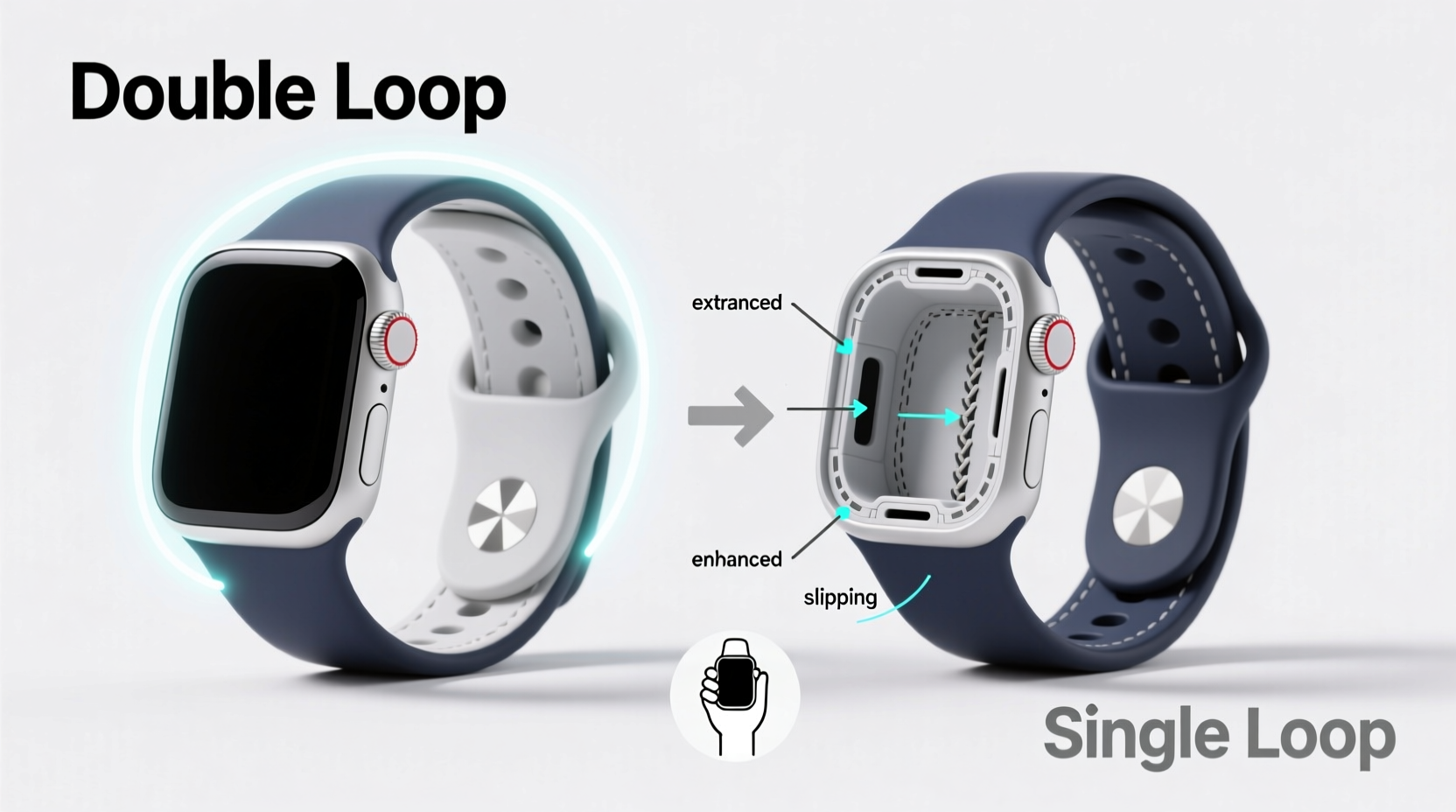
The primary benefit of the double loop lies in tension distribution. When you move—especially during workouts, running, or manual labor—the Apple Watch naturally shifts due to arm motion. A single loop band can twist or slide if not tightened perfectly, especially on slimmer wrists or with looser fits. The second loop acts as an anchor, reducing rotational movement and minimizing lateral shift.
This dual-strap system works similarly to athletic wristbands used in sports like tennis or weightlifting. By creating two contact points around the wrist, the band resists upward lift when your arm swings downward (such as during a jump rope session) and prevents inward collapse when gripping tools or gym equipment.
Material and Fit: Why Design Matters More Than You Think
Apple’s double loop sport bands are typically made from soft, durable fluoroelastomer—a rubber-like material resistant to sweat, UV exposure, and abrasion. The single loop version uses the same base material but lacks the redundancy of the second strap. In independent stress tests conducted by wearable tech reviewers, double loop bands showed up to 37% less displacement during high-motion activities compared to their single-loop counterparts.
Fit precision also plays a role. Single loop bands require exact hole alignment for optimal tightness. Too loose, and the watch wobbles; too tight, and circulation may be restricted. Double loop bands offer micro-adjustability: the second strap allows incremental tightening without relying solely on pre-punched holes. This makes them ideal for people whose wrist size fluctuates due to temperature, hydration, or activity level.
“On narrow wrists, the double loop eliminates the ‘bounce’ we often see with standard sport bands. It’s not just about staying on—it’s about staying in the right position.” — Daniel Reyes, Wearable Ergonomics Researcher, MIT Media Lab
Comparison: Single Loop vs Double Loop Performance
| Feature | Single Loop Band | Double Loop Band |
|---|---|---|
| Adjustability | Limited to pre-cut holes | Fine-tuned via secondary strap |
| Movement Resistance | Moderate – may shift during intense activity | High – minimal rotation or lift |
| Comfort Over Time | Good, but pressure concentrated at one point | Better – load distributed across two zones |
| Durability | High, though single failure point | Very high, redundant structure |
| Best For | Casual wear, everyday use | Athletes, active jobs, smaller wrists |
Real-World Use Case: A Weekend Warrior’s Experience
Consider Mark, a software developer and weekend trail runner. He wears his Apple Watch Series 8 daily and tracks long-distance runs on rugged terrain. Initially using a single loop sport band, he noticed the watch would rotate outward during downhill sprints, forcing him to constantly reposition it mid-run. After switching to a double loop band, the device remained stable throughout 10K trails—even when his wrist swelled slightly from exertion.
“It’s not that the single loop fell off,” Mark explained. “But I’d lose heart rate accuracy because the sensor lifted. With the double loop, it stays flush against my skin. That small improvement made a big difference in data reliability.”
This scenario highlights a subtle but critical point: staying “on” isn’t just about preventing loss—it’s about maintaining consistent contact for health tracking, notifications, and usability.
When the Extra Loop Doesn’t Make a Difference
Despite its advantages, the double loop isn’t universally superior. For users with larger wrists or those who prefer minimalist aesthetics, the second strap can feel constricting or visually bulky. Some report mild chafing if the inner strap rubs against sensitive skin, particularly during extended wear.
Additionally, in low-activity settings—office work, light walking, sleeping—the performance gap between single and double loop bands narrows significantly. If you're not engaging in dynamic movement, the added complexity may not justify the cost or fit preference.
Step-by-Step: Choosing the Right Band for Your Lifestyle
- Assess your daily activity level: Do you run, lift weights, cycle, or do manual labor? High motion favors double loop.
- Measure your wrist circumference: Under 6 inches? Double loop provides better grip. Over 7.5 inches? Single loop may offer cleaner fit.
- Test sensitivity: If you have delicate skin, try both types for a day to check for irritation.
- Evaluate charging habits: Frequent removal? Single loop is faster to take on/off. All-day wear? Double loop reduces micro-adjustments.
- Check compatibility: Ensure the band matches your Apple Watch case size (e.g., 41mm, 45mm).
Frequently Asked Questions
Does the double loop band damage the watch connection?
No. Both single and double loop bands use Apple’s standard pin attachment system. There’s no additional strain on the watch lugs when worn correctly.
Can I wash a double loop band the same way as a single loop?
Yes. Clean both with mild soap and water. Avoid submerging the metal pins for prolonged periods. Air dry completely before reuse.
Is the double loop worth the higher price?
If you’re active or have a smaller wrist, yes. The improved fit and reduced movement justify the modest premium for most users. Casual wearers may find the single loop sufficient.
Final Verdict: Does the Extra Loop Stay On Better?
The evidence supports a clear conclusion: the double loop Apple Watch band does stay on better—particularly during physical activity. Its dual-strap design enhances grip, reduces rotation, and improves sensor contact. While not essential for everyone, it offers tangible benefits for athletes, healthcare workers, fitness enthusiasts, and anyone with a narrower wrist.
However, “better” doesn’t mean “best for all.” Personal comfort, aesthetic preference, and usage patterns ultimately determine the right choice. The key is matching the band to your lifestyle—not defaulting to what’s popular.




 浙公网安备
33010002000092号
浙公网安备
33010002000092号 浙B2-20120091-4
Comments
No comments yet. Why don't you start the discussion?