
Walking your dog should be a relaxing, enjoyable experience for both of you. Yet, many pet owners dread walks because their dogs pull relentlessly on the leash, turning a simple outing into a tug-of-war. This behavior isn’t just frustrating—it can be dangerous for both the dog and handler. The good news is that leash pulling is not a permanent flaw. With consistency, patience, and the right techniques, any dog can learn to walk politely by your side. This guide breaks down practical, humane, and science-based methods to transform your walks from chaotic to calm.
Understanding Why Dogs Pull on the Leash
Dogs are naturally curious and eager to explore their environment. When they see something interesting—a squirrel, another dog, or a new scent—they move toward it. Since they don’t understand human walking etiquette, they simply go where their nose leads them. If pulling gets them where they want faster (even once), they learn that this behavior works. Over time, it becomes a reinforced habit.
Additionally, excitement plays a major role. Many dogs become overstimulated the moment they see the leash, associating it with freedom and adventure. Without proper training, they rush forward, dragging their owner behind them.
“Leash pulling is not defiance—it’s communication. Your dog is saying, ‘I want to go there!’ Our job is to teach them a better way.” — Dr. Karen Overall, Veterinary Behaviorist
Step-by-Step Training Plan to Stop Leash Pulling
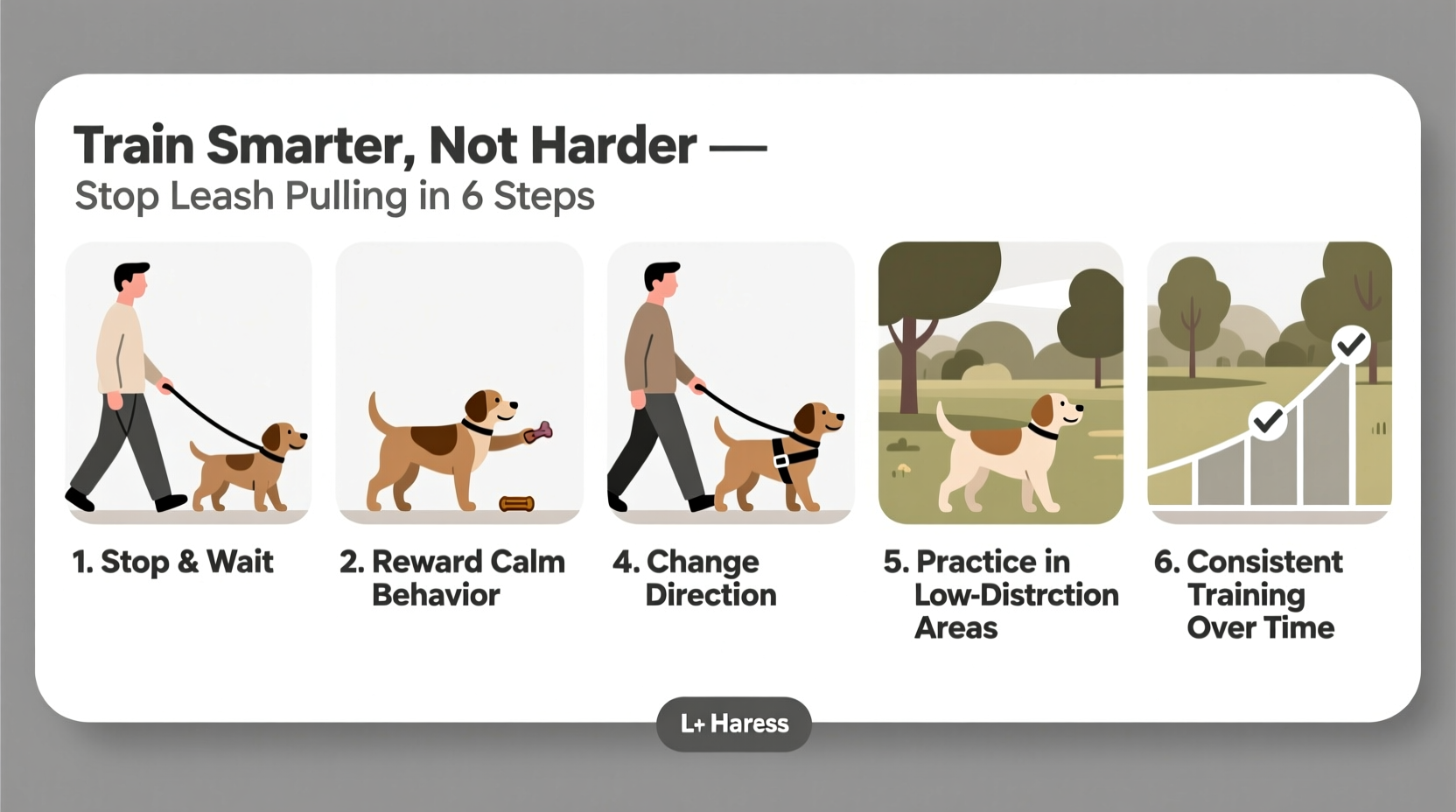
Changing your dog’s behavior requires more than just willpower—it needs a structured approach. Follow this five-phase plan to build loose-leash walking skills gradually.
- Phase 1: Practice Indoors First
Start in a quiet, distraction-free area like your living room. Use a standard 4–6 foot leash and a well-fitted harness or collar. Begin walking slowly while holding treats at your side. Reward your dog whenever they stay near your leg. If they surge ahead, stop immediately. Wait for them to turn back or slacken the leash, then mark the moment with a “yes” or clicker and reward. - Phase 2: Introduce Direction Changes
Once your dog follows you consistently indoors, add sudden U-turns. If they start to pull forward, pivot and walk the opposite way. This teaches them that pulling doesn’t get them closer to their goal, but staying with you does. Reward attention and position beside you. - Phase 3: Add Distractions Gradually
Move training to your backyard or a quiet sidewalk during off-peak hours. Start with low distractions and increase difficulty only when your dog succeeds consistently. Use higher-value treats if needed—such as small pieces of chicken or cheese—to maintain focus. - Phase 4: Implement the “Be a Tree” Technique
When your dog pulls, come to a complete stop. Stand still like a tree until the leash loosens—even if it takes 30 seconds. The moment tension releases, praise and continue walking. This teaches impulse control and reinforces that progress only happens when the leash is slack. - Phase 5: Build Duration and Real-World Application
Gradually increase walk length and introduce busier environments. Practice frequently—short, daily sessions are more effective than weekly long ones. Celebrate small improvements and remain patient through setbacks.
Essential Tools and Equipment That Help
While training is the foundation, the right gear can support your efforts and prevent injury.
| Tool | Best For | Why It Helps |
|---|---|---|
| Front-Clip Harness | Dogs who pull strongly | Redirects the dog’s momentum when they pull, making it harder to charge forward |
| No-Pull Harness | Medium to large breeds | Gentle pressure discourages pulling without choking |
| Head Halter (e.g., Gentle Leader) | Dogs with high prey drive | Offers gentle steering control around the muzzle, reducing strain on the neck |
| Standard 6-Foot Leash | All training stages | Provides optimal control and consistency; avoid retractable leashes for training |
Avoid choke chains, prong collars, or shock collars unless under the guidance of a certified trainer. These tools can cause physical harm and damage trust.
Common Mistakes That Undermine Progress
Even well-meaning owners accidentally reinforce pulling. Recognizing these pitfalls is crucial.
- Moving forward while the leash is taut: This rewards pulling by allowing progress.
- Inconsistent responses: Sometimes stopping, sometimes yanking, sometimes letting the dog pull sends mixed signals.
- Using retractable leashes during training: They encourage pulling and give poor feedback.
- Expecting immediate results: Behavior change takes weeks, not days. Patience is non-negotiable.
- Training only on walks: Practice loose-leash walking in short, focused sessions outside of regular walks.
Real-Life Example: Turning Around Max the Labrador
Max, a two-year-old Labrador Retriever, pulled so hard on walks that his owner, Sarah, developed shoulder pain. She tried yanking the leash and scolding, but Max only pulled harder. After consulting a certified dog trainer, she started the step-by-step method outlined above.
She began practicing indoors with a front-clip harness and high-value treats. Within a week, Max learned to stay at her side for short stretches. She introduced U-turns and stopped moving whenever he surged ahead. At first, Max would lunge, stop, sit, and look confused—but after several repetitions, he began checking in with her before moving forward.
After three weeks of consistent daily practice, Max walks calmly on the sidewalk with minimal pulling. Sarah now enjoys their morning routine instead of dreading it. Her success came not from strength, but from consistency and positive reinforcement.
Checklist: How to Successfully Train Loose-Leash Walking
Use this checklist to ensure you’re covering all bases in your training journey:
- ✅ Choose the right equipment (front-clip harness or head halter)
- ✅ Use high-value treats during early training phases
- ✅ Practice indoors before moving outdoors
- ✅ Stop completely when the leash tightens
- ✅ Reward your dog the moment the leash goes slack
- ✅ Incorporate frequent U-turns to maintain attention
- ✅ Keep training sessions short (5–10 minutes) but frequent
- ✅ Gradually increase distractions as skills improve
- ✅ Stay calm and patient—avoid yelling or jerking
- ✅ Celebrate progress, no matter how small
Frequently Asked Questions
How long does it take to stop a dog from pulling on the leash?
Most dogs show improvement within 2–4 weeks of consistent training. However, full reliability in all environments may take several months. The timeline depends on the dog’s age, temperament, previous habits, and the owner’s consistency.
Can older dogs learn not to pull?
Absolutely. While puppies are easier to train from the start, adult and senior dogs can learn new behaviors at any age. The key is patience and repetition. Older dogs may take longer due to established habits, but they often have better focus than young, excitable dogs.
Should I use a clicker for leash training?
A clicker can be a helpful tool for marking desired behavior precisely. If used correctly—click at the exact moment the leash is slack and follow with a treat—it speeds up learning. However, verbal markers like “yes!” work just as well if timing is accurate.
Conclusion: Transform Your Walks with Consistency and Kindness
Stopping leash pulling isn’t about dominance or force—it’s about communication and cooperation. By teaching your dog that walking beside you leads to rewards and forward motion, you build a partnership based on trust. Every step you take together in training strengthens your bond and makes future walks more enjoyable.
The techniques in this guide are grounded in positive reinforcement, supported by animal behavior experts, and proven in real-world homes. Success doesn’t require perfection—just persistence. Start today, even if it’s just five minutes in your hallway. Small efforts compound into lasting change.




 浙公网安备
33010002000092号
浙公网安备
33010002000092号 浙B2-20120091-4
Comments
No comments yet. Why don't you start the discussion?