
A rhinestone clutch is more than just an accessory—it’s a statement piece. Whether worn to a gala, wedding, or evening out, its shimmer commands attention. But that brilliance comes with responsibility. Rhinestones are delicate; improper storage can lead to chipping, loosening, tarnishing, or even complete detachment. Over time, neglect can dull the sparkle and compromise structural integrity. The good news: with mindful care and correct storage techniques, your clutch can retain its luster for years. This guide delivers practical, expert-backed strategies to preserve both beauty and function.
Understand What Makes Rhinestones Vulnerable
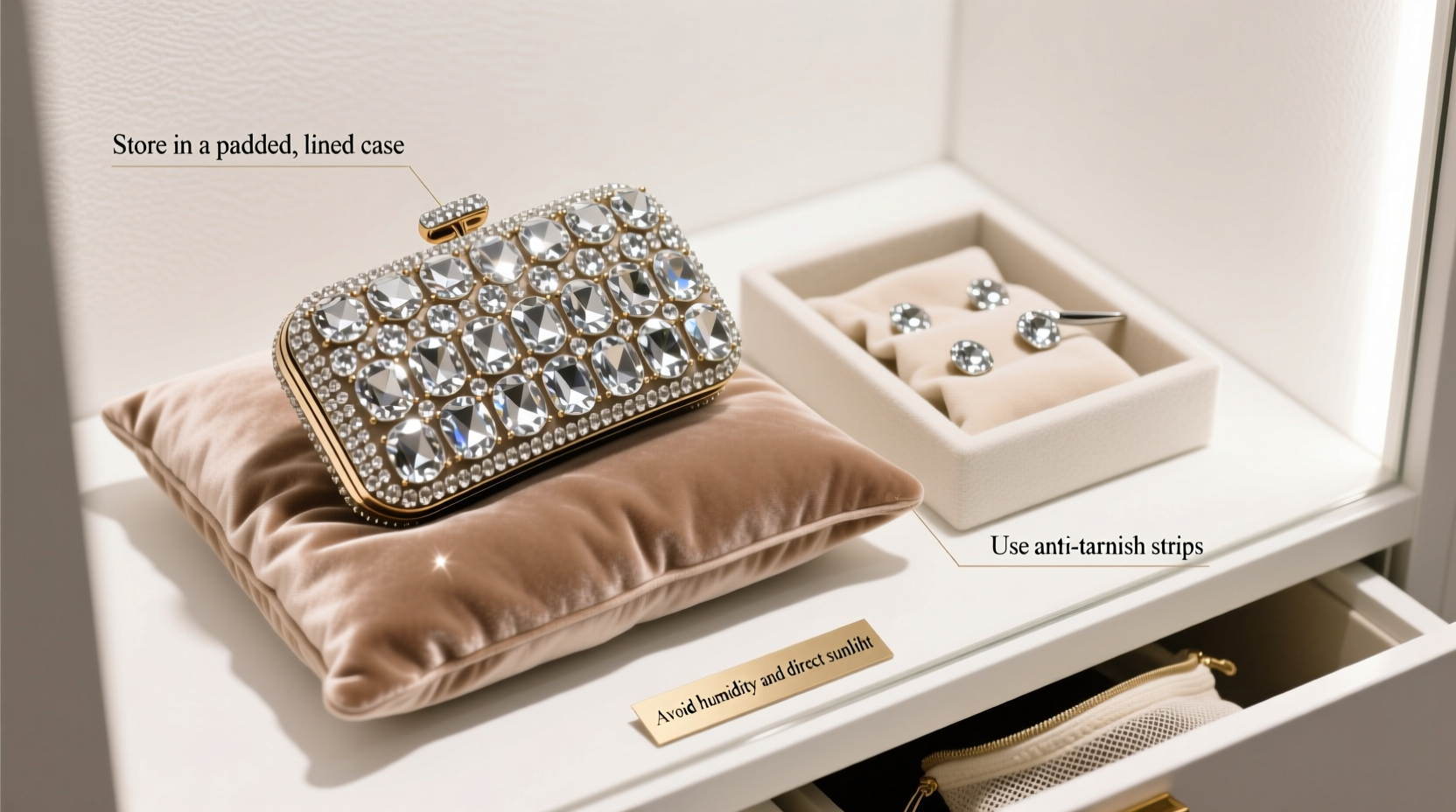
Rhinestones—whether glass, acrylic, or crystal—are typically adhered or set into metal prongs on a fabric, leather, or synthetic base. While they mimic diamonds in appearance, they lack their durability. Exposure to moisture, pressure, abrasion, or temperature fluctuations weakens adhesives and corrodes backing materials. Additionally, the clutch’s structure itself may warp if stored improperly, increasing stress on the stone settings.
The primary threats include:
- Friction: Rubbing against other items causes stones to scratch or pop off.
- Humidity: Promotes tarnishing of metal components and degrades adhesive bonds.
- Pressure: Stacking objects on the clutch distorts its shape and dislodges stones.
- Sunlight: UV rays fade colored stones and weaken glue over time.
“Rhinestones are fragile by design. Their longevity depends less on material and more on how they’re treated between uses.” — Lila Nguyen, Accessory Conservation Specialist, Metropolitan Fashion Archive
Step-by-Step Guide to Proper Storage
Storing a rhinestone clutch isn’t just about putting it away—it’s a deliberate process designed to minimize risk and maximize preservation. Follow this five-step routine every time you put the clutch aside.
- Clean gently before storage: Use a soft, dry microfiber cloth to wipe away fingerprints, makeup residue, or dust. Never use liquids unless absolutely necessary—and only then with extreme caution.
- Inspect for loose stones: Run fingers lightly across the surface. If any stone feels wobbly, address it before storing to prevent further damage.
- Shape support: Stuff the interior with acid-free tissue paper to maintain form without pressing against the embellished exterior.
- Wrap securely: Place the clutch in a breathable cotton pouch or wrap it in a clean, lint-free cloth. Avoid plastic bags, which trap moisture.
- Store flat in a protected space: Lay it horizontally in a drawer or shelf where it won’t be jostled or stacked upon.
Do’s and Don’ts of Rhinestone Clutch Storage
| Do’s | Don’ts |
|---|---|
| Store in a cool, dry place away from sunlight | Leave it exposed on a dresser near a window |
| Use a dedicated dust bag made of soft cotton or muslin | Keep it in a plastic zipper bag |
| Place it flat, not hanging or leaning | Hang it on a hook where weight pulls on the chain or frame |
| Check periodically for tarnish or lifting stones | Forget about it for months inside a crowded handbag bin |
| Repair minor issues immediately | Wait until multiple stones have fallen out |
Real Example: How One Collector Saved Her Vintage Piece
Maria R., a vintage accessories collector from Portland, inherited a 1970s silver rhinestone clutch from her grandmother. Though stunning, it had been stored in a cedar chest wrapped in plastic for decades. When she retrieved it, several stones were cloudy, and six had detached entirely. She consulted a textile conservator who explained that trapped moisture inside the plastic caused oxidation of the foil backing—a common issue known as \"stone rot.\"
Maria switched tactics: she cleaned the remaining stones with a dry brush, replaced the plastic wrap with a linen drawstring bag, and stored the clutch in a climate-controlled closet compartment. She also placed silica gel packets nearby (but not touching) to absorb ambient humidity. Within a year, no further degradation occurred. Today, the clutch remains a centerpiece of her collection, proof that proper storage reverses neglect trends.
When and How to Repair Loose Stones
Even with perfect storage, occasional maintenance is inevitable. If you notice a stone becoming loose, act promptly. Waiting allows movement that damages the setting or surrounding material.
For minor repairs at home:
- Use a toothpick to apply a tiny drop of E6000 or Gem-Tac adhesive—the industry standards for jewelry repair.
- Press the stone back gently and hold for 30 seconds.
- Let cure undisturbed for 24 hours in a flat, dust-free area.
For extensive damage—such as multiple missing stones or warped backing—consult a professional restorer. Many specialty handbag repair services offer rhinestone reapplication using heat-setting or precision glue methods that match original craftsmanship.
“A single loose stone is like a warning light. Fix it early, and you prevent cascading failure.” — Daniel Cho, Handbag Restoration Technician, Luxe Care Studio
Storage Checklist: Your Monthly Routine
To ensure long-term protection, perform this checklist once per month—especially if the clutch is seasonal or rarely used.
- ☐ Remove from storage and inspect under natural light
- ☐ Gently dust with a microfiber or jeweler’s cloth
- ☐ Check for loose, cracked, or discolored stones
- ☐ Verify the interior lining isn’t pulling near seams
- ☐ Replace tissue paper stuffing if wrinkled or compressed
- ☐ Confirm storage environment is dry and temperate
- ☐ Re-wrap in clean cloth or pouch before returning to shelf
Frequently Asked Questions
Can I store my rhinestone clutch in a regular handbag organizer?
Only if each compartment is padded and roomy enough to prevent rubbing. Most fabric organizers work well, but avoid mesh or tight-fitting slots that press against the stones. Ideally, give it its own dedicated space.
Is it safe to store rhinestone clutches in a garment bag with dresses?
Possibly, but with caveats. If the garment bag has a separate internal pocket and hangs vertically, the clutch could shift and rub against zippers or sequins. It’s safer to store it separately in a drawer or box.
How do I prevent tarnishing on silver-backed rhinestones?
Tarnish occurs when moisture reacts with metallic coatings. Prevent it by storing in low-humidity areas, avoiding perfumes or hairsprays near the clutch, and using anti-tarnish strips (placed nearby, not touching).
Final Thoughts: Preserve Beauty Through Discipline
A rhinestone clutch deserves more than fleeting admiration—it merits ongoing stewardship. The difference between a sparkling showpiece and a damaged relic often comes down to simple habits: wrapping it properly, storing it flat, and checking in regularly. These actions take minutes but extend the life of your accessory by years. Whether your clutch is a modern designer piece or a cherished heirloom, treat it with the same care you’d give fine jewelry. Its radiance is not just in the stones, but in the attention you give them.




 浙公网安备
33010002000092号
浙公网安备
33010002000092号 浙B2-20120091-4
Comments
No comments yet. Why don't you start the discussion?