
Modern interiors prioritize clean lines, uncluttered sightlines, and spatial intentionality—even during the holidays. As square footage shrinks in urban apartments and open-concept homes grow more common, traditional floor-standing Christmas trees increasingly clash with contemporary sensibilities. Meanwhile, floating shelf displays have surged not as novelty decor but as a considered design response: minimalist, adaptable, and deeply aligned with how people live today. This isn’t about choosing between “traditional” and “trendy.” It’s about matching your display method to your space’s architecture, lifestyle rhythms, and long-term aesthetic values.
Why Modern Spaces Demand a Rethink of Holiday Anchors
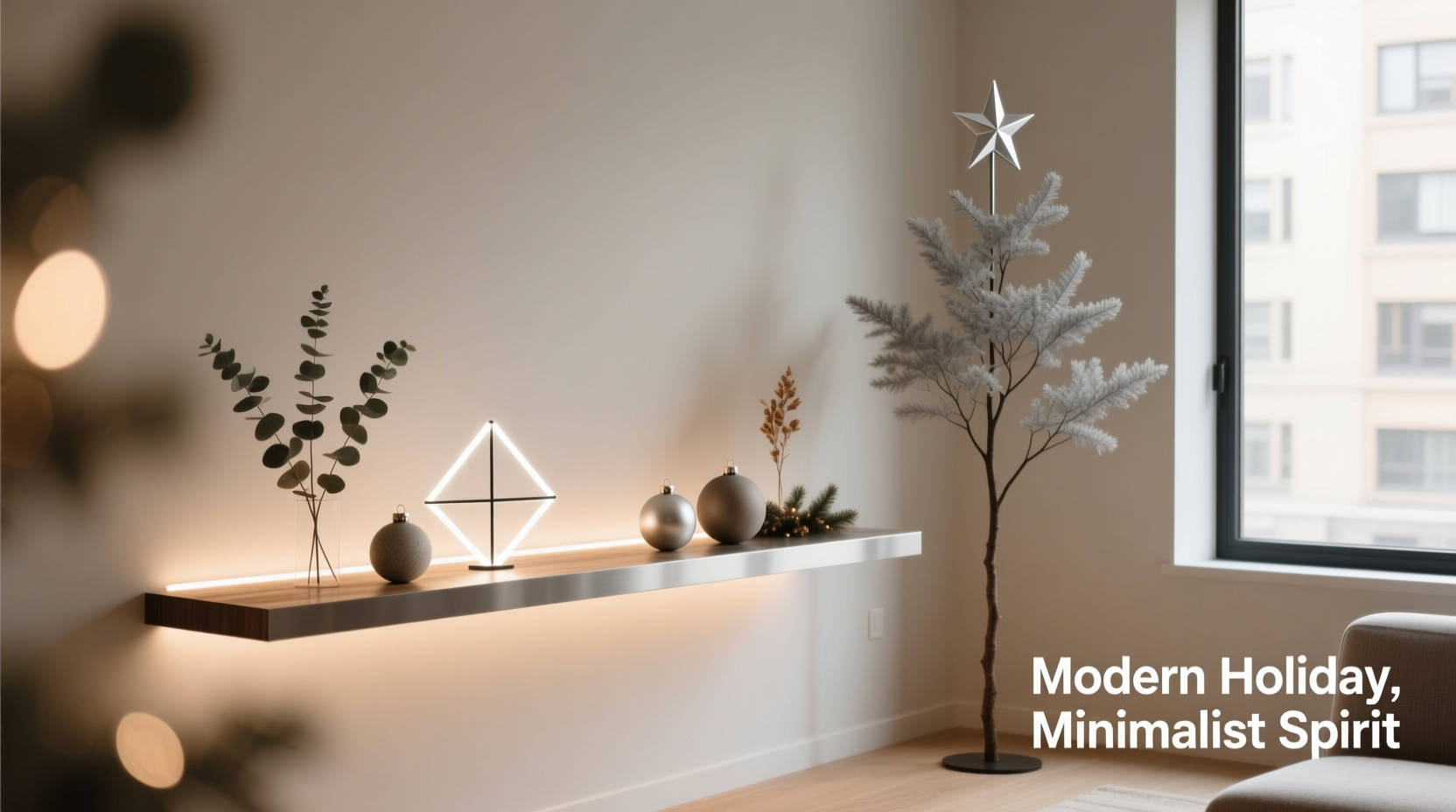
Contemporary living environments—think loft apartments with exposed ductwork, Scandinavian-inspired studios with pale oak floors, or Japanese-minimalist townhomes with built-in shelving—share key constraints: limited floor area, heightened awareness of visual weight, and an aversion to temporary clutter. A 6-foot pre-lit tree occupies 3–4 square feet, commands attention from every angle, and often requires structural anchoring (especially in rental units). In contrast, a curated shelf display occupies vertical real estate already designated for function and form. It doesn’t compete with circulation paths or dining zones; it integrates. Interior designer Lena Torres observes, “The most successful modern holiday schemes don’t *add* decoration—they reinterpret existing architecture as a canvas. A floating shelf isn’t just holding ornaments—it’s extending the room’s rhythm upward.”
Space Efficiency & Spatial Psychology: Floor vs. Wall
Space efficiency goes beyond square footage. It encompasses perception, movement, and hierarchy. A floor tree dominates the ground plane—the first thing the eye registers upon entering. In small rooms, this creates visual compression. Floating shelves, by contrast, activate the vertical zone between 48\" and 72\" off the floor—the human “eye-level corridor”—where attention naturally rests during conversation and daily use. This placement feels intentional, not intrusive.
Consider these spatial dynamics:
| Factor | Floor Tree | Floating Shelf Display |
|---|---|---|
| Floor footprint | 2.5–5 sq ft (plus clearance) | 0 sq ft—uses wall surface only |
| Vertical presence | Height-driven; draws eyes upward but blocks lower sightlines | Controlled height (typically 12–24\" tall); preserves full wall openness |
| Movement flow | Requires 18–24\" clearance on all sides; impedes traffic in narrow halls | No floor obstruction; enhances flow in tight corridors and studio layouts |
| Visual weight | High mass perception—even slim trees read as “heavy” | Low mass perception; appears light, airy, architectural |
| Rental compatibility | Often prohibited without landlord approval; drilling into floors rare | Mounting into wall studs is standard practice; easily reversible with spackle |
This isn’t merely logistical—it’s psychological. Research in environmental psychology shows that unobstructed floor planes reduce subconscious stress cues in compact environments. When your holiday display respects that principle, the season feels calmer, not busier.
Design Flexibility & Styling Longevity
Floor trees offer one dominant silhouette: conical, tapered, symmetrical. While variations exist (slim, pencil, flocked), their core structure remains fixed. Floating shelf displays, however, are inherently modular. You control scale, rhythm, and narrative through composition—not shape.
A single 36\" shelf can hold three distinct vignettes: a cluster of matte-black ceramic ornaments beside a brass candleholder and dried eucalyptus; a mid-shelf tier of frosted glass baubles suspended from clear monofilament; and a lower ledge featuring a miniature wooden sled with pinecones and cinnamon sticks. The same shelf can transition across seasons—swap ornaments for dried lavender and terracotta pots in spring, then citrus slices and linen napkins in summer.
By contrast, floor trees demand seasonal commitment. Their size and setup time discourage frequent re-styling. A shelf display invites iteration: rearrange weekly, add a new vintage book spine, rotate textiles seasonally. It functions less like a holiday prop and more like permanent, expressive millwork.
Safety, Stability & Practical Realities
Safety is rarely discussed in holiday decor articles—but it’s non-negotiable in modern households. Floor trees pose documented risks: tip-overs (especially with pets or active children), electrical hazards from tangled cords under furniture, and fire risk if placed near heat sources or overloaded with lights. According to the U.S. Consumer Product Safety Commission, over 1,000 home fires annually are linked to Christmas tree failures—most involving floor models near radiators or space heaters.
Floating shelves eliminate tip-over risk entirely when properly installed into wall studs using lag bolts rated for 50+ lbs per bracket. Cords run discreetly along the wall or behind the shelf, reducing tripping hazards and eliminating cord tangles under sofas or beds. Lighting options are equally safe: battery-operated micro-LEDs with timers, low-voltage plug-in strips hidden beneath shelf lips, or even solar-charged string lights mounted above the shelf.
Yet installation demands precision. A poorly mounted shelf—especially on drywall alone—can fail under weight or vibration. This isn’t DIY territory without proper tools and knowledge.
“Wall-mounted displays aren’t ‘easier’—they’re *different*. They shift the labor from daily maintenance (watering, vacuuming needles) to upfront craftsmanship (leveling, stud-finding, secure mounting). That trade-off rewards longevity and peace of mind.” — Marcus Chen, Certified Residential Designer & Fire Safety Consultant
Cost Analysis: Upfront Investment vs. Lifetime Value
At first glance, floor trees appear cheaper: $80–$250 for a quality artificial model. But that figure ignores recurring costs. Every year, you’ll replace bulbs, repair bent branches, buy new stands, and purchase fresh tree skirts, garlands, and storage bins. Over five years, those add up to $300–$500—and that’s before factoring in disposal fees or replacement due to wear.
Floating shelf systems require higher initial investment: $120–$350 for premium hardwood or powder-coated steel shelves with professional-grade brackets. However, they last 15–20 years with minimal upkeep. Ornaments, candles, and botanicals are reusable across decades. Even lighting systems are modular—swap batteries or upgrade LEDs without replacing the entire display framework.
More importantly, shelf displays increase perceived home value. Unlike a seasonal tree, a well-integrated floating shelf becomes part of the home’s architectural language—visible year-round as functional storage or art display. Realtors report that thoughtfully installed built-ins (including high-quality floating shelves) consistently improve buyer perception of space efficiency and design cohesion.
Real-World Application: A Brooklyn Loft Transformation
Take Maya R., a graphic designer living in a 650-square-foot Brooklyn loft with concrete floors, 11-foot ceilings, and floor-to-ceiling windows. Her previous 5.5-foot floor tree blocked natural light, cast long shadows across her drafting table, and required nightly pet-proofing (her two rescue cats treated it as a climbing gym). After consulting with a local interior architect, she installed three staggered walnut shelves (24\", 36\", and 18\") along a 12-foot blank wall beside her sofa.
She styled them with: • A 12\" matte-white ceramic tree silhouette as the central anchor • Vintage mercury-glass ornaments suspended at varying heights using clear wire • A woven jute runner running the length of the middle shelf, topped with pine sprigs and beeswax candles • A low-profile power strip mounted behind the bottom shelf, powering warm-white LEDs embedded in the shelf lip
The result? Her holiday display is visible from the hallway, the kitchen nook, and the bedroom doorway—but never obstructs movement. She spent 45 minutes setting it up, compared to the 3+ hours previously spent assembling, fluffing, and stabilizing her floor tree. Most significantly, her cats ignore it completely—no more shredded branches or toppled ornaments.
Step-by-Step: Installing a Safe, Stylish Floating Shelf Display
- Measure & Plan Layout: Sketch your wall. Mark stud locations (use a reliable stud finder—do not guess). Determine shelf height relative to furniture (e.g., 6–8\" above sofa back). Avoid placing directly above heat sources or HVAC vents.
- Select Hardware: Choose heavy-duty brackets rated for at least 2x your expected load. Use lag bolts (not drywall anchors) drilled into studs. For shelves >36\", use at least three brackets.
- Level & Mark: Use a laser level. Mark bracket positions precisely. Double-check with a traditional bubble level before drilling.
- Mount Brackets: Drill pilot holes into studs. Secure brackets tightly. Test stability with firm pressure before adding shelf.
- Install Shelf & Style: Place shelf onto brackets. Tighten locking screws. Begin styling with heaviest items centered over brackets. Distribute weight evenly—avoid loading ends heavily.
FAQ
Can I use a floating shelf display in a rental apartment?
Yes—with landlord permission. Mounting into wall studs is standard construction practice and fully repairable. Provide your landlord with a written plan, use removable paint-matching spackle for bracket holes, and offer to cover minor touch-up costs. Most landlords approve when presented professionally.
Won’t a shelf display look too sparse compared to a full tree?
Not if designed intentionally. Depth perception matters: layer objects front-to-back (e.g., a backdrop of greenery, mid-layer ornaments, foreground candles). Add dimension with varied textures—rough wood, smooth glass, matte ceramic, metallic accents. Strategic lighting (uplights behind the shelf, focused LED spots) creates volume and warmth that rivals a tree’s glow.
How do I store my floating shelf display components off-season?
Shelves remain mounted year-round—they’re permanent architecture. Store ornaments in compartmentalized boxes (acid-free tissue prevents scratches). Wrap delicate items individually. Keep cords coiled and labeled. Store botanicals separately in breathable cotton bags to prevent mold. Reassembly takes under 20 minutes annually.
Conclusion: Design With Intention, Not Tradition
The choice between floating shelf Christmas displays and floor trees isn’t nostalgic or sentimental—it’s architectural. It reflects whether you see your home as a container for seasonal rituals or as a living system that evolves with purpose. Floor trees serve a cultural script. Floating shelf displays serve your space, your safety needs, your aesthetic discipline, and your long-term vision for how beauty lives in everyday life.
Modern design isn’t about removing warmth—it’s about distilling it. A single brass bell hung from a walnut shelf, catching afternoon light. Three antique glass balls reflecting city skyline views through a window. A single white candle burning steadily beside a handwritten note. These moments carry the same reverence as any towering fir—perhaps more, because they ask for attention, not just accommodation.
If you’ve ever stepped back from your holiday decor and felt it didn’t quite *belong*—that it interrupted rather than enhanced your space—this is your invitation to shift perspective. Measure your wall. Find your studs. Choose one shelf. Style it with care. Let your home breathe, even in December.




 浙公网安备
33010002000092号
浙公网安备
33010002000092号 浙B2-20120091-4
Comments
No comments yet. Why don't you start the discussion?