
Language barriers have long been a challenge for travelers, business professionals, and language learners. With rapid advancements in AI and audio technology, real-time translation earbuds now promise seamless cross-language communication. Among the latest models, the g08 translator has gained attention for its bold feature set. But how does it truly compare to standard translation earbuds? And more importantly—do the added capabilities justify the higher price tag?
This article examines the functional differences, evaluates real-world performance, and helps you determine whether the g08’s extras deliver tangible benefits or just marketing hype.
Understanding Translation Earbud Categories
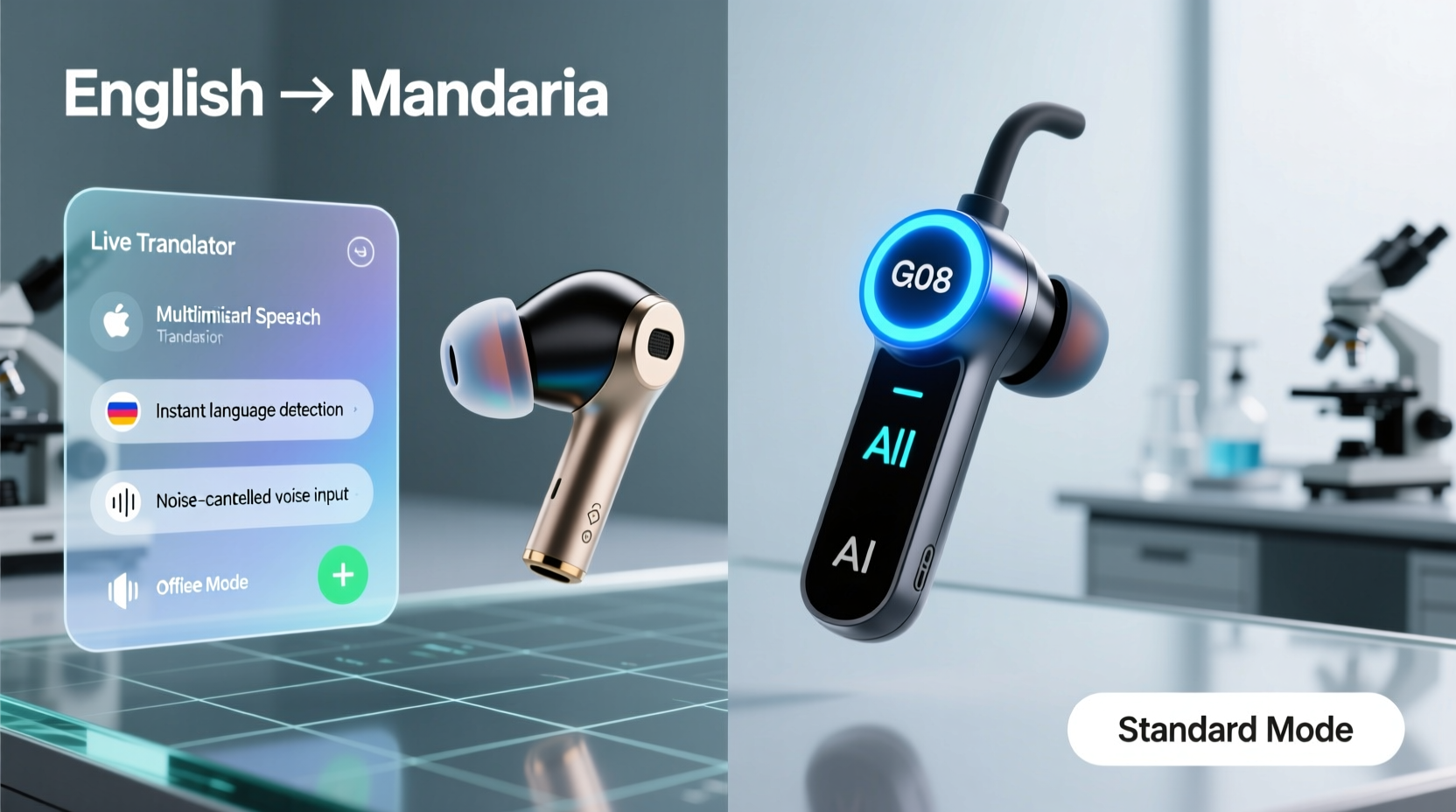
Translation earbuds fall into two broad categories: basic models designed primarily for one-way speech translation, and advanced devices like the g08 that offer bidirectional, real-time conversation support with additional smart features.
Standard translation earbuds typically rely on smartphone apps, require internet connectivity, and provide delayed output. They often support a limited number of languages and lack contextual understanding. In contrast, the g08 positions itself as an all-in-one solution with offline mode, voice isolation, speaker identification, and AI-driven fluency improvements.
Key Features: g08 vs Regular Models
To assess value, we need to compare core functionalities across both types of devices. The table below outlines the primary differences:
| Feature | Regular Translation Earbuds | g08 Translator |
|---|---|---|
| Real-Time Conversation Mode | Limited or app-dependent | Yes, dual-directional with minimal delay |
| Offline Translation | Rarely supported | Yes (supports 15+ languages offline) |
| Speaker Identification | No | Yes (distinguishes between speakers in dialogue) |
| Noise Cancellation | Basic ambient filtering | Adaptive ANC with voice focus |
| Battery Life | 3–5 hours | Up to 8 hours with case |
| Touch Controls & App Integration | Minimal | Gesture-based commands, companion app with history sync |
| Price Range | $80–$150 | $220–$260 |
The g08 clearly outperforms typical models in technical specifications. But specs alone don’t define usability. Real-world conditions—such as crowded markets, fast-paced meetings, or outdoor interviews—determine whether these upgrades matter.
When Extra Features Actually Make a Difference
Not every user needs speaker identification or offline AI processing. For casual tourists who only translate simple phrases, a budget model may suffice. However, certain scenarios reveal where the g08’s enhancements become essential.
- Business Negotiations: During multilingual meetings, accurately identifying who said what prevents confusion. The g08 logs each speaker separately, allowing post-meeting review.
- Medical Settings: Doctors using translation earbuds with patients benefit from accurate, low-latency interpretation. Misheard symptoms due to poor noise filtering can have serious consequences.
- Travel in Remote Areas: When roaming without reliable data, offline functionality ensures continuous access to translation—something most standard earbuds can’t offer.
“High-stakes communication demands precision. Devices like the g08 reduce cognitive load by handling context and speaker tracking automatically.” — Dr. Lena Torres, Human-Computer Interaction Researcher at MIT Media Lab
A Real Example: Field Testing in Tokyo
Sophie, a freelance journalist from Canada, traveled to rural Japan to interview artisans about traditional pottery. She brought both a mid-tier translation device and the g08 for comparison.
At first, the cheaper model worked adequately during quiet studio visits. But when she attended a bustling craft fair, background chatter overwhelmed its microphone. Translations became fragmented, and responses were delayed by several seconds—awkward in live conversation.
Switching to the g08, she noticed immediate improvement. Its directional microphones isolated her interviewee’s voice, even amid crowd noise. Offline mode allowed her to operate without Wi-Fi, and the device correctly attributed quotes to each artisan during group discussions. After five days, she concluded the $100 premium was justified by smoother interactions and reduced follow-up clarification work.
Step-by-Step: Choosing the Right Device for Your Needs
Deciding between the g08 and regular earbuds isn’t just about budget—it’s about use case alignment. Follow this decision framework:
- Define your primary use: Are you translating short phrases, engaging in full conversations, or documenting interviews?
- Evaluate connectivity needs: Will you have consistent internet access, or do you need robust offline performance?
- Assess environment type: Do you frequently operate in noisy public spaces or controlled settings?
- Check language requirements: Does your target language pair have strong AI support (e.g., Spanish/English vs. Thai/Finnish)?
- Test latency tolerance: Can you afford a 2–3 second delay, or do you need near-instant feedback?
- Determine long-term value: Will you use this weekly, monthly, or just once a year?
Common Misconceptions About Smart Translators
Many consumers assume that “more features” always mean “better performance.” This isn’t necessarily true. Here are three myths debunked:
- Myth 1: AI-powered means perfect accuracy. Even the g08 struggles with idioms, sarcasm, and regional slang. It interprets literal meaning, not cultural nuance.
- Myth 2: Bidirectional mode works flawlessly out of the box. Most users need to speak slowly and pause between sentences. Natural conversational rhythm takes practice.
- Myth 3: All translation earbuds work independently. Many still require a connected phone for processing. The g08 is among the few with onboard AI chips enabling standalone operation.
Frequently Asked Questions
Can the g08 translator replace human interpreters?
No. While the g08 excels in informal and semi-formal settings, it lacks emotional intelligence and contextual awareness. Legal, diplomatic, or therapeutic conversations still require professional human interpreters.
Does the g08 support rare languages like Icelandic or Swahili?
It supports 40+ languages, including Swahili, but less common ones like Icelandic are available only online and with reduced accuracy. Major global languages perform best, especially in offline mode.
How does battery life compare during heavy translation use?
Under continuous use, the g08 lasts about 5 hours—two hours longer than average competitors. The charging case provides two full recharges, making it suitable for full-day travel.
Final Verdict: Are the Extra Features Worth It?
For occasional travelers or language hobbyists, standard translation earbuds remain a cost-effective choice. If you're translating menus or asking for directions, advanced features won’t significantly improve your experience.
However, if your work involves frequent international communication—whether in journalism, healthcare, diplomacy, or global business—the g08’s extras translate into real efficiency gains. Reduced miscommunication, reliable offline access, speaker tracking, and superior audio clarity collectively save time, reduce stress, and enhance professionalism.
The $100–$150 price difference reflects not just hardware quality, but also software sophistication and independence from smartphones. You’re paying for autonomy, accuracy under pressure, and long-term reliability.




 浙公网安备
33010002000092号
浙公网安备
33010002000092号 浙B2-20120091-4
Comments
No comments yet. Why don't you start the discussion?