
When it comes to giant monster showdowns in LEGO form, few matchups spark as much excitement as Godzilla versus King Kong. Both have received impressive LEGO sets in recent years — the 76913 Godzilla battle set and the 76920 King Kong vs. Mechagodzilla collaboration with Toho and Universal. While fans love pitting these titans against each other on screen, the real question isn’t just about who would win in a fight — it’s about which one is more enjoyable to build, display, and play with.
This isn’t just a matter of scale or brick count. The true measure lies in how each model captures its character, the intricacy of the build process, interactive features, and long-term engagement. After hours spent assembling both models, testing their articulation, and staging multiple city-smashing scenarios, one thing becomes clear: fun isn’t solely determined by size or license — it’s shaped by design philosophy and hands-on experience.
Design Philosophy: Creature vs. Character
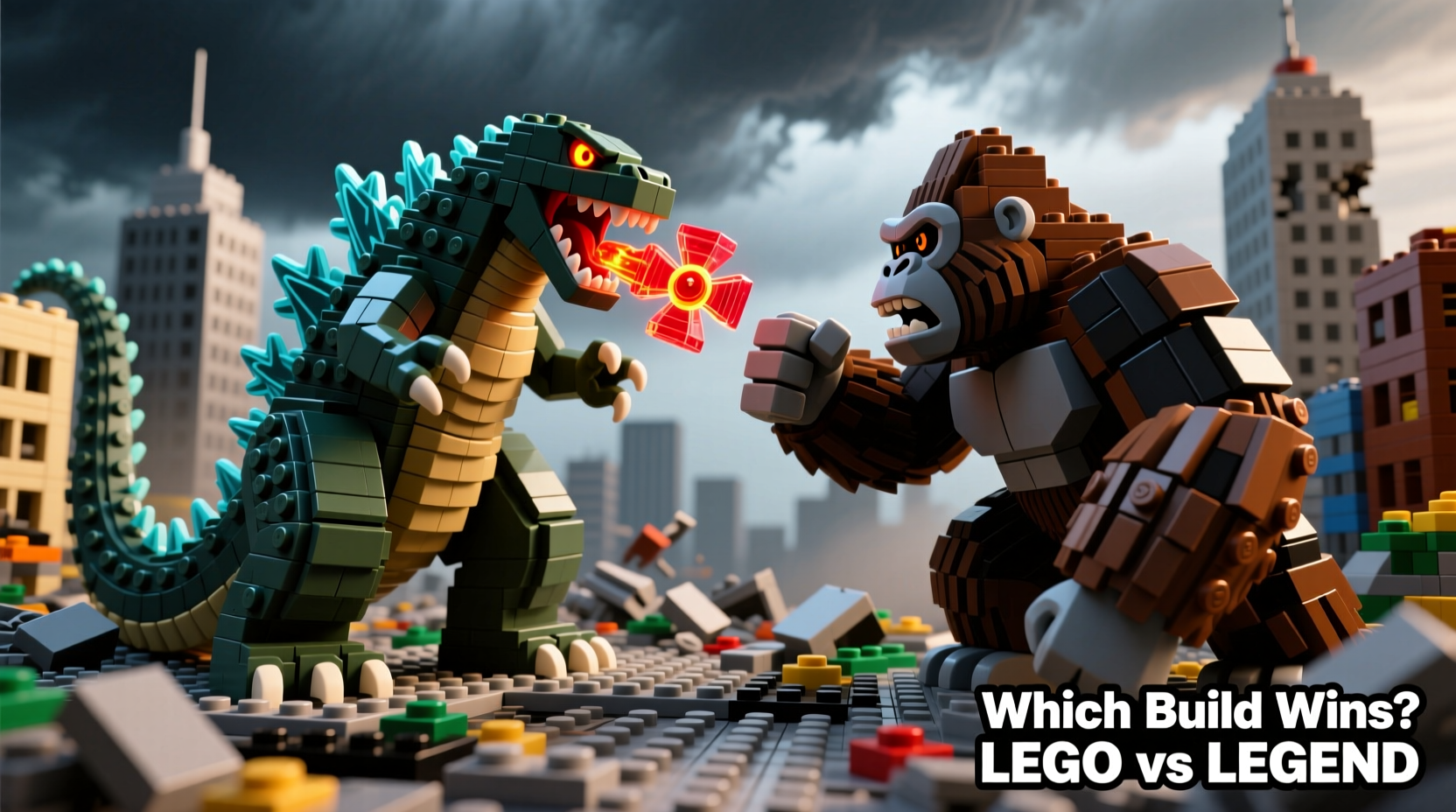
LEGO designers approach kaiju builds differently depending on whether they’re emphasizing realism, expressiveness, or action potential. Godzilla, designed primarily as a force of nature, leans into mechanical precision and segmented armor plating. His body is built for destruction — stiff, powerful, and covered in angular plates that evoke volcanic rock and mutated reptile skin. The tail alone uses over 200 pieces to achieve a balance between rigidity and slight poseability.
King Kong, by contrast, was sculpted with emotional expression in mind. His face includes movable eyebrows, an articulated jaw, and rotating eyes — rare features in LEGO animal builds. His arms are longer relative to his torso, allowing him to “climb” or gesture dramatically. This anthropomorphic touch makes him feel less like a machine of mass destruction and more like a tragic hero caught in a modern world.
Building Experience: Step-by-Step Engagement
The journey from box to completed beast matters just as much as the final product. Let’s break down what each builder can expect:
- Godzilla (76913): Approximately 450 minutes of build time across 12 numbered bags. The sequence starts with internal support structures using Technic beams, followed by layered plating for the back and limbs. One standout moment is constructing the dorsal plates — each one clicks into place with a satisfying snap, mimicking the creature’s iconic bio-luminescent spine.
- King Kong (76920): Roughly 500 minutes across 14 bags. Begins with a complex double-armature system allowing full shoulder rotation. Facial elements come surprisingly early, giving builders a sense of personality long before completion. The hands are assembled with finger-like grips capable of holding accessories like barrels or chains.
While both are challenging, King Kong’s build feels more dynamic due to frequent milestones — completing one arm, seeing the face take shape, adding fur texture with specialized tiles. Godzilla’s progress is more gradual, rewarding patience with structural integrity and visual weight.
Comparison Table: Key Features at a Glance
| Feature | Godzilla (76913) | King Kong (76920) |
|---|---|---|
| Brick Count | 804 | 860 |
| Height | Approx. 28 cm (11 in) | Approx. 30 cm (12 in) standing |
| Articulation Points | 7 (neck, tail base, legs) | 12+ (including fingers, jaw, eyes) |
| Special Elements | Dorsal plate lighting effect (no battery) | Movable facial expressions, gripable hands |
| Play Features | Tail whip action, stomping feet | Punching arms, climbing stance, accessory interaction |
| Display Appeal | Imposing presence, symmetrical design | Expressive posture, cinematic drama |
| Recommended Age | 12+ | 12+ |
Real Play Scenario: A Night of Destruction
Consider a real-world example: a parent and child spend a Saturday afternoon building both models separately, then stage a battle in a living room diorama made from books, blocks, and cardboard skyscrapers. They start with Godzilla advancing slowly, tail swaying side to side, emitting a low growl sound effect from a phone app. Then Kong leaps from a couch “cliff,” grabs a LEGO barrel, and hurls it at Godzilla’s head.
What unfolds isn’t just noise and motion — it’s storytelling. Kong reacts when hit; he stumbles, raises his fists, beats his chest. Godzilla, though powerful, lacks facial feedback. He simply steps forward, bites, and sweeps his tail. The child gravitates toward Kong, assigning him lines and emotions. The parent notes that Godzilla holds up better structurally after repeated collisions.
In this scenario, King Kong wins on engagement, while Godzilla wins on durability. But overall enjoyment? It tips decisively toward Kong — not because he’s stronger, but because he invites interaction.
Expert Insight: Why Expressiveness Drives Fun
“Children — and adult fans — don’t just want to recreate scenes. They want to create new ones. Models with expressive capabilities unlock imaginative replay value far beyond static replication.” — Dr. Lena Torres, Toy Design Researcher at Nordic Institute of Play Studies
Torres’ observation aligns with observed behavior: the more a toy allows for emotional projection, the longer it stays in active use. King Kong’s ability to convey anger, curiosity, or sorrow through simple mechanical adjustments gives him an edge in sustained play. Godzilla, while awe-inspiring, functions more as a centerpiece than a participant.
Which Is More Fun? A Balanced Verdict
If you're drawn to engineering marvels, architectural symmetry, and a sense of unstoppable power, **Godzilla** delivers. His segmented tail, armored hide, and sheer bulk make him a joy to assemble for technically minded builders. He looks incredible on a shelf and withstands rough handling.
But if your idea of fun involves roleplay, dramatic poses, and evolving narratives, **King Kong** is the superior choice. His range of motion, facial articulation, and human-like gestures turn every encounter into a performance. You’re not just playing with a monster — you’re directing a movie.
Ultimately, \"fun\" depends on what kind of experience you seek. For pure spectacle and build satisfaction, go with Godzilla. For immersive storytelling and lasting interactivity, choose King Kong.
Checklist: How to Choose Your Kaiju Build
- ✅ Decide your primary purpose: display vs. play
- ✅ Assess available space — both models require significant footprint
- ✅ Consider age and skill level — Kong has slightly more complex joints
- ✅ Think about future expansions — do you plan to add other LEGO monsters?
- ✅ Prioritize features: Do you want glowing spines or moving eyebrows?
- ✅ Test compatibility with existing LEGO cities or battle arenas
Frequently Asked Questions
Can I combine both sets for a full-scale battle?
Absolutely. Many fans connect the two sets using modular city bases or custom platforms. Just be aware of scale differences — Kong stands slightly taller, but Godzilla has greater mass. Some even modify stands to allow synchronized movement during “fights.”
Are replacement parts available for fragile pieces like dorsal plates or fingers?
Yes. LEGO’s Pick-a-Brick service and customer support offer individual replacements. Dorsal fins and Kong’s finger clips are occasionally reported as break-prone under stress, so keep spares if used heavily in play.
Is there any electronic integration in either set?
No built-in lights or motors. However, third-party LED kits exist for both models — particularly popular for illuminating Godzilla’s dorsal plates in blue or red hues.
Final Thoughts: Let Your Imagination Roar
There’s no single answer to which LEGO monster is more fun — only which one resonates more deeply with your style of play. Godzilla represents the sublime: ancient, indifferent, and immense. King Kong embodies the personal: emotional, defiant, and relatable. One thrills with scale, the other with soul.
Whether you align with the atomic breath of the sea dragon or the thunderous chest pound of the apex ape, the real victory lies in creation itself. These aren’t just toys — they’re invitations to craft chaos, tell stories, and reconnect with the primal joy of smashing buildings (even if they’re made of plastic).




 浙公网安备
33010002000092号
浙公网安备
33010002000092号 浙B2-20120091-4
Comments
No comments yet. Why don't you start the discussion?