
Finding the right shoe size isn’t just about comfort—it’s essential for foot health, posture, and long-term mobility. Yet many people wear shoes that are either too tight or too loose, often because they rely on inaccurate sizing methods or outdated measurements. This is especially true when shopping online or across international brands, where European (EU) sizing differs significantly from U.S., UK, or Asian standards.
European shoe sizes follow a precise metric-based system rooted in the Paris point (2/3 of a centimeter), making them more consistent than imperial-based systems. However, without proper measurement techniques, even this standardized approach can lead to errors. Whether you're ordering from a French boutique or browsing German athletic footwear, knowing your exact EU size ensures better fit, performance, and value.
Why Accurate Shoe Sizing Matters
Wearing incorrectly sized shoes contributes to a range of issues: blisters, bunions, plantar fasciitis, and even long-term joint misalignment. A study by the American Podiatric Medical Association found that 72% of adults have experienced foot pain due to ill-fitting shoes—most of which stemmed from incorrect sizing assumptions.
Unlike U.S. or UK sizing, which varies between genders and age groups, European sizes are unisex and based purely on foot length in millimeters. This simplifies international comparisons but demands precision in measurement. Guessing based on past purchases or brand-specific fits often leads to disappointment, particularly with narrow lasts or structured designs common in European footwear.
Step-by-Step Guide to Measuring Your Foot for EU Size
- Gather Supplies: You’ll need a ruler or measuring tape, a piece of paper larger than your foot, a pencil, and a flat surface.
- Prepare Your Foot: Wear the type of socks you typically pair with shoes. Stand barefoot on the floor—not carpet—for accuracy.
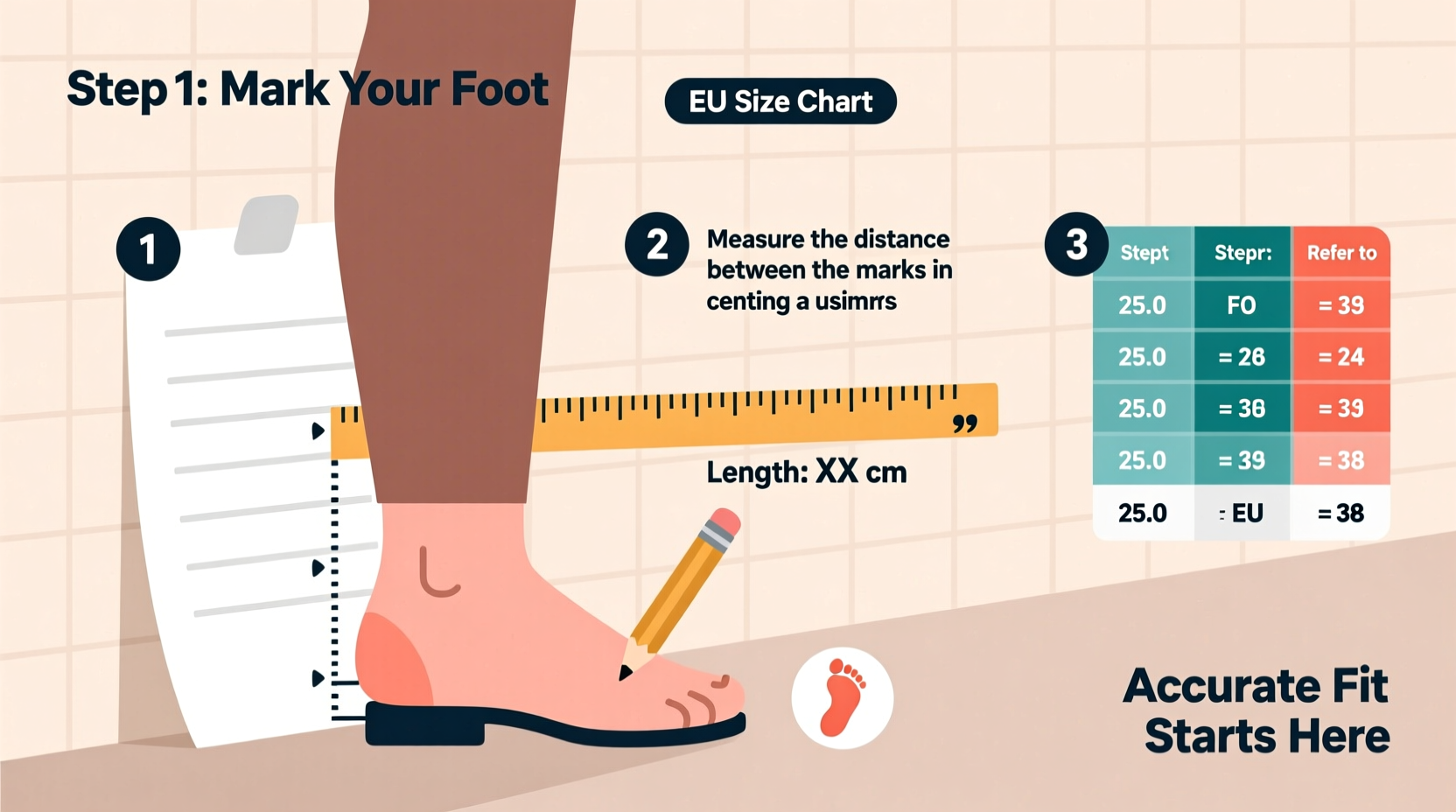
- Trace Your Foot: Place the paper against a wall. Position your heel flush against it and gently trace the outline of your foot with the pencil held vertically.
- Measure Length: Use the ruler to measure from the heel to the longest toe (usually the big toe or second toe). Record the distance in centimeters or millimeters.
- Repeat for Other Foot: Most people have one foot slightly longer than the other. Always use the larger measurement.
- Convert to EU Size: Apply the formula: EU Size = (Foot Length in cm + 2) × 1.5. Round to the nearest whole number.
For example, if your foot measures 25.8 cm: (25.8 + 2) × 1.5 = 41.7 → round to EU 42.
Common Measurement Mistakes to Avoid
- Using old shoe boxes or worn-out shoes as templates.
- Measuring while sitting down—feet elongate under body weight.
- Relying solely on conversion charts without verifying actual foot length.
- Ignoring width considerations, especially critical in dress shoes or boots.
“Many patients come in with chronic forefoot pain only to discover they’ve been wearing shoes two sizes too small for years.” — Dr. Lena Moreau, Podiatrist & Gait Specialist, Berlin Foot Clinic
Understanding the European Sizing System
The European shoe size standard (EN ISO 9407) uses the mondopoint system, where sizes are calculated using foot length in millimeters divided by 6.67 (one Paris point). The formula is: Size = (Foot Length in mm ÷ 6.67) + 1.5.
This method eliminates gender distinctions in base sizing, though manufacturers may adjust lasts accordingly. For instance, an EU 38 sneaker might fit differently in a women’s versus men’s version due to volume and width, but the length remains consistent.
Key Differences Between EU and Other Systems
| Region | Measurement Basis | Increment | Gender Split? |
|---|---|---|---|
| Europe (EU) | Metric (mm) | 6.67 mm (~⅔ cm) | No (unisex scale) |
| United States (US) | Imperial (barleycorns) | 8.46 mm (⅓ inch) | Yes (separate scales) |
| United Kingdom (UK) | Barleycorns minus last offset | 8.46 mm | Yes |
Real-World Example: Maria’s Online Shopping Fix
Maria, a 34-year-old teacher from Lisbon, ordered a pair of Italian leather loafers labeled EU 39. They arrived tight across the instep and caused blisters within hours. Assuming she was a “regular” EU 39 based on her usual sneakers, she hadn’t measured recently.
After re-measuring following the steps above, she discovered her right foot was actually 24.2 cm—placing her at EU 40 using the correct formula. She contacted the retailer, exchanged the shoes, and received a new pair in EU 40. With added insoles for minor slippage, the fit became ideal.
Her mistake? Relying on memory instead of current data. Feet change over time due to weight fluctuations, pregnancy, or aging ligaments. Her case highlights why periodic reassessment is crucial—even for seasoned shoppers.
Essential Checklist Before Buying Shoes
- ✅ Measure both feet in centimeters at the end of the day
- ✅ Use the longer foot’s measurement for sizing
- ✅ Confirm whether the brand uses standard EU sizing or deviates (e.g., some Italian brands run small)
- ✅ Check return policy before purchasing online
- ✅ Consider width—many EU brands offer narrow or wide fittings (indicated as E, EE, F, G)
- ✅ Read customer reviews for fit feedback (“runs large/small”)
Frequently Asked Questions
Can I convert my U.S. shoe size directly to EU?
Only approximately. While general charts exist, accurate conversion requires knowing your actual foot length. A U.S. women’s 8 is often around EU 39, but this varies by manufacturer and foot proportions. Always verify with physical measurement.
Do children’s EU sizes work the same way?
Yes, the principle is identical—based on foot length in millimeters—but children’s sizes use different starting points and growth allowances. Infant sizes start around EU 16 (approx. 10 cm), increasing in 6.67 mm increments like adult sizes.
What should I do if my foot length falls between two EU sizes?
Choose the larger size, especially for walking or athletic shoes. It’s easier to adjust excess space with insoles than to stretch an undersized shoe. For formal footwear with minimal stretch, consult the brand’s fit guide.
Final Recommendations for Lasting Fit Accuracy
Your feet are dynamic—they swell during travel, expand with age, and vary slightly day to day. To maintain confidence in your EU size, remeasure every six months or whenever switching to a new brand or style category (e.g., moving from sneakers to oxfords).
Keep a personal shoe profile: record your exact foot length, typical brand fits (e.g., “Nike runs large”), and preferred width. This becomes invaluable when shopping internationally or trying new designers.
Remember, no single chart replaces precise measurement. Even within Europe, regional preferences affect construction—French styles tend to be narrower, German shoes often roomier in the toe box. Knowledge of your true dimensions empowers smarter choices regardless of origin.




 浙公网安备
33010002000092号
浙公网安备
33010002000092号 浙B2-20120091-4
Comments
No comments yet. Why don't you start the discussion?