
Procrastination isn’t just about laziness or poor time management. It’s often a response to fear, overwhelm, or the pressure of perfectionism. The moment you face a daunting task, your brain may instinctively resist, opting for distraction instead. But what if you could bypass that resistance not by pushing harder, but by scaling down? By focusing on tiny, almost effortless actions—tiny wins—you can disrupt the inertia of delay and begin building unstoppable momentum.
Tiny wins are small, specific achievements that require minimal effort but deliver maximum psychological reward. They’re not about finishing a project; they’re about starting it. Not about writing a report, but about opening the document. These micro-successes rewire your relationship with work, reduce anxiety, and create a self-reinforcing loop of action and motivation. Over time, this subtle shift transforms how you approach challenges—and ultimately, how much you accomplish.
The Psychology Behind Procrastination and Progress
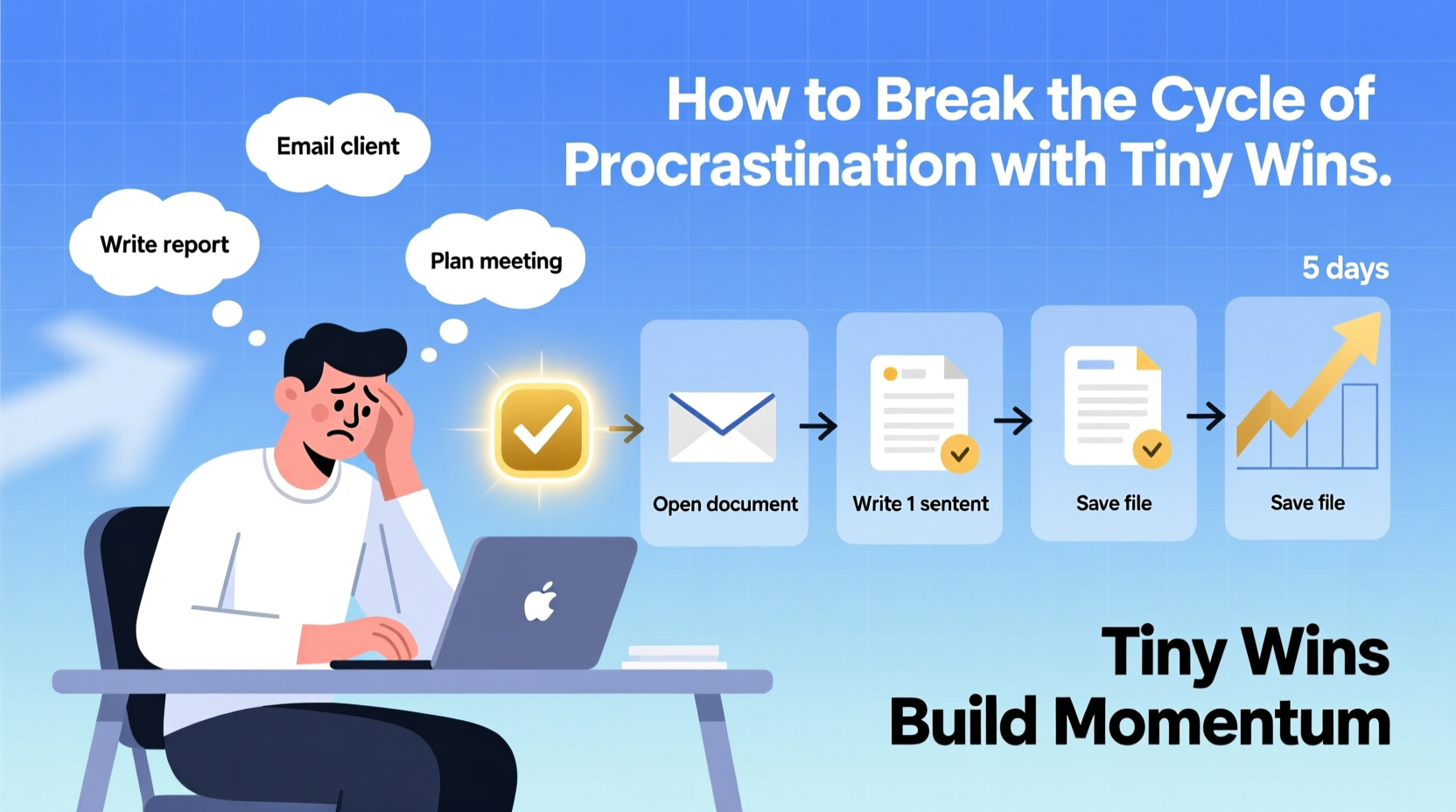
At its core, procrastination is an emotional regulation problem, not a time management one. Research from Dr. Piers Steel, author of *The Procrastination Equation*, shows that people delay tasks not because they lack discipline, but because they’re trying to avoid negative emotions—boredom, frustration, fear of failure, or uncertainty.
When faced with a large or ambiguous task, the brain perceives it as a threat. Dopamine, the neurotransmitter linked to pleasure and motivation, dips. Instead of acting, we seek short-term relief through distractions like social media, snacks, or busywork. This provides immediate comfort but deepens the cycle of guilt and stress.
Tiny wins interrupt this pattern by offering a low-risk entry point. Because the action is so small, it doesn’t trigger resistance. Completing it releases a small burst of dopamine, reinforcing the behavior. Over time, these repeated successes rebuild your confidence and reduce the emotional weight of starting.
“Success breeds motivation. When people experience small wins, they start to believe progress is possible.” — Dr. Teresa Amabile, Harvard Business School, co-author of *The Progress Principle*
How Tiny Wins Create Momentum
Momentum is not created by massive effort. It begins with motion—any motion. Consider Newton’s first law: an object at rest stays at rest unless acted upon by an external force. In personal productivity, that initial force doesn’t need to be strong; it just needs to exist.
Tiny wins serve as that catalyst. Each one reduces friction, making the next step easier. For example:
- Writing one sentence leads to writing a paragraph.
- Opening your workout clothes leads to putting them on.
- Sending one email builds confidence to tackle the inbox.
This principle is backed by behavioral science. BJ Fogg, founder of the Behavior Design Lab at Stanford, emphasizes that lasting change comes from making behaviors “so easy you can’t say no.” His model—B = M.A.P. (Behavior = Motivation, Ability, Prompt)—shows that when ability is high (i.e., the task is easy), even low motivation can lead to action.
A Step-by-Step Guide to Building a Tiny Wins Routine
Adopting tiny wins isn’t about lowering standards—it’s about raising consistency. Follow this five-step process to integrate them into your daily workflow:
- Identify the Task You Keep Avoiding
Name it clearly. Is it writing a proposal? Calling a client? Starting a fitness routine? Specificity eliminates ambiguity, which is a major trigger for procrastination. - Break It Into Micro-Actions
Deconstruct the task into absurdly small steps. For example:- Instead of “write blog post,” try “open document and write title.”
- Instead of “clean kitchen,” try “rinse one dish.”
- Instead of “study for exam,” try “read one page.”
- Set a Two-Minute Rule
Commit only to actions that take less than 120 seconds. This removes the pressure of “finishing” and makes starting feel risk-free. - Use Implementation Intentions
Pair each tiny win with a clear cue. Use the formula: “When [situation], I will [tiny action].”- “When I sit at my desk, I will open my to-do list.”
- “When I finish dinner, I will put on my running shoes.”
- Track and Acknowledge Completion
Check off each micro-task. The physical act of marking progress reinforces success and trains your brain to associate action with reward.
Real Example: From Paralysis to Progress
Meet Sarah, a freelance designer who hadn’t touched her portfolio update in eight months. Every time she opened the file, she felt overwhelmed by the number of projects to revise, images to edit, and descriptions to rewrite. She’d close it within minutes, frustrated and guilty.
After learning about tiny wins, she changed her approach. Instead of aiming to “update portfolio,” she committed to:
- Day 1: Open the folder on her desktop.
- Day 2: Rename one outdated project file.
- Day 3: Copy one completed project into the new folder.
- Day 4: Write two sentences of description for that project.
Within two weeks, she had three full projects updated—not because she suddenly had more time or energy, but because she stopped fighting the urge to do everything at once. The tiny wins built confidence, reduced anxiety, and eventually pulled her into deeper work.
Common Pitfalls and How to Avoid Them
Tiny wins are powerful, but they only work if applied correctly. Here are common mistakes and how to overcome them:
| Pitfall | Why It Happens | How to Fix It |
|---|---|---|
| Setting wins too big | Trying to make progress fast leads to choosing actions that still feel intimidating. | Ask: “Can I do this even smaller?” If yes, shrink it further. |
| Skipping tracking | Without acknowledgment, the brain doesn’t register the win. | Use a checklist, app, or notebook to mark each completed micro-action. |
| Expecting immediate results | Tiny wins build momentum over days, not hours. | Focus on consistency, not outcome. Trust the compounding effect. |
| Not linking to larger goals | Small actions feel meaningless without context. | Regularly remind yourself how each win connects to your bigger objective. |
Your Tiny Wins Action Checklist
Use this checklist to implement the strategy today:
- ✅ Identify one recurring task you consistently delay.
- ✅ Break it into 3–5 micro-actions, each under 2 minutes.
- ✅ Schedule the first action right after a daily trigger (e.g., after brushing teeth).
- ✅ Perform the first tiny win immediately—don’t wait for “the right time.”
- ✅ Mark it complete in a notebook or app.
- ✅ Repeat tomorrow, even if you don’t feel motivated.
- ✅ After seven days, review your progress and adjust as needed.
Frequently Asked Questions
Isn’t this just avoiding real work?
No. Tiny wins aren’t a substitute for effort—they’re a gateway to it. The goal isn’t to stay small forever, but to start. Once you begin, the likelihood of continuing increases dramatically. Studies show that people who start a task are far more likely to complete it, even if they stop shortly after beginning.
What if I still don’t feel motivated after doing a tiny win?
That’s normal. Motivation often follows action, not the other way around. The purpose of a tiny win is not to make you feel inspired, but to prove to yourself that you can act despite not feeling like it. Over time, this builds self-trust, which is more reliable than fleeting motivation.
How long does it take to see results?
Most people notice a shift in their mindset within 3–5 days. Within two weeks, many report increased productivity and reduced anxiety around tasks. The key is consistency. Like compound interest, tiny wins grow silently at first, then accelerate.
Conclusion: Start Small, Win Often, Change Everything
Breaking the cycle of procrastination doesn’t require willpower marathons or dramatic overhauls. It requires one thing: the courage to begin impossibly small. Tiny wins dismantle the illusion that progress must be visible, measurable, or impressive. Instead, they teach you that every achievement—no matter how minor—counts.
Each time you choose action over avoidance, even for ten seconds, you reshape your identity. You become someone who starts. Someone who follows through. And over time, that person accomplishes what the old version thought was impossible.
You don’t need to be ready. You don’t need to feel like it. You just need to do one tiny thing—right now. Open the file. Write the subject line. Put on the shoes. That’s where real change begins.




 浙公网安备
33010002000092号
浙公网安备
33010002000092号 浙B2-20120091-4
Comments
No comments yet. Why don't you start the discussion?