
For many homeowners, upgrading bathroom hygiene is no longer just about luxury—it's about health, sustainability, and long-term value. The rise in popularity of water-based cleansing has brought two main options into focus: bidet attachments and full smart toilets. While both deliver improved cleanliness over traditional toilet paper, they differ significantly in cost, installation, features, and user experience. Understanding these differences helps ensure you make a choice that aligns with your lifestyle, budget, and bathroom setup.
Understanding the Core Differences
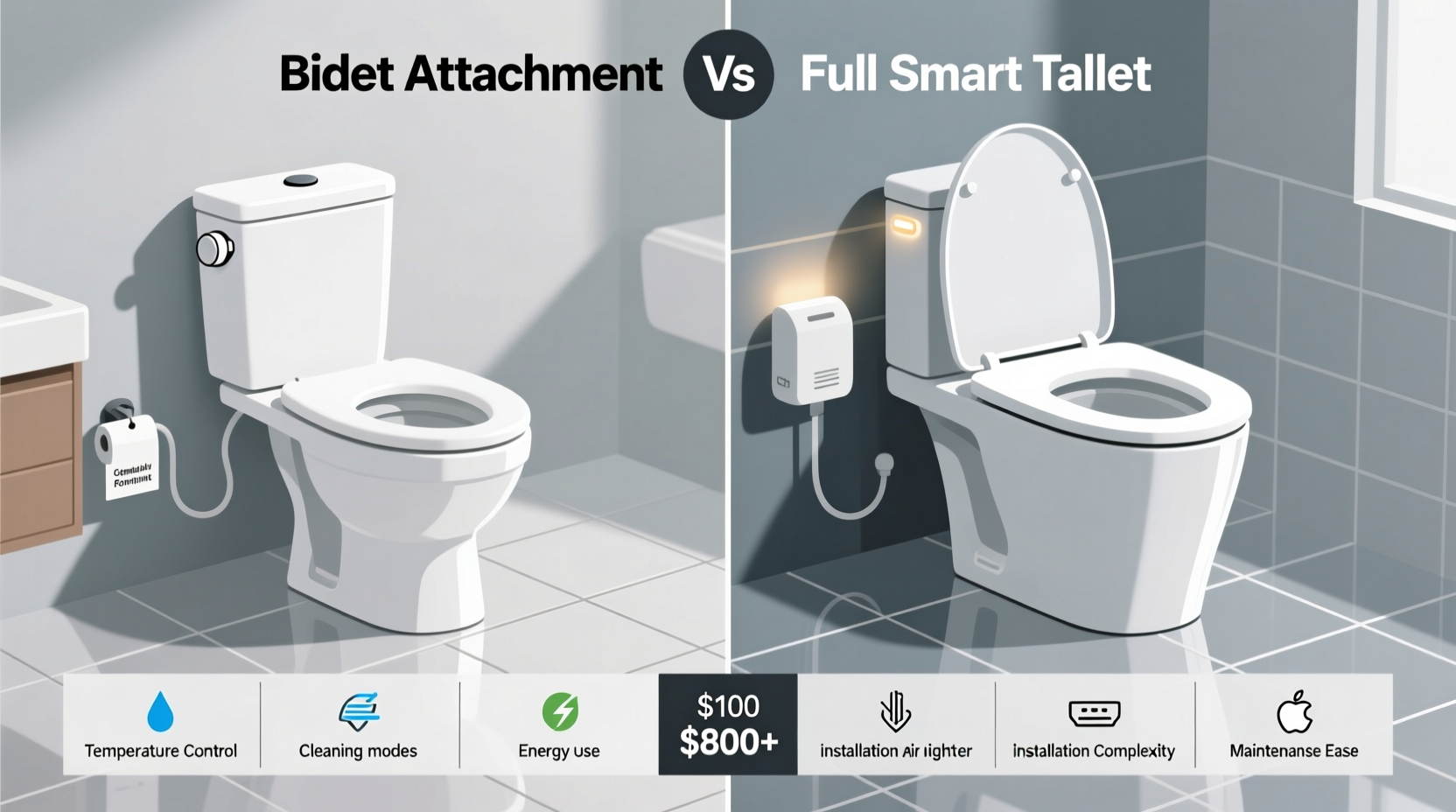
A bidet attachment is a compact device installed directly onto your existing toilet bowl. It typically connects to the same water supply line as your toilet and uses a nozzle to spray water for cleaning after use. Most models are manually operated or come with basic remote controls, offering essential features like adjustable spray position, water pressure, and sometimes a heated seat.
In contrast, a full smart toilet—also known as an integrated bidet toilet—is a complete unit combining a toilet and bidet functionalities into one seamless design. These models often include advanced technology such as automatic flushing, seat warming, air drying, deodorization, night lights, and even smartphone connectivity. Brands like Toto, Kohler, and Brondell dominate this space with high-end finishes and sophisticated engineering.
The fundamental distinction lies in integration. A bidet attachment enhances your current toilet; a smart toilet replaces it entirely. This difference affects everything from upfront costs to long-term maintenance.
Cost Comparison: Budgeting for Long-Term Value
Price is often the deciding factor when choosing between these two options. Bidet attachments generally range from $60 to $250, depending on brand and features. Installation can usually be done by the homeowner in under an hour with basic tools. There are no major structural modifications required, which keeps labor costs low or eliminates them altogether.
Smart toilets, however, start around $800 and can exceed $3,000 for premium models with self-cleaning nozzles, air purification, and customizable settings. Professional installation is typically recommended due to electrical requirements (most need a grounded outlet nearby) and precise alignment with drainage systems. This adds $150–$300 in labor costs, bringing the total investment significantly higher.
Despite the steeper initial price, smart toilets may offer better long-term value through energy efficiency, reduced paper usage, and enhanced comfort. Some users report saving up to $100 annually on toilet paper alone. Additionally, homes with smart toilets often see increased perceived value during resale, particularly in markets where modern bathrooms are highly desirable.
“Smart toilets represent the future of personal hygiene—they’re not just about convenience but promoting better health outcomes through consistent, gentle cleansing.” — Dr. Lena Patel, Urology Specialist and Wellness Advocate
Feature Breakdown: What Each Option Offers
To help clarify what you gain—or sacrifice—with each option, here’s a detailed comparison table outlining key features:
| Feature | Bidet Attachment | Full Smart Toilet |
|---|---|---|
| Installation Complexity | Easy (DIY-friendly) | Moderate to High (often requires electrician/plumber) |
| Heated Seat | Select models only | Standard on most models |
| Adjustable Water Pressure & Temperature | Limited (some have warm water via mixing valve) | Yes, fully customizable |
| Warm Air Dryer | Rare | Common |
| Deodorizer | No | Yes, built-in fans and filters |
| Automatic Flush/Lid | No | Available on higher-end models |
| Night Light | No | Yes, motion-activated |
| Remote Control / App Integration | Basic remotes on select models | Advanced remotes or smartphone apps |
| Self-Cleaning Nozzle | No | Yes, with UV or electrolyzed water |
| Power Requirement | None (non-electric) or standard outlet (electric models) | Requires nearby grounded electrical outlet |
This table illustrates that while bidet attachments excel in simplicity and affordability, smart toilets provide a comprehensive, automated experience. Your decision should hinge on whether you prioritize function over form—or vice versa.
Real-Life Decision Making: A Mini Case Study
Consider Sarah, a homeowner in Portland, Oregon, renovating her guest bathroom. She wanted to improve hygiene without breaking the bank. Her existing toilet was in good condition, and she didn’t want to deal with complex installations or rewiring.
After researching, she chose a mid-range bidet attachment with warm water capability and adjustable nozzle positioning. Total cost: $180 plus tax. She installed it herself in 40 minutes using the included wrench and instructions. Her guests appreciated the added comfort, and within six months, she noticed a 70% reduction in toilet paper usage.
In contrast, her neighbor Mark replaced his aging master bathroom toilet with a top-tier Toto Washlet. He paid $2,200 for the unit and $280 for professional installation, including adding a GFCI outlet behind the toilet. For him, the investment was justified by daily comfort, automatic functions, and the prestige of having a spa-like bathroom. Over time, he found the air dryer especially useful, eliminating the need for wiping entirely.
Their stories highlight a central truth: there’s no universal “best” option. The right choice depends on individual priorities—be it cost, convenience, aesthetics, or technological appeal.
Step-by-Step Guide to Choosing the Right Option
Follow this practical sequence to determine which solution fits your needs:
- Evaluate your current toilet’s condition. If it’s leaking, inefficient, or outdated, replacing it with a smart toilet might be more economical than repairing and modifying it for an attachment.
- Check available space and plumbing layout. Ensure there’s enough clearance around the toilet for a remote control or side panel. Verify access to a water shutoff valve compatible with bidet hoses.
- Determine power availability. Most smart toilets require electricity. Confirm a grounded outlet is within reach, or budget for an electrician to install one safely.
- Assess household needs. Are elderly individuals or people with mobility issues using the bathroom? Heated seats, automatic lids, and easy-to-use controls could significantly enhance accessibility.
- Set a realistic budget. Include not just the purchase price but also installation, potential electrical work, and ongoing maintenance.
- Research user reviews and reliability. Look for models with strong customer support, durable materials, and proven performance over time.
- Test if possible. Some showrooms allow demo units. Even watching video demonstrations can clarify usability differences.
Environmental and Hygiene Benefits
Both options contribute to environmental sustainability by reducing reliance on toilet paper, much of which comes from virgin forests and requires significant water and energy to produce. According to the Natural Resources Defense Council, the average American uses 141 rolls per year—equivalent to nearly one tree every three years.
From a hygiene standpoint, water cleansing removes residue more effectively than dry wiping, lowering the risk of irritation, urinary tract infections, and hemorrhoid flare-ups. Dermatologists often recommend bidets for patients with sensitive skin, eczema, or post-surgical recovery.
While both systems offer these advantages, smart toilets tend to go further with antibacterial surfaces, auto-flushing to minimize touchpoints, and self-cleaning nozzles that sanitize before and after use—features especially valuable in shared or high-traffic bathrooms.
Frequently Asked Questions
Can I install a bidet attachment on any toilet?
Most standard elongated and round bowls are compatible with bidet attachments, provided they have a two-bolt mounting system and accessible water supply on the left or rear side. Toilets with concealed tanks, skirted designs, or unusual shapes may pose compatibility challenges. Always check manufacturer specifications before purchasing.
Do smart toilets use a lot of electricity?
On average, a smart toilet consumes between 500 and 800 watts per day—mainly for heating water, warming the seat, and powering the dryer. This translates to roughly $5–$10 per month in electricity, depending on local rates and usage frequency. Energy-efficient models feature timers and motion sensors to reduce idle consumption.
Are bidet attachments hygienic?
Yes. Modern bidet attachments use retractable stainless steel nozzles that self-clean before and after each use. Non-contact operation minimizes contamination, and since water does the cleaning, there’s less bacterial transfer compared to manual wiping. Regular wiping of the nozzle with a disinfectant cloth ensures continued cleanliness.
Final Checklist Before You Buy
- ☐ Measure toilet dimensions and confirm model compatibility
- ☐ Verify water pressure and temperature stability
- ☐ Check for nearby electrical outlet (required for smart toilets)
- ☐ Decide whether warm water, drying, or automation are must-have features
- ☐ Read warranty terms and return policies
- ☐ Compare at least three reputable brands (e.g., Bio Bidet, Luxe, Toto, Brondell)
- ☐ Consider ease of cleaning and maintenance long-term
Conclusion: Make the Choice That Fits Your Life
Choosing between a bidet attachment and a full smart toilet isn’t about picking the “better” technology—it’s about matching functionality to your unique circumstances. A bidet attachment delivers remarkable value for those seeking an affordable, reversible upgrade. It’s ideal for renters, secondary bathrooms, or anyone testing the waters of water-based hygiene.
A full smart toilet, meanwhile, transforms your bathroom into a personal wellness retreat. With seamless design, intelligent features, and superior comfort, it’s a worthwhile investment for primary bathrooms, aging-in-place renovations, or luxury-focused remodels.
No matter which path you take, you’re embracing a cleaner, greener, and more comfortable way of living. Evaluate your priorities, consider your space and budget, and take the next step toward modern hygiene today.




 浙公网安备
33010002000092号
浙公网安备
33010002000092号 浙B2-20120091-4
Comments
No comments yet. Why don't you start the discussion?